Odisha Forest Rights Cell Closure Prompts Ministry Scrutiny
Source:The Hindu ↗
Why It Matters
Implementation of the Forest Rights Act, 2006, is a recurring theme in both UPSC Prelims and Mains. The article exposes critical ground-level administrative challenges (pendency of claims, lack of permanent manpower) and highlights the dynamic between Central welfare schemes (DA-JGUA) and State execution. Awareness of DA-JGUA and Mo Jungle Jami Yojana serves as good fodder for Mains answers regarding tribal empowerment and governance bottlenecks.
Summary
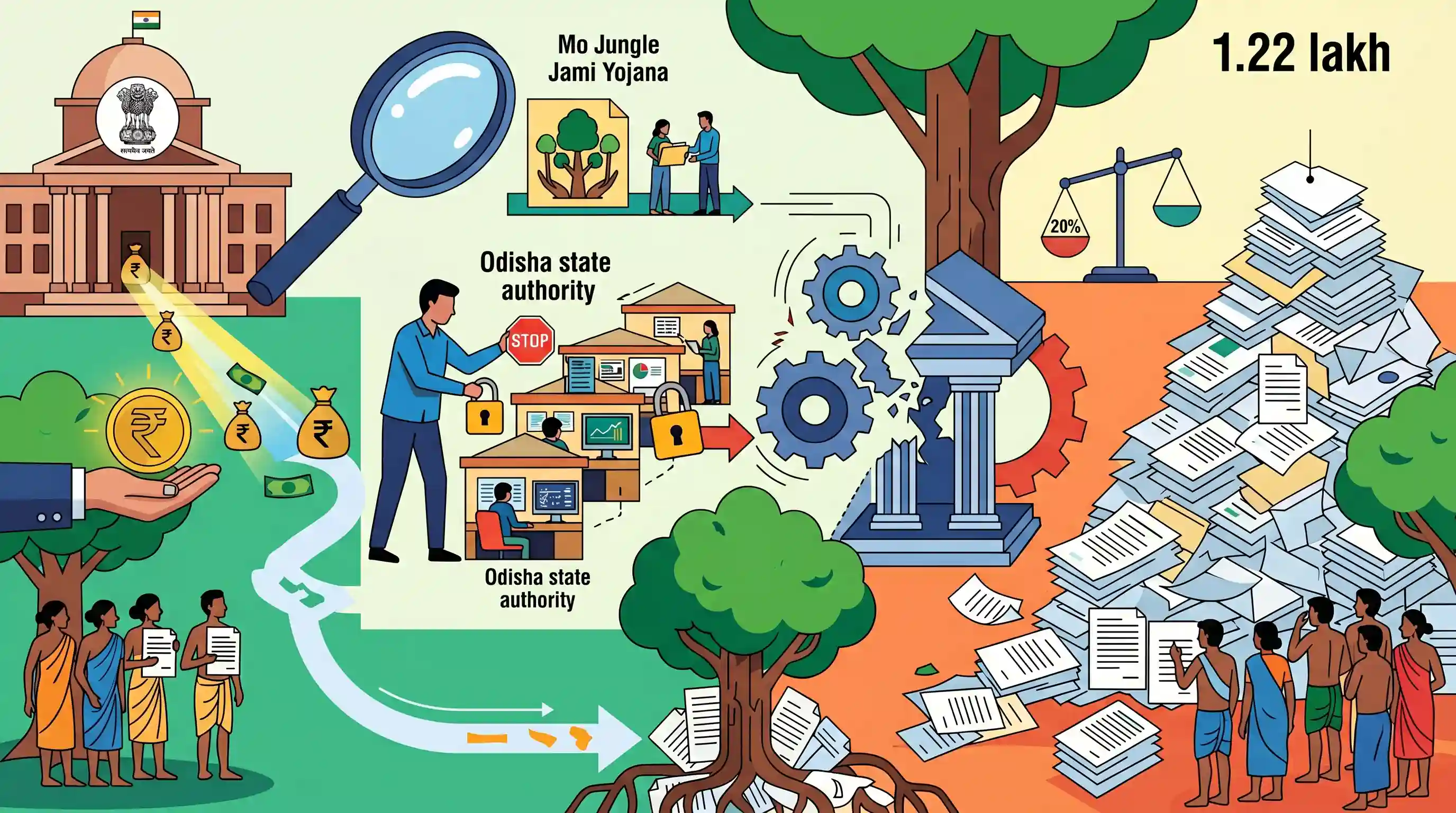
The Odisha government's abrupt directive to shut down 50 sub-divisional Forest Rights Act (FRA) Cells by March has triggered scrutiny from the Union Ministry of Tribal Affairs. These cells were heavily supported under the central scheme, Dharti Aaba Janjatiya Gram Utkarsh Abhiyan (DA-JGUA), aimed at expediting the processing of forest rights and digitising titles. The move follows the state's earlier discontinuation of personnel under its own Mo Jungle Jami Yojana. Despite Odisha being the second-highest issuer of forest rights titles in India, the state continues to grapple with a 20% pendency rate, encompassing over 1.22 lakh individual and community forest claims. The administrative disruption raises serious concerns over the effective implementation of the FRA, 2006, and federal coordination in safeguarding tribal rights.
Key Points
- The Odisha government has ordered the closure of 50 sub-divisional Forest Rights Act (FRA) Cells funded under the central DA-JGUA scheme by the end of March.
- The sudden shutdown and sacking of support staff have prompted an inquiry from the Union Ministry of Tribal Affairs, highlighting federal friction in tribal welfare administration.
- Odisha had previously discontinued the services of FRA Cell personnel working under its state-sponsored Mo Jungle Jami Yojana.
- Although Odisha has issued the second-highest number of forest rights titles nationally (after Chhattisgarh), it still suffers from a 20% pendency rate with over 1.22 lakh individual and thousands of community claims unresolved.
Important Terms
Forest Rights Act, 2006

A landmark legislation recognizing land and resource rights of Forest Dwelling Scheduled Tribes and Other Traditional Forest Dwellers. It corrects historical injustices by empowering Gram Sabhas to manage community forest resources.
UPSC context
GS Paper II (Social Justice) and Paper III (Environment). Tests legislative provisions for vulnerable sections and community-led conservation.
Dharti Aaba Janjatiya Gram Utkarsh Abhiyan (DA-JGUA)
A central mission launched in 2024 to saturate tribal-majority villages with infrastructure, health, and education. It involves 25 interventions by 17 ministries to improve socio-economic conditions of over 5 crore tribal citizens.
UPSC context
GS Paper II (Government Policies). Important for understanding holistic tribal development and the "whole-of-government" convergence model.
Mo Jungle Jami Yojana
An Odisha state-funded scheme launched in 2023 to accelerate the implementation of the Forest Rights Act. It focuses on digitizing records, recognizing community rights, and ensuring livelihood security for forest dwellers.
UPSC context
GS Paper II (State Government Policies). Illustrates how state-level initiatives complement central laws to ensure grassroots implementation of rights.
Union Ministry of Tribal Affairs
The central nodal agency for tribal welfare in India. It administers the Forest Rights Act, oversees development schemes like DA-JGUA, and coordinates with states to monitor progress and address implementation gaps.
UPSC context
GS Paper II (Statutory/Regulatory Bodies). Tests knowledge of the institutional framework for safeguarding tribal rights and administrative federalism.
ST & SC Development, Minorities & Backward Classes Welfare Department (Odisha)
The Odisha state department responsible for the socio-economic development and welfare of Scheduled Tribes and Scheduled Castes. It serves as the nodal agency for implementing the Forest Rights Act within the state.
UPSC context
GS Paper II (Governance). Relevant for understanding the role of state departments in executing social justice policies at the local level.
Prelims Trap
The Ministry of Environment, Forest and Climate Change is the nodal agency for implementing the Forest Rights Act.
The Ministry of Tribal Affairs (MoTA) is the statutory nodal agency for FRA 2006, not MoEFCC, which handles forest conservation and clearances.
Static Concepts Connected
What is the statutory process for recognizing forest rights under FRA, 2006?
- Gram Sabha initiation: The Gram Sabha receives claims, consolidates them, and passes a resolution recommending the nature and extent of forest rights.
- Sub-Divisional Committee: Examines Gram Sabha resolutions, prepares the record of forest rights, and acts as the first appellate body.
- District Level Committee: Serves as the final appellate authority to approve the record of forest rights and issue titles.
What are the core objectives of the DA-JGUA scheme for tribal welfare?
- Scheme Scope: Dharti Aaba Janjatiya Gram Utkarsh Abhiyan targets saturation of critical gaps in social infrastructure across 63,000 tribal-majority villages.
- Key Pillars: Focuses on holistic development including health, education, livelihood generation, all-weather roads, and electrification.
Cross-Topic Patterns
Federal Friction in Welfare Delivery
Discontinuation of central scheme machinery (DA-JGUA) for state equivalents (Mo Jungle Jami) mirrors the ongoing Centre-State tussles seen in Ayushman Bharat vs State health schemes.
Forest Rights vs Green Clearances
High FRA pendency (Odisha's 1.22 lakh claims) legally complicates forest diversion for critical minerals mining or renewable energy projects, linking social justice to green transitions.

Expect a 2026 Prelims question testing Gram Sabha’s statutory role in FRA alongside the objectives of the new DA-JGUA scheme.
Linked PYQs · 4
Linked PYQs · 4
- 2019PrelimsGS1
Consider the following statements: 1. As per recent amendment to the Indian Forest Act, 1927, forest dwellers have the right to fell the bamboos grown on forest areas. 2. As per the Scheduled Tribes and Other Traditional Forest Dwellers (Recognition of Forest Rights) Act, 2006, bamboo is a minor forest produce. 3. The Scheduled Tribes and Other Traditional Forest Dwellers (Recognition of Forest Rights) Act, 2006 allows ownership of minor forest produce to forest dwellers. Which of the statements given above is/are correct?
- 2013PrelimsGS1
Under the Scheduled Tribes and Other Traditional Forest Dwellers (Recognition of Forest Rights) Act, 2006, who shall be the authority to initiate the process for determining the nature and extent of individual or community forest rights or both?
- 2021PrelimsGS1
At the national level, which ministry is the nodal agency to ensure effective implementation of the Scheduled Tribes and Other Traditional Forest Dwellers (Recognition of Forest Rights) Act, 2006?
- 2019MainsGS2
Performance of welfare schemes that are implemented for vulnerable sections is not so effective due to absence of their awareness and active involvement at all stages of policy process. Discuss.
