Debrigarh Wildlife Sanctuary Tiger Sighting and Habitat Significance
Source:Indian Express ↗
Why It Matters
Important for Prelims and Mains regarding protected areas, wildlife corridors, tiger conservation efforts, and balancing human settlement with wildlife management in India.
Summary
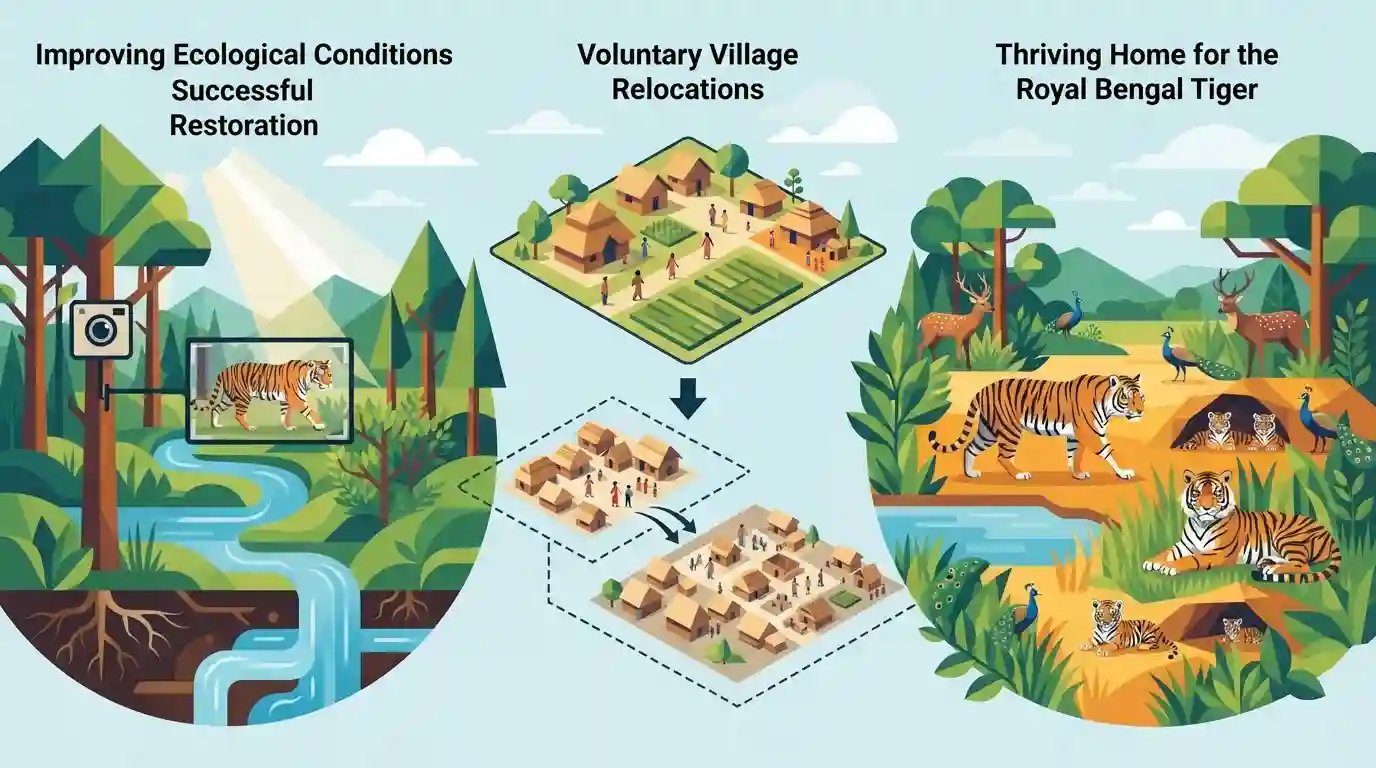
Recent tiger sightings in Odisha's Debrigarh Wildlife Sanctuary spotlight the sanctuary's improving ecological conditions, successful habitat restoration, and voluntary village relocations that make it a thriving home for the Royal Bengal Tiger.
Key Points
- Recent sightings of the Royal Bengal Tiger in Debrigarh Wildlife Sanctuary highlight its expanding big cat population and improving habitat health.
- Debrigarh, located in Odisha, features a unique landscape abutting the Hirakud Reservoir, offering rich biodiversity and prey base.
- The sanctuary has undergone systematic voluntary village relocations, reducing human-wildlife conflict and securing core wildlife habitats.
- These developments underscore the success of wildlife corridors and protected area management in enhancing tiger populations in eastern India.
Important Terms
Debrigarh Wildlife Sanctuary

A prominent protected area located in Odisha's Bargarh district, bordered by the Hirakud Reservoir. It features dry deciduous forests and thriving wildlife, and is currently proposed as a tiger reserve.
UPSC context
GS Paper III (Environment & Ecology); important for Protected Area Network questions and location-based prelims tracking.
Project Tiger
India's flagship centrally sponsored conservation program launched in 1973 to protect the Royal Bengal Tiger, overseen statutorily by the National Tiger Conservation Authority (NTCA).
UPSC context
GS Paper III (Biodiversity Conservation); tests knowledge of species recovery plans and statutory environmental bodies.
Wildlife Protection Act 1972
India's principal legislation enacted in 1972 providing legal frameworks for wildlife conservation, protected areas, and stringent anti-poaching penalties.
UPSC context
GS Paper III (Environment & Ecology); fundamental legal framework tested frequently in Prelims and Mains.
Static Concepts Connected
What are the key statutory bodies and legal provisions governing Tiger Reserves in India?
- NTCA Mandate: Statutory body established in 2005 under the Wildlife (Protection) Act, 1972, following the Tiger Task Force recommendation.
- Core-Buffer Strategy: Core areas require inviolate status for tiger conservation; buffer areas foster co-existence with participatory local management.
- Legal Notification: Notified by state governments upon recommendation of the NTCA; modification or denotification requires National Board for Wild Life approval.
Cross-Topic Patterns
Tiger Reserve Notification & Forest Rights Act
Wildlife sanctuary upgrading to tiger reserve involves statutory NTCA approval and notification under Wildlife Protection Act, intersecting federal forest governance with state-led voluntary village rehabilitation packages.

Expect a match-the-following or statement-based question on Odisha's tiger reserves, Hirakud Ramsar ecology, and NTCA guidelines.
Linked PYQs · 3
Linked PYQs · 3
- 2020PrelimsGS1
Among the following Tiger Reserves, which one has the largest area under "Critical Tiger Habitat"?
- 2017PrelimsGS1
From the ecological point of view, which one of the following assumes importance in being a good link between the Eastern Ghats and the Western Ghats?
- 2026PrelimsGS1
With reference to Madhav National Park, which of the following statements is/are correct ? 1. It was declared a Tiger Reserve in India in 2025. 2. Sakhya Sagar, which is designated as a Ramsar Site, is situated within this National Park. 3. Its area is shared between Madhya Pradesh and Rajasthan. Select the answer using the code given below :
