Odisha and Chhattisgarh Move to Amicably Resolve Mahanadi Dispute
Source:The Hindu ↗
Why It Matters
Inter-state river water disputes (governed by Article 262 and the 1956 Act) are chronic governance issues in India. An out-of-tribunal, amicable resolution guided by the CWC represents a critical case study in cooperative federalism. It is highly relevant for GS2 (Federalism, Governance) and GS1 (Water stress, River Geography).
Summary
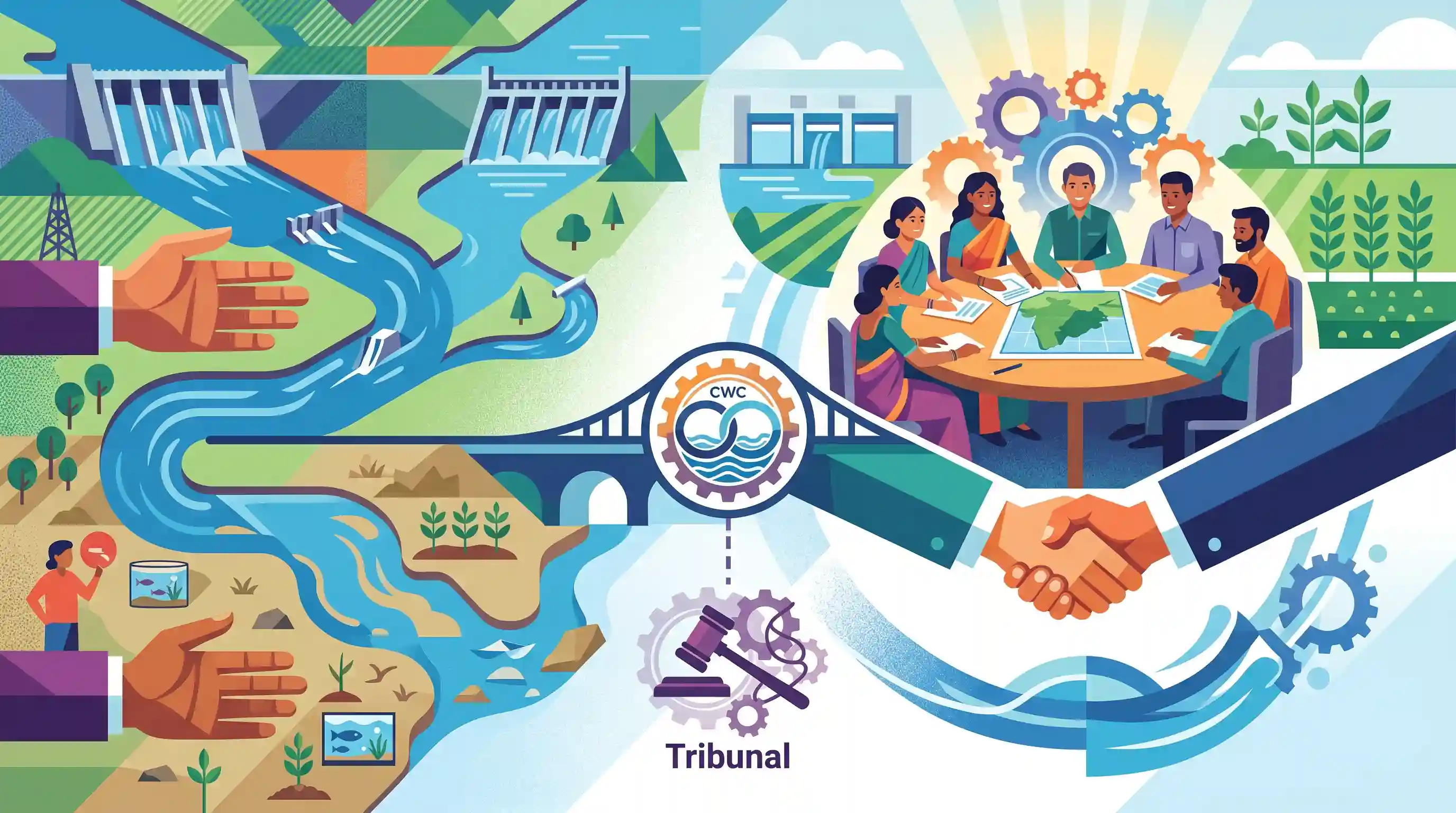
Odisha and Chhattisgarh have indicated their intent to amicably resolve the ongoing Mahanadi river water dispute, signaling a shift toward cooperative federalism. Appearing before the Mahanadi Water Disputes Tribunal, representatives from both states proposed forming a joint committee headed by the Central Water Commission (CWC) to find a mutually agreeable solution. The long-standing conflict stems from Chhattisgarh's construction of upstream barrages and irrigation projects, which Odisha claims has severely restricted downstream flow during non-monsoon months. Resolving this via dialogue circumvents the traditionally protracted legal battles under the Inter-State River Water Disputes Act, 1956.
Key Points
- Odisha and Chhattisgarh have expressed their willingness to resolve the Mahanadi water dispute amicably before the Mahanadi Water Disputes Tribunal (MWDT).
- A joint committee headed by the Central Water Commission (CWC), with representatives from both States, will be formed to discuss an out-of-tribunal settlement.
- The dispute originates from Chhattisgarh constructing multiple upstream irrigation projects and industrial barrages, which Odisha alleges drastically cut downstream flow.
- The MWDT, chaired by retired Supreme Court judge Justice Bela M. Trivedi, heard the submissions and scheduled the next hearing for July 2026.
- The amicable resolution attempt highlights the role of cooperative federalism over protracted litigation under the Inter-State River Water Disputes Act.
Important Terms
Inter-State River Water Disputes Act, 1956

A 1956 law enacted under Article 262 empowering the Union to establish ad-hoc tribunals for adjudicating water sharing conflicts between states when negotiations fail.
UPSC context
GS Paper II (Governance/Polity); tests understanding of statutory mechanisms for resolving federal disputes and the role of Article 262.
Mahanadi Water Disputes Tribunal (MWDT)
A tribunal constituted in 2018 to adjudicate the water-sharing conflict between Odisha and Chhattisgarh over the Mahanadi River, following a Supreme Court directive.
UPSC context
GS Paper I (Geography) and II (Polity); relevant for regional river systems and specific ongoing inter-state disputes.
Central Water Commission (CWC)
India’s premier technical organization in water resources, responsible for coordinating with state governments for the control, conservation, and utilization of water across the country.
UPSC context
GS Paper III (Environment/Infrastructure); tests knowledge of institutional frameworks for water resource management and technical adjudication support.
Article 262
Constitutional provision allowing Parliament to legislate for the adjudication of inter-state river disputes and specifically barring the jurisdiction of the Supreme Court in such matters.
UPSC context
GS Paper II (Polity); a core concept regarding federalism and the exclusion of judicial review in specific administrative/political conflicts.
Cooperative Federalism
A horizontal relationship where the Union and States work together to solve common problems, emphasizing consensus and negotiation over litigation and confrontation.
UPSC context
GS Paper II (Polity/Federalism); tests the ability to analyze the shift from adversarial legalism to collaborative governance in state relations.
Supreme Court (Article 262 context)
The highest judicial body, which under Article 262 is barred from original jurisdiction in water disputes but retains the power to ensure tribunal compliance and legal interpretations.
UPSC context
GS Paper II (Polity); examines the separation of powers and the constitutional limits on judicial reach in specific federal matters.
Prelims Trap
The Supreme Court has original and exclusive jurisdiction over inter-state river water disputes under Article 131.
Article 262 lets Parliament bar SC jurisdiction. The Inter-State River Water Disputes Act 1956 excludes the SC's original jurisdiction, though states often bypass this using Article 136 (Special Leave Petition).
Static Concepts Connected
How does the Constitution handle Inter-State River Water Disputes?
- Article 262: Empowers Parliament to provide for the adjudication of any dispute or complaint regarding the use, distribution, or control of inter-state river waters.
- Jurisdiction bar: Parliament may by law provide that neither the Supreme Court nor any other court shall exercise jurisdiction over such water disputes.
- Statutory Acts: Parliament enacted the River Boards Act (1956) and the Inter-State River Water Disputes Act (1956) under these constitutional provisions.
What are the key geographical features of the Mahanadi basin?
- Origin: Rises near Sihawa in the Raipur district of Chhattisgarh, flowing eastwards through Odisha into the Bay of Bengal.
- Tributaries: Left bank tributaries include Seonath, Hasdeo, Mand, and Ib. Right bank tributaries include Ong, Tel, and Jonk.
- Key Projects: The Hirakud Dam in Odisha is the longest major earthen dam in India, crucially built across the Mahanadi for flood control.
Cross-Topic Patterns
Zonal Councils and Water Disputes
Unlike adjudicatory water tribunals, Zonal Councils (States Reorganisation Act, 1956) foster cooperative federalism and dialogue, often serving as initial pre-litigation consultation platforms for resource sharing between states.
Single Tribunal vs Ad-hoc Tribunals
The out-of-tribunal CWC panel highlights the failure of ad-hoc tribunals. The pending Inter-State River Water Disputes Amendment Bill seeks a permanent single tribunal with an active Dispute Resolution Committee.

Expect a multi-statement Prelims question in 2026 linking Article 262's SC jurisdiction bar with Mahanadi's exact tributaries.
Linked PYQs · 5
Linked PYQs · 5
- 2015MainsGS2
The concept of cooperative federalism has been increasingly emphasized in recent years. Highlight the drawbacks in the existing structure and the extent to which cooperative federalism would answer the shortcomings.
- 2018MainsGS2
How far do you agree with the view that tribunals curtail the jurisdiction of ordinary courts? In view of the above, discuss the constitutional validity and competency of the tribunals in India.
- 2019MainsGS1
What is water stress? How and why does it differ regionally in India?
- 2025PrelimsGS1
With reference to ancient India (600-322 BC), consider the following pairs: Territorial region River flowing in the region I. Asmaka : Godavari II. Kamboja : Vipas III. Avanti : Mahanadi IV. Kosala : Sarayu How many of the pairs given above are correctly matched?
- 2016PrelimsGS1
Recently, linking of which of the following rivers was undertaken?
