Ocean Warming and Extreme Rainfall Disasters in Asia
Source:The Hindu ↗
Why It Matters
Provides empirical evidence linking climate change (SST rise) to extreme weather events (intensified cyclones and heavy rainfall) and highlights how unplanned urbanization multiplies disaster risks—highly relevant for geography and disaster management answers.
Summary
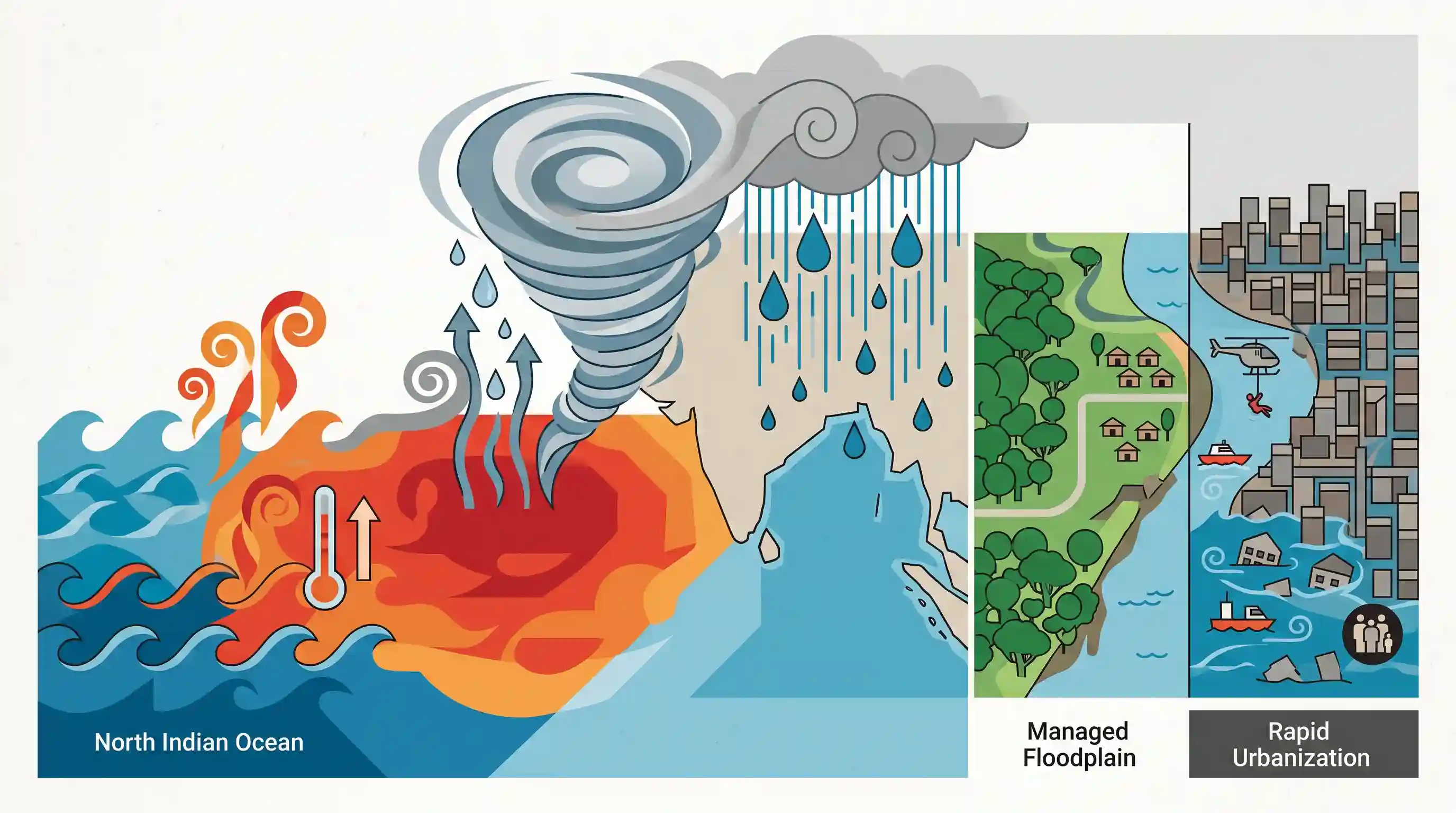
A study by the World Weather Attribution (WWA) links the severe flooding and landslides that killed over 1,600 people in South and Southeast Asia to climate change-induced ocean warming. Warmer sea surface temperatures (SSTs) in the North Indian Ocean fueled cyclones Senyar and Ditwah, increasing atmospheric moisture capacity and causing intense rainfall. The study emphasizes that rapid urbanization and the expansion of settlements into vulnerable floodplains drastically amplified the destructive human toll of these extreme weather events.
Key Points
- Unusually warm Sea Surface Temperatures (SSTs) in the North Indian Ocean provided additional energy to cyclones Senyar and Ditwah, according to a World Weather Attribution (WWA) study.
- These energized cyclonic systems fed intense rainfall, triggering deadly floods and landslides that claimed over 1,600 lives across Southeast and South Asia.
- WWA researchers found that North Indian Ocean SSTs were 0.2°C higher than the recent 30-year average and approximately 1°C warmer than pre-industrial levels due to climate change.
- A warmer atmosphere holds more moisture, directly correlating global temperature rises to more extreme precipitation events.
- The disaster was exacerbated by high human exposure resulting from rapid urbanization, growing population density, and the placement of infrastructure in low-lying, vulnerable floodplains.
Important Terms
World Weather Attribution (WWA)

An international scientific collaboration that analyzes the role of human-induced climate change in extreme weather events like heatwaves, floods, and storms using real-time attribution studies.
UPSC context
GS Paper III (Environment/Disaster Management); tests understanding of scientific evidence linking climate change to specific disasters.
Sea Surface Temperature (SST)
The water temperature at the ocean's surface. Elevated SSTs provide heat and moisture, fueling the rapid intensification and increased rainfall capacity of tropical cyclones.
UPSC context
GS Paper I (Physical Geography); critical for explaining cyclogenesis and the impact of global warming on oceanic basins.
Urban Flooding
Inundation of property in built-up environments caused by heavy rainfall overwhelming drainage systems, often exacerbated by concretization, encroachment on water bodies, and unplanned urbanization.
UPSC context
GS Paper III (Disaster Management); frequently tested as an emerging climate-induced disaster requiring resilient infrastructure planning.
Extreme Weather Attribution
A science that calculates how much more likely or intense an extreme weather event has become due to human-caused global warming by comparing historical data with climate models.
UPSC context
GS Paper III (Environment); relevant for discussions on "Loss and Damage" and legal liability in international climate negotiations.
Tropical Cyclones
A low-pressure system over tropical oceans with strong winds and heavy rain. Climate change is causing these to intensify faster and dump more moisture, even with lower wind speeds.
UPSC context
GS Paper I & III; focuses on changing patterns (frequency/intensity) in the North Indian Ocean and mitigation strategies.
Disaster Management
A systematic process of using administrative decisions, organization, and operational skills to implement policies and coping capacities to lessen the adverse impacts of hazards and disasters.
UPSC context
GS Paper III; core topic assessing the transition from reactive relief to proactive risk reduction and resilience.
Prelims Trap
"Climate change causes a direct increase in the frequency of tropical cyclones in the North Indian Ocean."
Warming oceans definitively increase cyclone intensity and rapid intensification (more moisture/thermal energy), but overall frequency may actually remain stable or decrease globally.
Static Concepts Connected
What are the primary atmospheric conditions required for tropical cyclogenesis?
- Warm Ocean: A large sea surface with a temperature continuously greater than 27°C to provide latent heat.
- Coriolis Force: Presence of the Coriolis force to create the cyclonic vortex (absent right at the equator).
- Low Wind Shear: Low wind shear (small variations in vertical wind speed) so the storm's structure isn't torn apart.
- Pre-existing Low: A pre-existing weak low-pressure area or low-level cyclonic circulation to initiate the updraft.
What is the Clausius-Clapeyron relation in the context of climate change?
- Moisture Capacity: It dictates that a warmer atmosphere can hold exponentially more water vapor.
- 7% Rule: The atmosphere's moisture-holding capacity increases by roughly 7% for every 1°C rise in temperature.
- Extreme Rainfall: This physical law explains why global warming leads to shorter, more extreme precipitation events and flash floods.
Cross-Topic Patterns
Climate Extremes + Urban Flooding
Natural hazards are converted into disasters by human exposure. Unplanned urbanization in low-lying floodplains amplifying climate events is a persistent GS3 Mains theme.
Elevated SSTs + Marine Heatwaves
The same SST anomalies driving rapid cyclone intensification also trigger marine heatwaves, leading to mass coral bleaching—a highly tested Prelims environment topic.

Expect a multi-statement Prelims question combining the Clausius-Clapeyron moisture relation, SST anomalies, and cyclone intensification.
Linked PYQs · 3
Linked PYQs · 3
- 2024MainsGS1
What is sea surface temperature rise? How does it affect the formation of tropical cyclones?
- 2024MainsGS3
Flooding in urban areas is an emerging climate-induced disaster. Discuss the causes of this disaster. Mention the features of two such major floods in the last two decades in India. Describe the policies and frameworks in India that aim at tackling such floods.
- 2022MainsGS3
Explain the mechanism and occurrence of cloudburst in the context of the Indian subcontinent. Discuss two recent examples.
