Bihar Cabinet Approves Landmark Labour and Safety Rules
Source:bihar-infra-tales ↗
Why It Matters
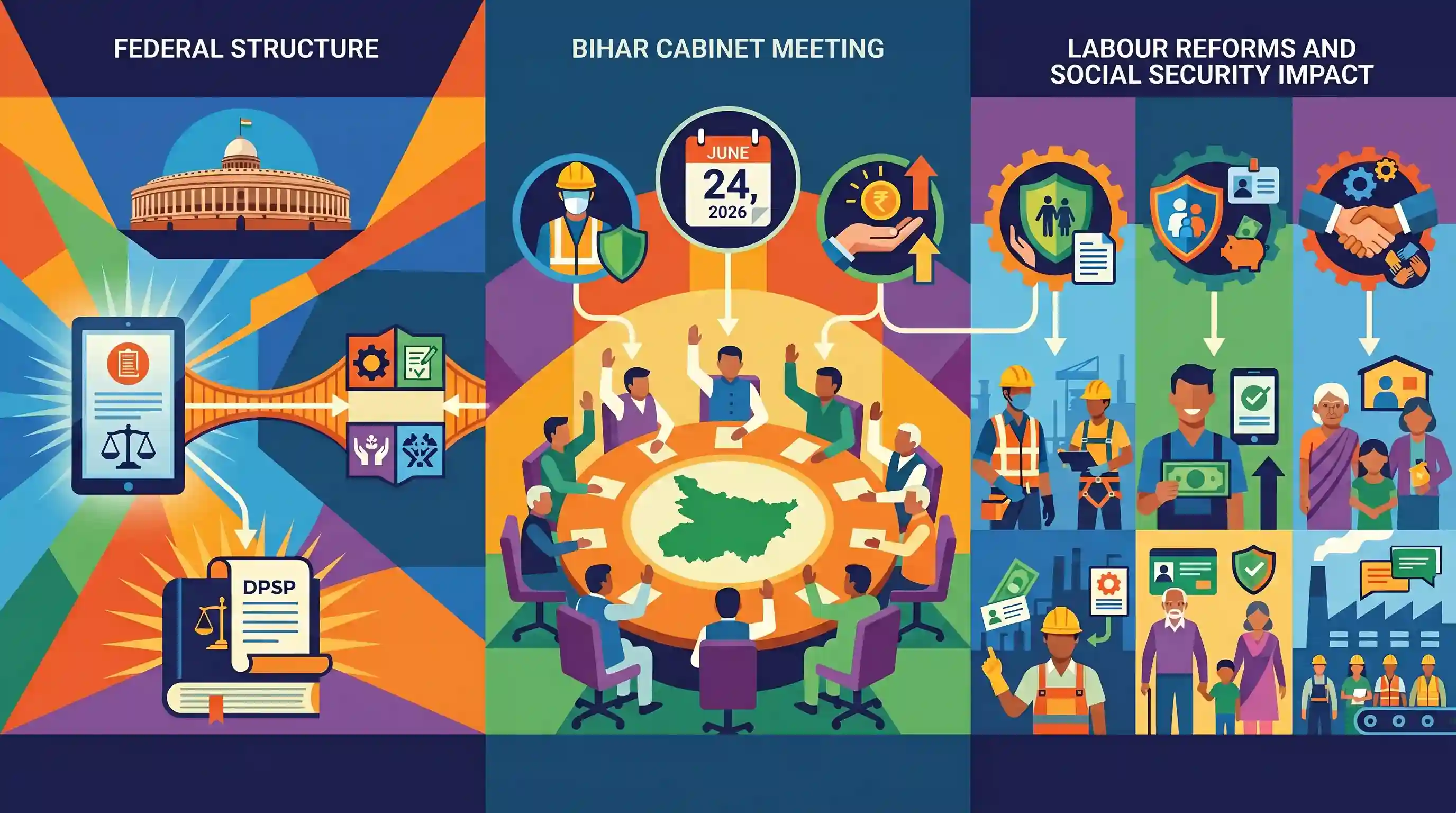
This news highlights the federal system in action, specifically how subjects on the Concurrent List (like Labour) require state-level rules to implement central acts. It is highly relevant for BPSC Prelims questions concerning the Seventh Schedule, DPSP Articles (39d, 42, 43), and state cabinet welfare policies.
Summary
On June 24, 2026, the Bihar Cabinet approved the 'Occupational Safety, Health & Working Conditions (Bihar) Rules, 2026' alongside three other critical labor codes—the Wage Code, Social Security, and Industrial Relations (Bihar) Rules, 2026. Formulated by the Labour Resources Department, these rules represent a major state-level step in implementing India's four Central Labour Codes of 2019-2020, leveraging Bihar's legislative powers over 'Labour' under the Concurrent List of the Seventh Schedule.
Key Points
- On June 24, 2026, the Bihar Cabinet approved four historic labor-related rules under the Labour Resources Department: the Occupational Safety, Health & Working Conditions (Bihar) Rules, 2026; Wage Code (Bihar) Rules, 2026; Social Security (Bihar) Rules, 2026; and Industrial Relations (Bihar) Rules, 2026.
- The formulation and approval of these state rules are necessary because 'Labour' is a subject on the Concurrent List (Seventh Schedule) of the Indian Constitution, requiring both Central and State-level legal frameworks for implementation.
- These rules pave the way for implementing the four landmark Central Labour Codes of 2019-2020, which consolidated 29 existing central labor laws to simplify compliance and boost worker welfare.
- The state-level codes directly align with and execute various Directive Principles of State Policy (Part IV of the Constitution), such as Article 39(d) (Equal pay for equal work), Article 42 (Just and humane conditions of work, maternity relief), and Article 43 (Living wage and welfare of workers).
Important Terms
Central Labour Codes (2019-2020)

A monumental legislative reform consolidating 29 central labor laws into four unified codes to simplify compliance, enhance ease of doing business, and guarantee universal social security and minimum wages for India's workforce.
UPSC context
GS Paper III (Employment and Industrial Growth). Tests knowledge of labor market reforms, informal sector formalization, and ease of doing business.
The Code on Wages, 2019
A central law standardizing minimum wage determination, introducing a statutory floor wage, prohibiting gender discrimination in wages, and expanding wage-payment rules digitally to all employees without a wage ceiling.
UPSC context
GS Paper III (Inclusive Growth and Welfare). Tests understanding of wage security, minimum wage mechanisms, and gender equality in remuneration.
The Occupational Safety, Health and Working Conditions Code, 2020
A central code consolidating laws regulating occupational health and safety across establishments, mandating standards like free health checkups, work hour limits, and safety provisions for inter-state migrant workers.
UPSC context
GS Paper II & III (Social Justice and Employment). Tests understanding of labor welfare, work environments, and hazard mitigation in industries.
The Code on Social Security, 2020
A unified central code extending social security protections, including provident funds, maternity benefits, and life insurance, to unorganized sector employees, gig workers, and platform workers.
UPSC context
GS Paper III (Inclusive Growth & Welfare Schemes). Tests knowledge of social safety nets, gig economy dynamics, and informal workforce coverage.
The Industrial Relations Code, 2020
A legislative framework regulating trade unions, industrial dispute settlements, and employment conditions, designed to offer industries greater operational flexibility while securing workers' right to dispute resolution.
UPSC context
GS Paper III (Employment and Industrial Growth). Tests understanding of dispute mechanisms, collective bargaining, and balancing employer-employee relations.
Occupational Safety, Health & Working Conditions (Bihar) Rules, 2026
State-level rules framed by Bihar's government under its Concurrent List jurisdiction to implement the central OSH Code, defining state-specific workplace safety, health, and welfare standards for regional enterprises.
UPSC context
GS Paper II (Federalism and Centre-State Relations). Tests understanding of concurrent legislative powers, cooperative federalism, and localized execution of national laws.
Prelims Trap
The four Central Labour Codes of 2019-2020 automatically override the need for state-specific rule formulation to ensure national uniformity.
Labour is a Concurrent List subject. While Central codes establish the legislative framework, state governments must notify their own rules for implementation within their respective jurisdictions.
Static Concepts Connected
Which DPSPs secure the welfare of workers and labor rights?
- Article 39(d): Directs the state to ensure equal pay for equal work for both men and women.
- Article 42: Requires the state to secure just and humane conditions of work and maternity relief.
- Article 43: Urges the state to secure a living wage and a decent standard of life for all workers.
- Article 43A: Mandates state action to secure the participation of workers in the management of undertakings and industries.
How is labor legislative power divided under the Seventh Schedule?
- Concurrent List: Entry 22 (industrial disputes) and Entry 24 (labor welfare) allow both Parliament and States to legislate, with states needing to frame implementation rules.
- Union List Exclusive: Entry 55 reserves regulation of labor and safety in mines and oilfields exclusively to the Parliament.
Cross-Topic Patterns
Concurrent List friction in labor reforms
Delay in national labor code rollout highlights how concurrent jurisdiction requires dual-level legislative consensus, showing the practical limits of unilateral central policymaking.
Labor flexibility vs. welfare economics
Consolidating 29 laws into four codes attempts to balance India's global ease-of-doing-business ratings with social security mandates for informal and gig sector workers.

Multi-statement items may test the Concurrent List status of labor alongside conceptual differences between living, fair, and minimum wages.
Linked PYQs · 3
Linked PYQs · 3
- 2025BPSC_PRELIMSGS1
Consider the following subjects belonging to different lists of the constitution of India. Which of the following subjects belong to concurrent list? 1) Protection of wildlife 2) Income on Agriculture 3) Tax on Electricity consumption or sale 4) Price control Out of these:
- 2016BPSC_PRELIMSGS1
Which of the following is/are listed among the Directive Principles in Part-IV of the Constitution of India? I. Equal Pay for Equal Work II. Uniform Civil Code III. Small family norm IV. Education through mother tongue at primary level
- 2022BPSC_PRELIMSGS1
The new ministry proposed in the Bihar Budget for the year 2021-22 focuses on
