High Court rules on legality of obstructing stray dog feeding
Source:Indian Express ↗
Why It Matters
This judgment is significant for UPSC aspirants as it provides a practical application of the newly enacted Bharatiya Nyaya Sanhita (BNS) in everyday urban conflicts. It highlights the ongoing governance challenge of balancing animal welfare (Constitutional duty of compassion for animals) with public safety (Right to life and protection from public nuisance) under the framework of the Animal Birth Control Rules, 2023.
Summary
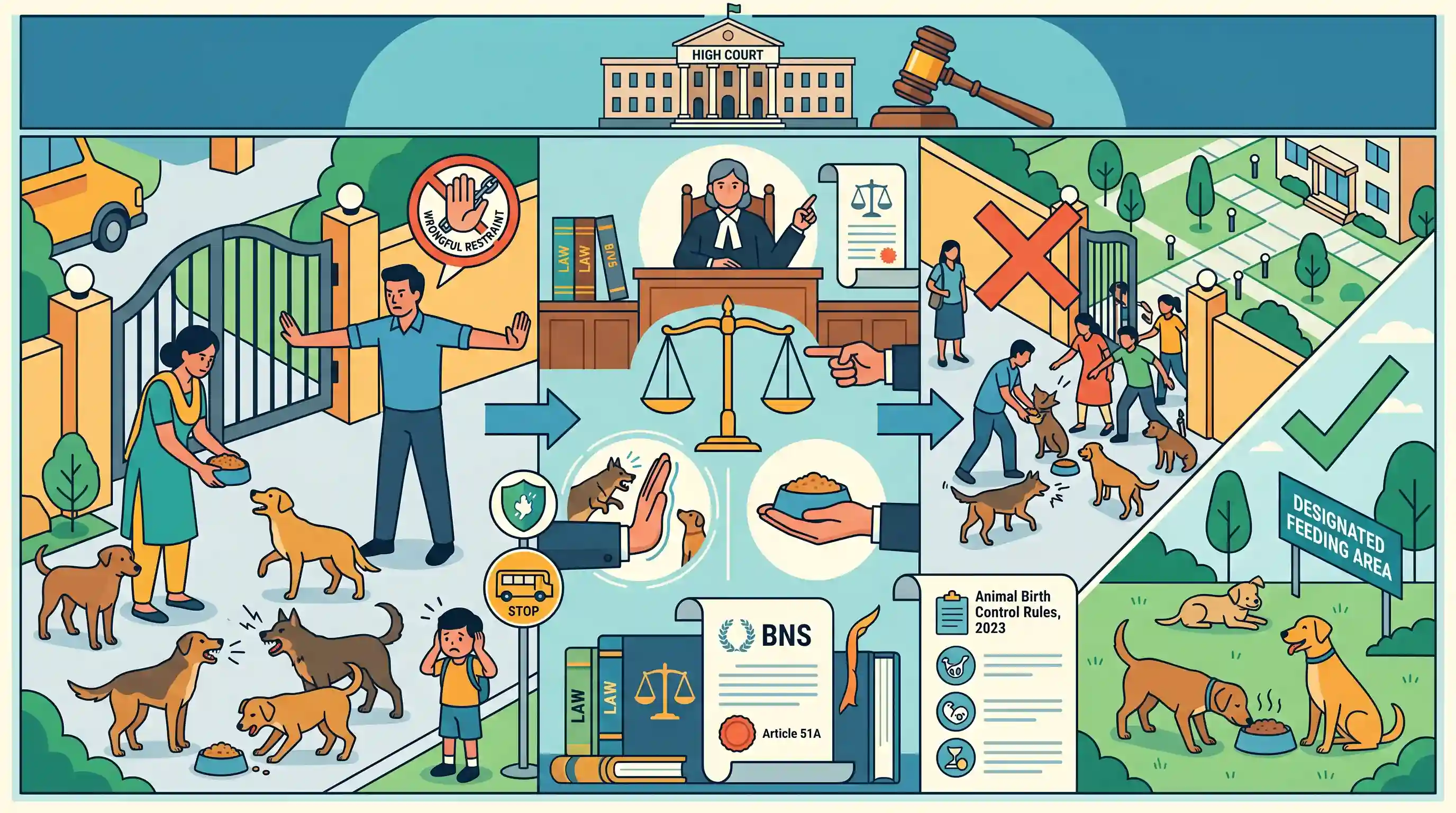
The Bombay High Court quashed an FIR against a man accused of stopping a woman from feeding stray dogs near a housing society gate. The Court determined that this action did not amount to "wrongful restraint" under Section 126 of the Bharatiya Nyaya Sanhita (BNS), as the obstruction was done in good faith to prevent public nuisance and ensure the safety of residents after numerous dog bite incidents. The judgment cited the Animal Birth Control Rules, 2023, which require stray dogs to be fed only in designated areas to avoid conflicts, especially near common entry points and school bus stops.
Key Points
- The Bombay High Court ruled that obstructing someone from feeding stray dogs in non-designated common areas does not constitute "wrongful restraint" under Section 126 of the Bharatiya Nyaya Sanhita (BNS).
- Section 126(1) of the BNS includes an exception stating that obstructing a private way in good faith, believing one has a lawful right to do so, is not an offense.
- The Animal Birth Control Rules, 2023 mandate that Resident Welfare Associations (RWAs) must establish designated feeding spots for stray dogs to mitigate man-animal conflict in urban spaces.
- The ruling balances the fundamental duty to show compassion for living creatures (Article 51A(g)) with public safety and the fundamental right to life (Article 21), particularly in preventing public nuisance and dog bites.
Important Terms
Bharatiya Nyaya Sanhita (BNS)

India's new unified criminal code that replaced the Indian Penal Code (IPC) on July 1, 2024, aiming to modernize legal provisions and emphasize victim-centric justice.
UPSC context
GS Paper II: Criminal justice reforms, modernization of colonial laws, and judicial interpretations of new penal sections.
Animal Birth Control Rules, 2023
Notified under the PCA Act 1960, these rules mandate the sterilization and immunization of stray dogs while requiring designated feeding areas to minimize human-animal conflict.
UPSC context
GS Paper III: Animal welfare, urban governance, and policies addressing human-wildlife/stray conflicts.
Animal Welfare Board of India (AWBI)
A statutory advisory body established in 1962 under the Prevention of Cruelty to Animals Act to promote animal welfare and advise the government on protection laws.
UPSC context
GS Paper II: Statutory and regulatory bodies; their role in enforcing ethical standards and animal rights.
Prevention of Cruelty to Animals Act, 1960
The primary legislation in India enacted to prevent unnecessary pain or suffering to animals, aligning with the fundamental duty of compassion under Article 51A(g).
UPSC context
GS Paper II: Social justice and legislation for vulnerable/non-human entities; constitutional link to Fundamental Duties.
Resident Welfare Associations (RWAs)
Voluntary non-governmental organizations registered under the Societies Registration Act, 1860, that represent and manage the collective interests and amenities of urban housing residents.
UPSC context
GS Paper II: Role of civil society and pressure groups in local governance and urban management.
Prelims Trap
The Animal Birth Control Rules, 2023 empower Resident Welfare Associations (RWAs) to completely ban the feeding of stray dogs.
RWAs cannot ban feeding outright. The 2023 Rules explicitly mandate them to designate specific feeding spots away from children and the elderly to manage conflict.
Static Concepts Connected
How does the Constitution balance animal welfare with human rights?
- Article 51A(g): Mandates a fundamental duty for all citizens to protect the environment and have compassion for living creatures.
- Article 48A: A Directive Principle introduced by the 42nd Amendment requiring the State to protect the environment and safeguard wildlife.
- Article 21: Courts consistently hold that human right to life and public safety (preventing dog bites) take precedence over animal feeding privileges when the two clash.
What is the statutory framework of the Animal Welfare Board of India (AWBI)?
- Statutory Basis: Established in 1962 under the Prevention of Cruelty to Animals Act, 1960, making it a statutory advisory body.
- Nodal Ministry: It currently operates under the Ministry of Fisheries, Animal Husbandry and Dairying, not the Ministry of Environment, Forest and Climate Change.
- Key Mandate: Advises the Centre on framing animal welfare rules, including the Animal Birth Control Rules, and provides grants to recognized animal welfare organizations.
Cross-Topic Patterns
Urban Governance & Man-Animal Conflict
The shift of human-animal conflict from forests to urban spaces (stray dogs, monkeys) necessitates RWAs and Urban Local Bodies taking active, regulated roles in urban ecological management.
Testing the new BNS exceptions
Judicial interpretations of new Bharatiya Nyaya Sanhita (BNS) sections, such as the 'good faith' exception in wrongful restraint, provide critical fodder for Mains GS2 answers on criminal justice reforms.

Animal Birth Control Rules 2023 + AWBI's statutory backing + Article 51A(g) will likely form a multi-statement Prelims question.
Linked PYQs · 2
Linked PYQs · 2
- 2009PrelimsGS1
Where is the headquarters of Animal Welfare Board of India located?
- 2022MainsGS2
“The most significant achievement of modern law in India is the constitutionalization of environmental problems by the Supreme Court.” Discuss this statement with the help of relevant case laws.
