Free Speech Limitations and Judicial Protection for Cartoonists
Source:The Hindu ↗
Why It Matters
This development is crucial for understanding the contemporary constitutional debate balancing Article 19(1)(a) and Article 21 in the digital era. It underscores the challenges of social media regulation, the ethical implications of online free speech (hate speech vs. expression), and the judiciary's proactive stance in safeguarding individual dignity and fraternity.
Summary
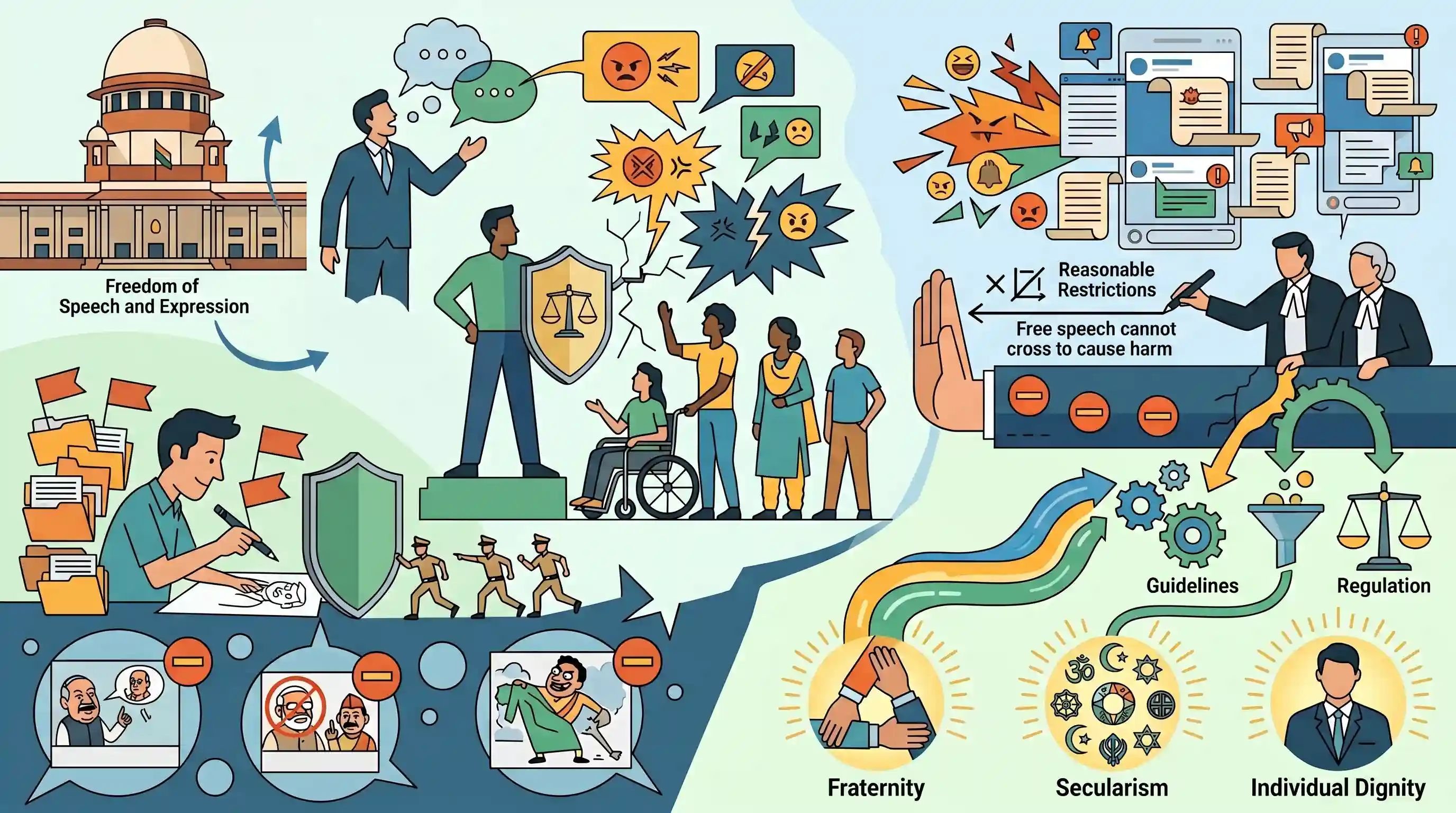
The Supreme Court of India granted interim protection from arrest to a cartoonist facing multiple FIRs over allegedly objectionable illustrations of the Prime Minister and the RSS. However, across multiple recent hearings, different Benches of the Supreme Court have strongly condemned the widespread abuse of social media. The judiciary has increasingly highlighted the conflict between Article 19 (freedom of speech) and Article 21 (right to life with dignity), firmly stating that free speech cannot justify making insensitive remarks about marginalized groups, such as persons with disabilities, or using derogatory language. The Court indicated a potential need for guidelines to regulate social media content to preserve constitutional values like fraternity, secularism, and individual dignity.
Key Points
- The Supreme Court granted interim protection to cartoonist Hemant Malviya, who faced FIRs for allegedly posting objectionable cartoons of PM Modi and the RSS.
- While protecting the cartoonist, the Supreme Court voiced serious concerns over the increasing abuse of social media platforms under the guise of free speech.
- The Court emphasized that the freedom of speech and expression (Article 19) cannot overpower the fundamental right to a dignified life (Article 21), particularly in cases where content mocks persons with disabilities or uses abusive language.
- The judiciary hinted at formulating guidelines to curb insensitive, abusive, and derogatory content on social media to uphold fraternity, secularism, and individual dignity.
Important Terms
Article 19(1)(a)

Guarantees Indian citizens the right to express views freely via speech, writing, or media. It is essential for a functional democracy but is not absolute.
UPSC context
GS Paper II: Fundamental Rights. Tests understanding of democratic foundations and judicial balancing of civil liberties.
Article 21
Fundamental right stating no person shall be deprived of life or personal liberty except by procedure established by law; judicially expanded to include the right to dignity.
UPSC context
GS Paper II: Polity. Crucial for understanding the "Right to Life" as a broad, evolving umbrella for various human rights.
Reasonable Restrictions
The legal power under Article 19(2) allowing the State to limit free speech for reasons like public order, morality, or the sovereignty of India.
UPSC context
GS Paper II: Constitutional Provisions. Key for evaluating the limits of liberty and State authority.
Constitutional Fraternity
A Preamble-based value and Fundamental Duty (Article 51A(e)) promoting common brotherhood; recently used by courts to justify curbing speech that vilifies specific communities.
UPSC context
GS Paper II: Preamble & Fundamental Duties. Relates to social cohesion and judicial efforts to prevent communal discord.
Right to Dignity
An interpretive component of Article 21, asserting that an individual's right to live with self-respect can override another's right to absolute free speech.
UPSC context
GS Paper II: Fundamental Rights. Essential for "Rights vs. Rights" debates and social justice issues.
Interim Protection
Judicial relief preventing the arrest of an accused person while a case is pending or before an investigation is completed.
UPSC context
GS Paper II: Judiciary/Criminal Justice. Tests knowledge of legal remedies and the protection of individual liberty during litigation.
Prelims Trap
The Constitution explicitly lists "hate speech" as a ground for restricting freedom of speech under Article 19(2).
Article 19(2) explicitly lists 8 grounds (e.g., public order, decency, defamation). "Hate speech" is not an explicit constitutional term; it is interpreted under broader headings like "incitement to an offence".
Static Concepts Connected
What are the explicit grounds for restricting free speech under Article 19(2)?
- State Security: Sovereignty and integrity of India, security of the State, and friendly relations with foreign States.
- Public Order: Public order, decency, or morality to maintain societal peace and ethics.
- Defamation & Contempt: Contempt of court, defamation, and incitement to an offence.
How does the judiciary resolve conflicts between competing Fundamental Rights?
- Harmonious Construction: The courts interpret conflicting provisions (like Art 19 vs 21) so they coexist, ensuring neither right completely overrides or nullifies the other.
- Proportionality Test: Any restriction placed on one fundamental right to protect another must be legally valid, necessary, and strictly proportionate to the objective.
Cross-Topic Patterns
IT Rules 2021 & Free Speech
SC's hint at new guidelines for social media platforms runs parallel to the ongoing legal scrutiny of the IT Rules 2021, particularly the 'safe harbour' protections for intermediaries under Section 79.
PwD Rights & Article 21
The Court’s specific focus on mocking persons with disabilities bridges GS2 Polity (Article 21 dignity) with Social Justice (Rights of Persons with Disabilities Act, 2016).

Expect a 2026 Mains GS2 question testing the judicial balancing of Article 19(1)(a) and Article 21 through the lens of digital abuse.
Linked PYQs · 3
Linked PYQs · 3
- 2014MainsGS2
What do you understand by the concept "freedom of speech and expression"? Does it cover hate speech also ? Why do the films in India stand on a slightly different plane from other forms of expression ? Discuss.
- 2023MainsGS2
“The Constitution of India is a living instrument with capabilities of enormous dynamism. It is a constitution made for a progressive society.” Illustrate with special reference to the expanding horizons of the right to life and personal liberty.
- 2025MainsGS4
In the present digital age, social media has revolutionised our way of communication and interaction. However, it has raised several ethical issues and challenges. Describe the key ethical dilemmas in this regard.
