Supreme Court examines OBC reservations in local body elections
Source:scobserver ↗
Why It Matters
It deals with the constitutional framework of local self-government bodies (Panchayats and Municipalities) and the parameters of OBC reservations in Maharashtra, directly aligning with MPSC polity and governance syllabus.
Summary
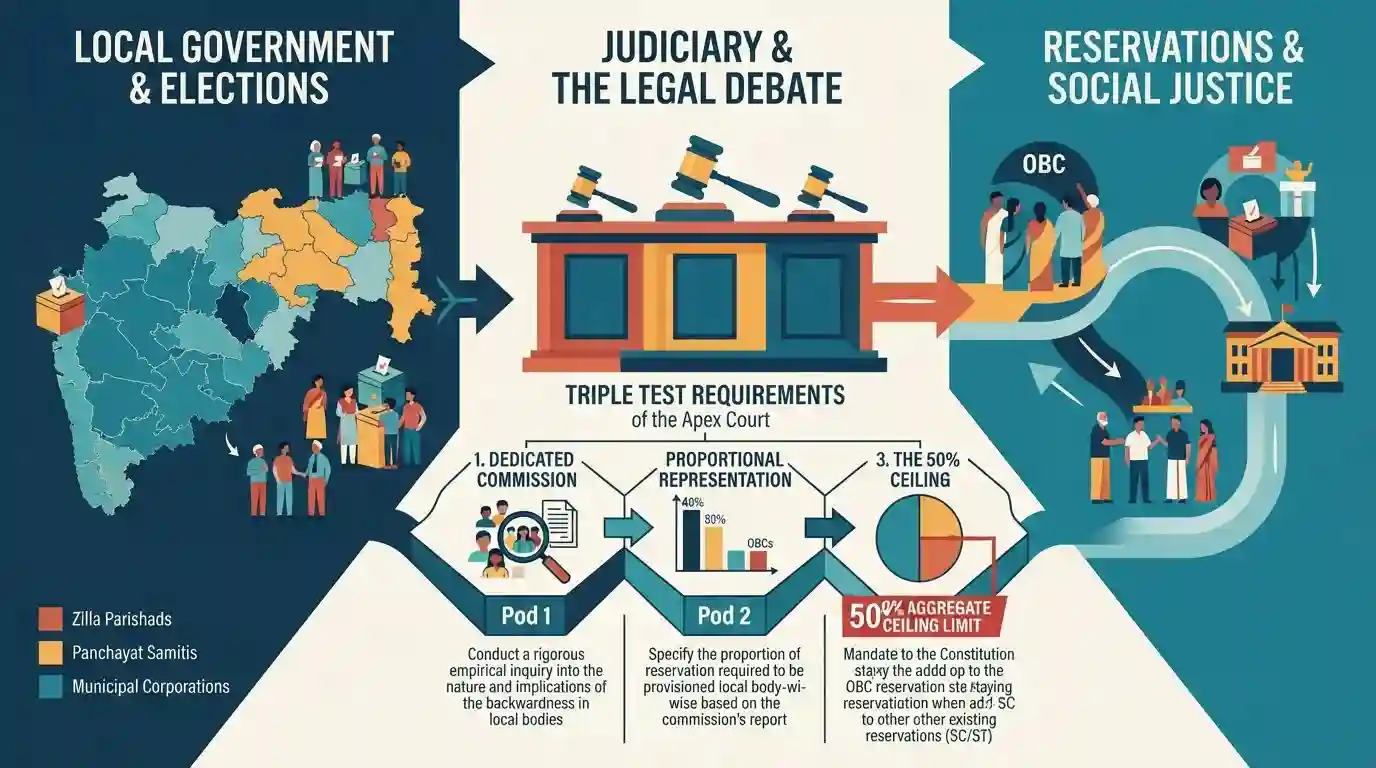
The Supreme Court of India is hearing petitions regarding Other Backward Classes (OBC) reservations in local body elections in Maharashtra. The core legal debate centers around fulfilling the 'triple test' requirements specified by the Apex Court for granting political reservations without breaching the 50% aggregate ceiling limit mandated for local self-governments under the 73rd and 74th Constitutional Amendments.
Key Points
- The Supreme Court is examining issues surrounding Other Backward Classes (OBC) reservations in local body polls across Maharashtra.
- The controversy involves compliance with the 'triple test' criteria mandated by the Supreme Court to provide political reservation for OBCs in local bodies.
- The triple test requires setting up a dedicated commission to gather empirical data on backwardness, specifying the proportion of reservation needed local-body-wise, and ensuring total reservations do not exceed the 50% ceiling limit.
Important Terms
Constitution (Seventy-Third and Seventy-Fourth Amendment) Acts

Constitutional amendments of 1992 that gave constitutional status to rural (Panchayats) and urban (Municipalities) local governments respectively, embedding provisions for mandatory reservations for SCs, STs, and women.
UPSC context
Important for MPSC Polity (Local Government & Decentralization); tests the constitutional framework, devolution of powers, and reservation structures in local bodies.
Maharashtra State Election Commission
A constitutional body established under Article 243K of the Constitution responsible for superintendence, direction, and conduct of elections to panchayats and municipalities in Maharashtra.
UPSC context
Crucial for MPSC General Studies (State Governance and Constitutional Bodies); tests functions and powers of state-level electoral authorities in conducting local body polls.
Supreme Court of India
The apex judicial body of India with original, appellate, and advisory jurisdiction, responsible for interpreting constitutional provisions and adjudicating disputes such as OBC quotas in local governance.
UPSC context
Vital for MPSC Polity (Judiciary & Basic Structure); tests judicial review, interpretation of fundamental rights, and limits on reservation policies.
Static Concepts Connected
What are the components of the Supreme Court's 'Triple Test' for OBC reservations in local bodies?
- Empirical Data: A dedicated commission must be set up to conduct a rigorous empirical inquiry into the nature and implications of backwardness in local bodies.
- Proportion Specification: The commission must specify the proportion of reservation required local-body-wise based on the empirical findings.
- 50% Ceiling: Aggregate reservations for SC, ST, and OBC combined must not exceed the mandatory 50% ceiling limit.
Cross-Topic Patterns
Local Governance vs. Judicial Review
The 50% reservation ceiling limit for local bodies is tested alongside judicial oversight of administrative tribunals and executive discretion in state-level decentralization.

OBC local body reservations + Triple Test criteria in Maharashtra likely to appear as a matching or multi-statement question.
Linked PYQs · 3
Linked PYQs · 3
- 2023MPSC_PRELIMSGS1
Match the pairs correctly. | Column A | Column B | |---|---| | A. Part - I | i. Fundamental Rights | | B. Part - III | ii. Panchayat Raj | | C. Part - IX | iii. Citizenship | | D. Part - II | iv. The Union and its territory | Code: A B C D
- 2021MPSC_PRELIMSGS1
Maharashtra Legislative Council completed its 50 years of existence in ______.
- 2023MPSC_PRELIMSGS1
Which of the following is/are non-constitutional body/bodies ? I. NITI Aayog II. State Finance Commission III. National Commission for Backward Classes IV. Central Information Commission
