Caste Census Methodology and Unique Coding Demands
Source:The Hindu ↗
কেন এটি গুরুত্বপূর্ণ
The issue of caste census and the technical challenges of data collection (such as caste coding) directly impact social justice, targeted welfare delivery, and representation. Understanding the administrative hurdles, such as regional synonyms and sub-castes, is crucial for analyzing the effectiveness of India's census methodologies and welfare policies.
সারসংক্ষেপ
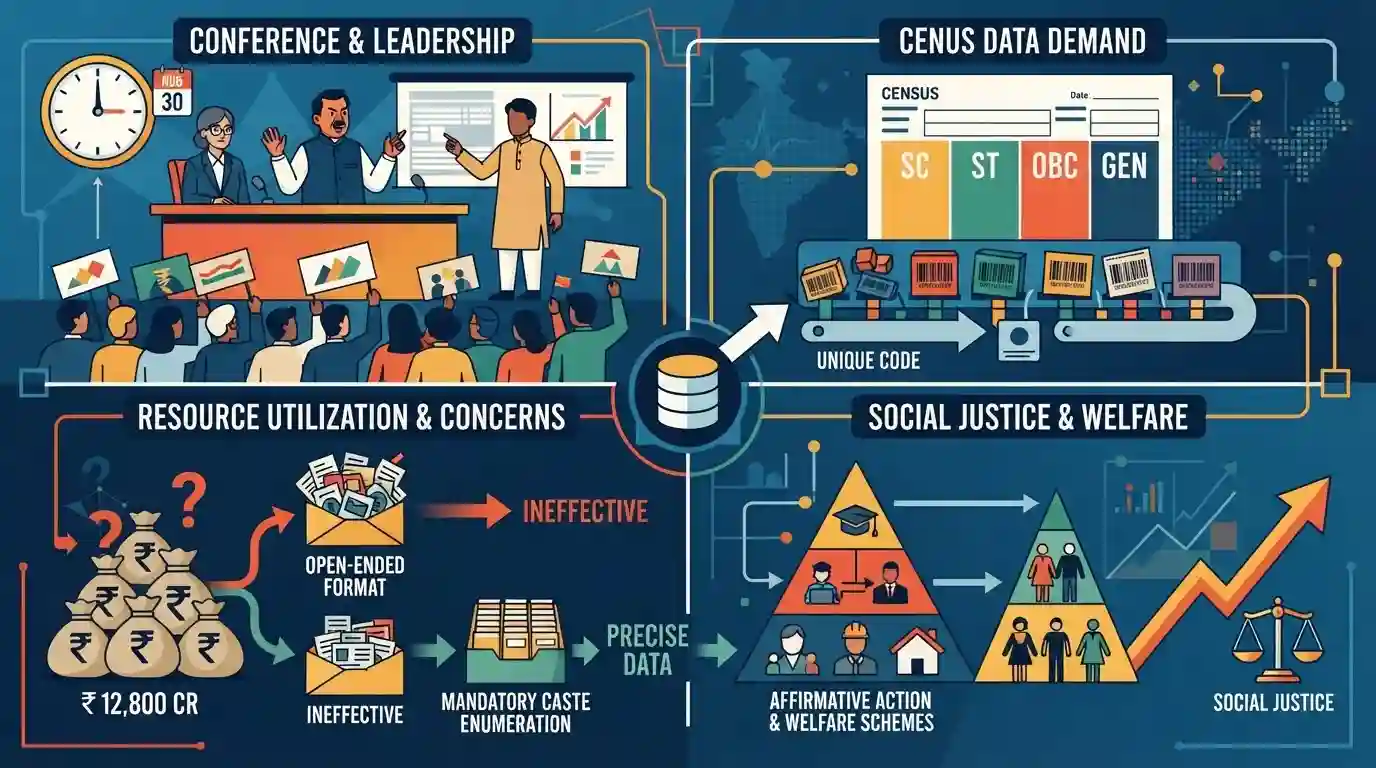
At a national OBC conference held on August 30, 2026, OBC groups and leaders demanded that the Central government make caste enumeration mandatory in the nationwide Census and assign a separate 'unique code' to every caste. The speakers, including former IAS officer T. Chiranjeevulu, Rajya Sabha MP P. Wilson, and professor Yogendra Yadav, argued that conducting the Census with an open-ended format is 'unscientific' due to regional and linguistic variants of caste names, which would render the ₹12,800 crore exercise infructuous. They demanded separate columns for OBCs and the General Category, similar to SCs and STs, and warned of a nationwide movement if the Census is not halted until a consensus is reached.
মূল বিষয়
- Demands for mandatory caste enumeration in the nationwide Census and assigning a 'unique code' to every caste.
- Warning that conducting a Census without caste coding is 'unscientific' and would make the ₹12,800 crore budget a waste of public money.
- Discussion on linguistic variations, regional synonyms, and sub-castes that create data categorization issues in an open-ended questionnaire.
- Demand for separate columns for OBCs and the General Category, parallel to SCs and STs.
- Call to halt the Census until a nationwide consensus is built, with the threat of a potential countrywide movement.
গুরুত্বপূর্ণ শব্দ
Census of India

The decennial, official administrative exercise of systematically counting and collecting demographic, social, and economic information of the country's population, conducted by the Registrar General and Census Commissioner of India.
UPSC context
GS Paper I (Demography) & GS Paper II (Governance); tests understanding of key demographic exercises and federal administrative processes.
Census Act 1948
The post-independence central legislation providing the statutory framework for conducting population enumeration in India, guaranteeing the absolute confidentiality of recorded personal census data.
UPSC context
GS Paper II (Governance/Polity); tests knowledge of legal frameworks governing national data, privacy, and constitutional division of powers.
Dravida Munnetra Kazhagam
A major regional political party in Tamil Nadu founded in 1949 by C.N. Annadurai, historically rooted in the Dravidian self-respect movement and social reform.
UPSC context
GS Paper II (Federalism & Regional Parties); tests understanding of Dravidian ideology, regionalism, and subaltern political representation.
All India OBC Students Association
An active student and youth advocacy organization in India representing Other Backward Classes (OBC) interests, focusing on social justice, student fellowships, and fair implementation of reservation policies.
UPSC context
GS Paper II (Social Justice/Pressure Groups); tests dynamics of student mobilization, social advocacy, and affirmative action implementation.
Backward Classes Intellectual Forum
An intellectual and civil society platform in India that advocates for the rights, standardized representation, and policy interests of Other Backward Classes (OBC).
UPSC context
GS Paper II (Governance/Social Justice); tests the role of non-governmental advocacy groups, policy formulations, and structural challenges in welfare delivery.
প্রিলিমস ফাঁদ
The Socio-Economic and Caste Census (SECC) of 2011 was legally mandated and conducted under the Census Act, 1948.
SECC 2011 was conducted via executive order, meaning respondents were not legally bound to provide accurate data under the penal provisions of the Census Act, 1948.
সংযুক্ত স্থির ধারণা
Under which constitutional and statutory provisions is the Decennial Census of India conducted?
- constitutional_basis: Entry 69 of the Seventh Schedule (Union List) vests the exclusive legislative and executive power to conduct the population census with the Union Government.
- statutory_backing: Conducted under the Census Act, 1948, which guarantees data confidentiality and makes it legally binding for citizens to answer questions truthfully.
- nodal_authority: Executed by the Office of the Registrar General and Census Commissioner of India (ORGI) under the Ministry of Home Affairs.
How did the 102nd and 105th Constitutional Amendments redefine the identification of backward classes?
- constitutional_status: The 102nd Amendment (2018) inserted Article 338B, making NCBC a constitutional body, and Article 342A, empowering the President to notify the Central list of SEBCs.
- federal_restoration: The 105th Amendment (2021) amended Article 342A to explicitly restore the power of State Governments and Union Territories to maintain their own state lists of SEBCs.
আন্তঃবিষয় প্যাটার্ন
Federalism vs Centralized Data Standards
The tension between State-level OBC lists (restored by the 105th Amendment) and a standardized national census coding highlights the governance challenge of aligning federal autonomy with centralized data standards.
Affirmative Action and Data Scientificity
Linking Articles 15(4) and 16(4) with data precision. Courts increasingly demand quantifiable, up-to-date empirical data to justify reservation quotas and sub-categorization.

Expect a multi-statement question linking the 105th Amendment (state SEBC lists) with the statutory/constitutional limits of the Census Act.
সংযুক্ত PYQ · 3
সংযুক্ত PYQ · 3
- 2022MainsGS2
Discuss the role of the National Commission for Backward Classes in the wake of its transformation from a statutory body to a constitutional body.
- 2018MainsGS1
Caste system is assuming new identities and associational forms. Hence, caste system cannot be eradicated in India." Comment.
- 2023MainsGS2
“Development and welfare schemes for the vulnerable, by its nature, are discriminatory in approach.” Do you agree? Give reasons for your answer.
