OBC Creamy Layer Income Test Administrative Friction and Delays
Source:The Hindu ↗
Why It Matters
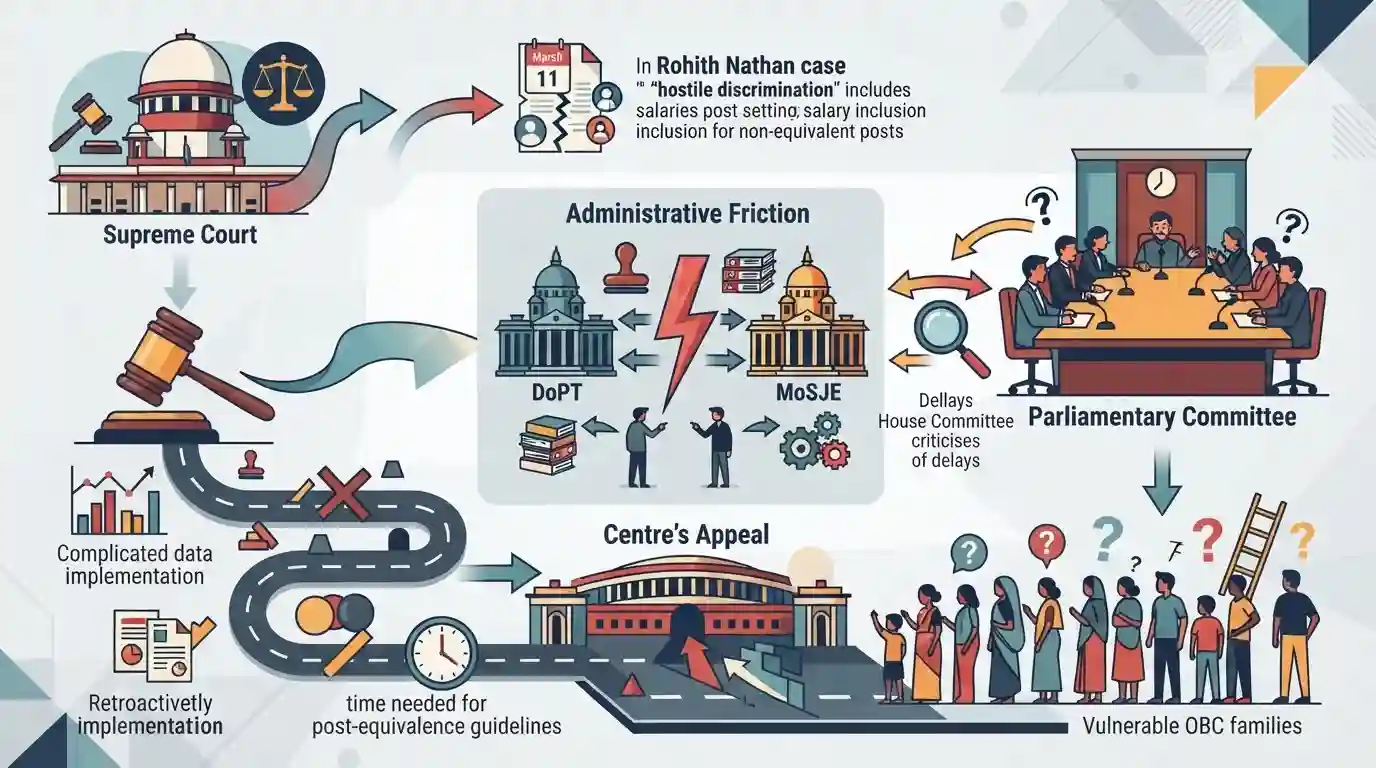
This article highlights critical institutional friction in affirmative action administration in India. It illustrates the complex interplay between judicial directives, executive delays, and parliamentary oversight, which directly impacts the constitutional rights and social justice delivery to backward classes.
Summary
The implementation of the Supreme Court's March 11 judgment (Rohith Nathan case) concerning the OBC creamy layer income-test remains stalled due to administrative friction between the Department of Personnel and Training (DoPT) and the Ministry of Social Justice and Empowerment (MoSJE). The Court had ruled that including salaries in the income test for OBC candidates whose parents' posts lack established government equivalence (like State PSUs) amounts to 'hostile discrimination'. While the House Committee on Welfare of OBCs has strongly criticized the bureaucratic delays and blame games between the two ministries, the Centre has approached the apex court seeking relief, citing the extreme difficulty of retrospective implementation and the time needed to establish post-equivalence guidelines.
Key Points
- The core issue involves the OBC Non-Creamy Layer (OBC-NCL) income-test, specifically the exclusion of 'salaries' and 'agricultural income' from the calculation of the current ₹8 lakh per annum threshold.
- For children of government employees, the 'creamy layer' status is determined by rank/post. For those in PSUs, banks, or the private sector, 'equivalence of posts' with government services must be established; otherwise, the income test is applied.
- In the Rohith Nathan judgment, the Supreme Court ruled that including 'salary' in the income test for candidates whose parents work in organizations without established post-equivalence (e.g., State PSUs) constitutes 'hostile discrimination' and ordered the Centre to exclude salary from the test.
- Implementation of this judgment is stalled due to bureaucratic friction and lack of coordination between the DoPT and the Ministry of Social Justice and Empowerment (MoSJE).
- The central government has approached the Supreme Court seeking clarification, citing that retrospective implementation is 'extremely difficult' and establishing post-equivalence across state PSUs could take up to two years.
- The Parliamentary Committee on the Welfare of Other Backward Classes, led by Ganesh Singh, has criticized the ministries for their delay, highlighting that the misapplication of a 2004 DoPT circular has wrongfully denied reservation to thousands of OBC candidates.
Important Terms
OBC Non-Creamy Layer (OBC-NCL)

The segment of Other Backward Classes (OBCs) whose parental income falls below the specified threshold (currently ₹8 lakh), excluding salary and agriculture, making them eligible for the 27% quota in jobs and education.
UPSC context
GS Paper II (Social Justice/Polity); tests reservation mechanisms, socio-economic criteria, and affirmative action.
Rohith Nathan Case (2026)
A landmark 2026 Supreme Court judgment ruling that parental salary from PSUs/private firms cannot solely determine OBC creamy layer status without post-equivalence guidelines, as doing so violates Article 14's equality mandate.
UPSC context
GS Paper II (Judiciary/Polity); tests judicial review of reservation criteria and executive implementation of court verdicts.
House Committee on the Welfare of Other Backward Classes
A joint parliamentary committee comprising 30 members (20 Lok Sabha, 10 Rajya Sabha) tasked with examining the representation, welfare schemes, and implementation of reservation policies for OBCs in central services.
UPSC context
GS Paper II (Parliamentary Committees); tests legislative oversight of reservation policies and welfare administration.
Department of Personnel and Training (DoPT)
The nodal central government department under the Ministry of Personnel, Public Grievances and Pensions responsible for administrative policy, personnel management, service allocation, and the implementation of reservation rules.
UPSC context
GS Paper II (Governance/Executive); tests knowledge of civil services recruitment, personnel administration, and policy execution.
Ministry of Social Justice and Empowerment (MoSJE)
The nodal Union ministry responsible for formulating welfare policies, educational support, and reservation frameworks for marginalized and vulnerable sections of society, including Other Backward Classes (OBCs).
UPSC context
GS Paper II (Welfare Schemes/Social Justice); tests administrative roles in social justice policies and empowerment initiatives.
Prelims Trap
The ₹8 lakh threshold for OBC Non-Creamy Layer status is an all-inclusive income limit that includes parental salary and agricultural earnings.
Under the 1993 DoPT Office Memorandum, income from salaries and agricultural land is strictly excluded when calculating the ₹8 lakh limit for NCL status determination.
Static Concepts Connected
What is the Creamy Layer concept and how is it determined?
- Origin and Mandate: Introduced in the Indra Sawhney (1992) judgment to exclude socially and educationally advanced sections of OBCs from reservation benefits.
- Ram Nandan Committee: Constituted in 1993 to lay down specific socio-economic criteria for identifying the creamy layer among backward classes.
- Income Exclusion Rule: Explicitly excludes income derived from salaries and agricultural land from the statutory threshold calculation.
What is the composition and mandate of the Parliamentary Committee on Welfare of OBCs?
- Membership Details: Consists of 30 members: 20 from Lok Sabha and 10 from Rajya Sabha, elected annually.
- Mode of Election: Elected via proportional representation by means of a single transferable vote from among the members of Parliament.
- Ministerial Exclusion: Ministers are barred from being members of this committee to ensure unbiased legislative oversight of executive actions.
Cross-Topic Patterns
Administrative Law: Circulars vs. Policy
Illustrates the constitutional hierarchy of norms where executive clarifications or circulars cannot override substantive policy guidelines established under official memorandums.
Welfare Governance & Inter-Ministerial Silos
Highlights how administrative friction between personnel departments (DoPT) and welfare ministries (MoSJE) delays constitutional rights, a recurring theme in GS-2 governance efficiency.

SC rulings on creamy layer combined with the rules of calculating the Rs 8 Lakh NCL threshold likely to feature in multi-statement MCQ.
Linked PYQs · 3
Linked PYQs · 3
- 2022MainsGS2
Discuss the role of the National Commission for Backward Classes in the wake of its transformation from a statutory body to a constitutional body.
- 2021MainsGS2
Do Department-related Parliamentary Standing Committees keep the administration on its toes and inspire reverence for parliamentary control? Evaluate the working of such committees with suitable examples.
- 2023PrelimsGS1
Consider the following organizations/bodies in India: 1. The National Commission for Backward Classes 2. The National Human Rights Commission 3. The National Law Commission 4. The National Consumer Disputes Redressal Commission How many of the above are constitutional bodies?
