Census Questionnaire Methodology and Caste Data Collection Debates
Source:The Hindu ↗
Why It Matters
The debate surrounding the methodology of the upcoming Census 2027 and the inclusion of a structured caste/OBC census touches upon critical dimensions of social justice, constitutional mandates for backward classes, and policy design. For UPSC aspirants, analyzing the administrative and technical challenges of open-ended vs. structured questionnaires is essential for understanding demographic data collection, policy targeting, and political representation.
Summary
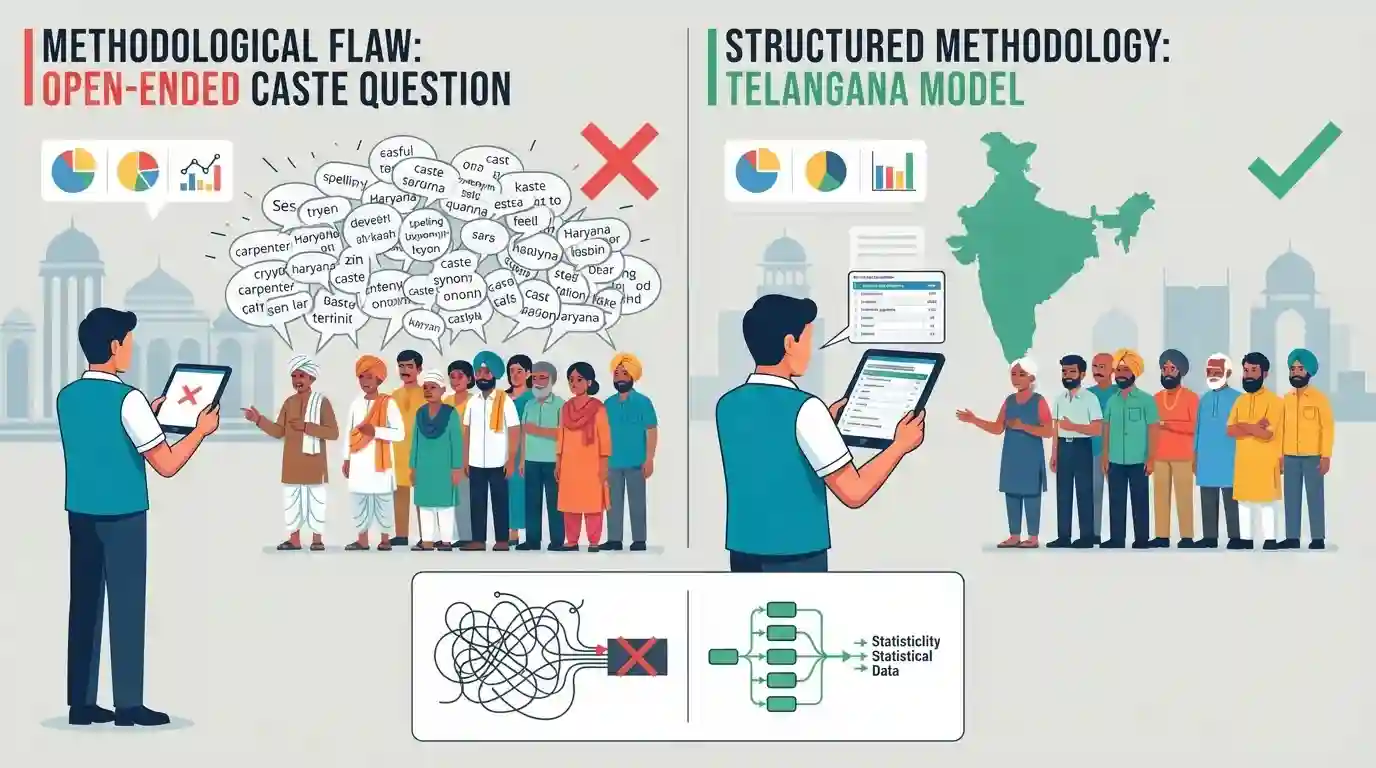
The Indian National Congress has accused the Union government of deliberately excluding a dedicated OBC column from the Census 2027 questionnaire, arguing it is part of a plan to obscure actual OBC population data. The party highlighted key methodological flaws, such as an 'open-ended' caste question that could yield millions of fragmented spelling and synonym entries (e.g., multiple sub-caste names for carpenters in Haryana), making scientific categorization nearly impossible. To resolve this, they urged the Centre to adopt structured methodologies similar to Telangana's state-level survey, which pre-listed 242 castes within a structured 54-question format.
Key Points
- The Congress party has accused the Union government of intentionally omitting a dedicated Other Backward Classes (OBC) column from the Census 2027 questionnaire released on August 14, 2026.
- Congress OBC department chairman Anil Jaihind argued that the absence of a distinct category in the 10th question of the census questionnaire would prevent an accurate, scientific determination of the actual OBC population.
- The critique highlights major technical challenges with the proposed 'open-ended' question on caste. Due to regional variations, spellings, and synonyms (e.g., Jangid, Jangra, Khati, Dhiman, and Vishwakarma for the carpenter community in Haryana), open-ended queries can result in up to 46 lakh fragmented caste entries, rendering data classification unscientific.
- The Telangana state caste survey model is presented as a scientifically sound alternative, which used a structured 54-question questionnaire pre-identifying 242 castes to avoid spelling and name variations.
- The political push for a comprehensive caste census has been a core demand of the opposition since 2023, leading to the central government's April 2025 announcement to record caste data, but the current methodology remains heavily contested.
Important Terms
Census 2027

India's delayed 16th decennial demographic enumeration, conducted digitally in two phases. Beyond standard population metrics, its second phase will gather detailed caste data for the first time since 1931.
UPSC context
GS 1 (Population) & GS 2 (Governance). Evaluates demographic data collection methods, policy formulation, and modernization of administrative exercises.
Socio-Economic and Caste Census (SECC)
A 2011 door-to-door survey designed to rank households by multi-dimensional deprivation for welfare targeting. While it successfully generated socio-economic data, its national caste enumeration was never fully released due to classification issues.
UPSC context
GS 2 (Social Justice). Tests understanding of poverty estimation, BPL beneficiary identification, and debates over caste-based data transparency.
Telangana Comprehensive Caste Survey
A state-level socio-economic enumeration utilizing a structured multi-question format with a pre-defined list of castes. It provides granular empirical data to facilitate targeted welfare and representation for marginalized communities.
UPSC context
GS 2 (Governance & Social Justice). Highlights state-led data models for evidence-based policymaking, affirmative action, and vulnerable section empowerment.
OBC Census Enumeration
A proposed dedicated category in the national census questionnaire meant to accurately count Other Backward Classes. Without a structured column, open-ended caste queries risk yielding millions of fragmented, unusable entries.
UPSC context
GS 2 (Social Justice). Tests knowledge of affirmative action, the constitutional mandate for backward classes, and data-driven policymaking.
Prelims Trap
The Central Government holds exclusive constitutional authority to identify and specify all lists of Socially and Educationally Backward Classes (OBCs).
The 105th Constitutional Amendment Act, 2021, explicitly restored the state governments' power to identify and maintain their own state-level lists of OBCs/SEBCs.
Static Concepts Connected
What constitutional provisions govern the identification and welfare of OBCs in India?
- Article 340: Empowers the President to appoint a commission to investigate the conditions of socially and educationally backward classes and recommend remedial steps.
- Article 338B: Establishes the National Commission for Backward Classes (NCBC), giving it constitutional status to safeguard OBC welfare and investigate complaints.
- 105th Amendment Act: Restored the legislative and executive power of State Governments and Union Territories to identify and specify their own lists of SEBCs/OBCs.
What legal and constitutional frameworks govern the conduct of India's population Census?
- Seventh Schedule: Places the subject of "Census" under Entry 69 of the Union List (List I), giving exclusive legislative power to the Parliament.
- Census Act, 1948: Provides the statutory framework for conducting the census, guaranteeing data confidentiality and making response to census questionnaires legally mandatory.
- Office of the RGCCI: Vests the executive responsibility of conducting the census with this office under the administrative control of the Ministry of Home Affairs.
Cross-Topic Patterns
Federal dynamics of demographic data
State-led caste surveys reflect states asserting policy autonomy, directly impacting state-level welfare targeting and challenging centralized demographic data systems like the decennial Union Census.
Digital governance and social statistics
Transitioning to digital census formats requires standardized taxonomy to prevent lexical fragmentation, directly linking digital governance frameworks with robust social welfare planning.

Multi-statement questions linking Seventh Schedule Entry 69, the 105th Amendment, and Article 340's role in OBC reservation are highly probable.
Linked PYQs · 4
Linked PYQs · 4
- 2022MainsGS2
Discuss the role of the National Commission for Backward Classes in the wake of its transformation from a statutory body to a constitutional body.
- 2018MainsGS1
Caste system is assuming new identities and associational forms. Hence, caste system cannot be eradicated in India." Comment.
- 2020MainsGS1
Has caste lost its relevance in understanding the multi-cultural Indian Society? Elaborate your answer with illustrations.
- 2023PrelimsGS1
Consider the following organizations/bodies in India: 1. The National Commission for Backward Classes 2. The National Human Rights Commission 3. The National Law Commission 4. The National Consumer Disputes Redressal Commission How many of the above are constitutional bodies?
