Judicial Review of Reservation Status and Empirical Data
Source:Indian Express ↗
Why It Matters
This case highlights the procedural and constitutional requirements for granting affirmative action, specifically the necessity of empirical data and the indispensable role of Backward Classes Commissions (Articles 340, 338B). It provides a contemporary example of judicial review over executive and legislative actions concerning reservations, a recurring theme in UPSC exams.
Summary
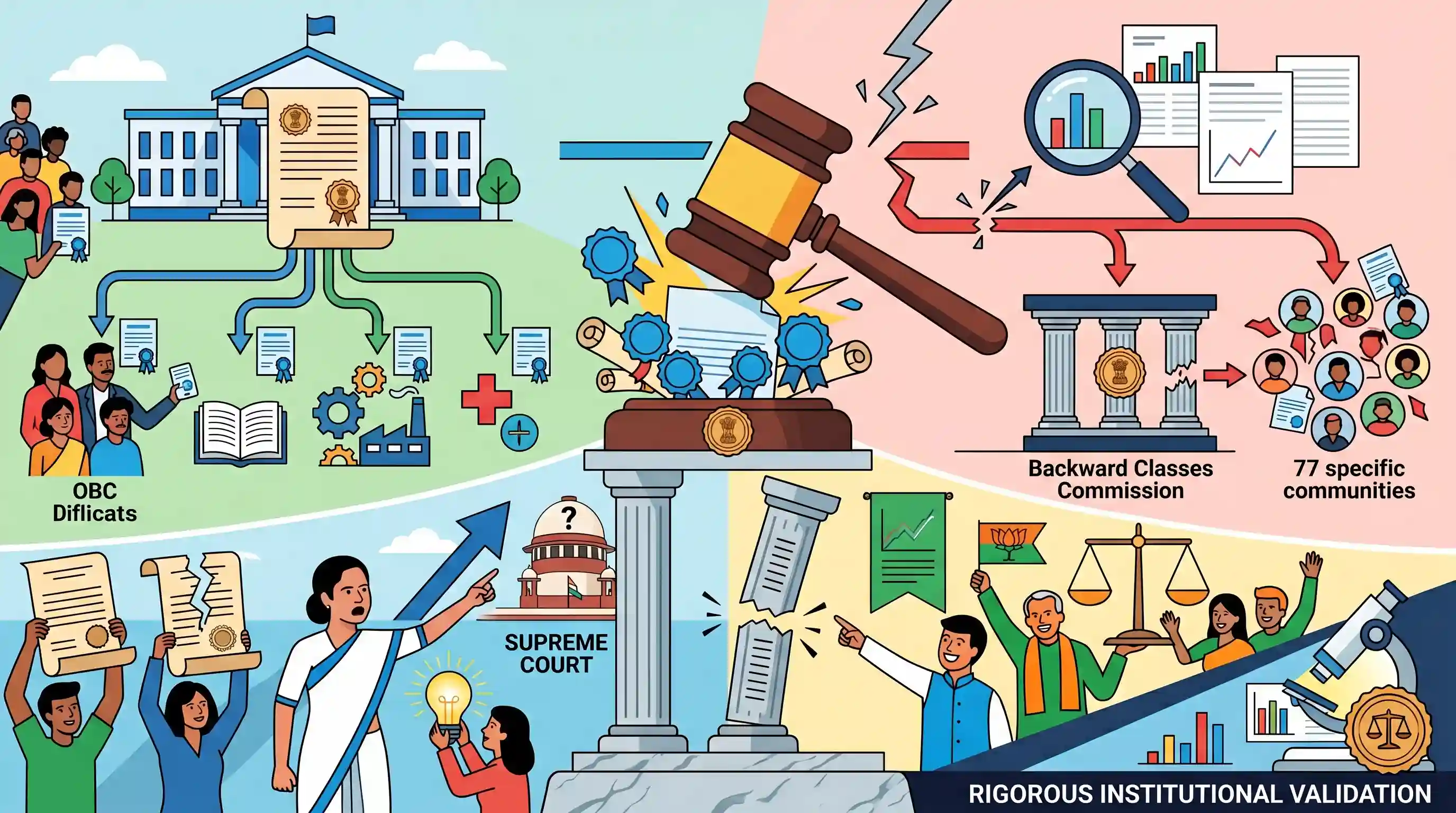
The Calcutta High Court recently struck down the Other Backward Classes (OBC) status of 77 communities in West Bengal, effectively cancelling nearly 5 lakh OBC certificates issued after 2010 under the state's 2012 Backward Classes Act. The court ruled that the state government included these groups—predominantly from the Muslim community—without the mandatory empirical data or recommendations from the Backward Classes Commission. The BJP welcomed the verdict, arguing the previous list was an act of political appeasement that deprived genuine OBCs of their rights. Conversely, Chief Minister Mamata Banerjee defended the classification process as constitutionally sound and stated her government would not accept the order, signaling a likely appeal to the Supreme Court. The judgment reinforces the legal principle that affirmative action requires rigorous institutional validation.
Key Points
- The Calcutta High Court cancelled the OBC status of 77 classes in West Bengal, voiding nearly 5 lakh OBC certificates issued since 2010.
- The court found that the state government bypassed the statutory Backward Classes Commission and failed to provide quantifiable empirical data proving social and educational backwardness.
- A significant majority of the classes struck down belonged to the Muslim community, prompting the BJP to allege that the inclusions were driven by political appeasement rather than constitutional criteria.
- Chief Minister Mamata Banerjee rejected the court's verdict, claiming the state conducted proper surveys and followed the Constitution, and announced plans to challenge the order.
- The ruling underscores the stringent constitutional mandate that reservation policies under Articles 15 and 16 require objective assessment by designated commissions and cannot be arbitrary.
Important Terms
West Bengal Backward Classes Act, 2012

State legislation providing reservation in public employment. The Calcutta High Court struck down several of its provisions for bypassing the mandatory consultative role of the Backward Classes Commission.
UPSC context
GS Paper II: Statutory bodies and reservation policies. Tests understanding of legislative competence vs judicial oversight in affirmative action.
Backward Classes Commission
A statutory or constitutional body (Art 338B) tasked with identifying backward classes. Its recommendations are mandatory for the inclusion or exclusion of communities in reservation lists.
UPSC context
GS Paper II: Constitutional and statutory bodies. Tests knowledge of institutional safeguards for vulnerable sections.
Judicial Review
The power of courts to examine the constitutionality of legislative and executive acts. It ensures reservation policies adhere to the 'twin tests' of backwardness and inadequate representation.
UPSC context
GS Paper II: Separation of powers and the Judiciary. A core concept for evaluating the limits of state power.
Indra Sawhney Case
Landmark 1992 Supreme Court judgment that capped total reservation at 50%, introduced the 'creamy layer' concept, and mandated empirical data for identifying backwardness.
UPSC context
GS Paper II: Landmark judgments. The foundational legal precedent for all reservation-related litigation in India.
Other Backward Classes (OBC)
Socially and educationally backward communities eligible for 27% reservation in central services. State-specific lists are determined based on region-specific socio-economic data.
UPSC context
GS Paper I & II: Social justice and welfare schemes. Tests understanding of social stratification and affirmative action.
Article 16(4)
Constitutional provision enabling the State to make reservations in appointments for any backward class of citizens not adequately represented in the services under the State.
UPSC context
GS Paper II: Fundamental Rights. Essential for explaining the constitutional basis and legal limits of reservation in public employment.
Prelims Trap
Religious minority communities cannot be included in State OBC lists as it violates secularism and Article 15.
This is false. Minority communities can be granted OBC status based on socio-educational backwardness and inadequate representation; they simply cannot be classified solely on the basis of religion.
Static Concepts Connected
What is the constitutional framework for States to identify Backward Classes?
- 105th Amendment (2021): Restored the power of State governments to identify and maintain their own list of Socially and Educationally Backward Classes (SEBCs).
- Article 342A(3): Empowers states and UTs to maintain a separate SEBC list from the Central list strictly for state-level reservations.
- Article 16(4) mandate: Enables state reservations, but requires objective, quantifiable empirical data proving backwardness and inadequate representation (Indra Sawhney case).
What is the role of Backward Classes Commissions in reservation policies?
- Article 338B status: The 102nd Amendment granted constitutional status to the NCBC, shifting it from a statutory body to a constitutional one.
- Mandatory Consultation: Governments must consult these commissions for inclusions/exclusions to ensure objective socio-educational criteria replace arbitrary political classification.
Cross-Topic Patterns
OBC Sub-categorization & Rohini Commission
Judicial insistence on quantifiable data for state OBC lists directly mirrors the mandate of the Justice G. Rohini Commission regarding the equitable sub-categorization of Central OBC quotas.
Judicial Review vs. Welfare Populism
Mirrors the broader trend of courts striking down state quota expansions (like Maratha or Jat quotas) for failing to provide empirical data or breaching the 50% ceiling established in Indra Sawhney.

Expect a multi-statement question linking the 105th Amendment's restoration of State SEBC lists with Article 16(4) empirical data rules.
Linked PYQs · 4
Linked PYQs · 4
- 2023PrelimsGS1
Consider the following organizations/bodies in India: 1. The National Commission for Backward Classes 2. The National Human Rights Commission 3. The National Law Commission 4. The National Consumer Disputes Redressal Commission How many of the above are constitutional bodies?
- 2023PrelimsGS1
Consider the following statements: Statement-I: The Supreme Court of India has held in some judgements that the reservation policies made under Article 16(4) of the Constitution of India would be limited by Article 335 for maintenance of efficiency of administration. Statement-II: Article 335 of the Constitution of India defines the term 'efficiency of administration'. Which one of the following is correct in respect of the above statements?
- 2022MainsGS2
Discuss the role of the National Commission for Backward Classes in the wake of its transformation from a statutory body to a constitutional body.
- 2023MainsGS2
“Development and welfare schemes for the vulnerable, by its nature, are discriminatory in approach.” Do you agree? Give reasons for your answer.
