Anti-Defection Law Context of Political Defections in State Politics
Source:Indian Express ↗
Why It Matters
High-profile political defections and realignments serve as practical case studies for UPSC aspirants to understand the nuances of the Anti-Defection Law (Tenth Schedule), the discretionary powers of the Speaker, and the broader dynamics of state politics and regional parties in India's federal democratic setup.
Summary
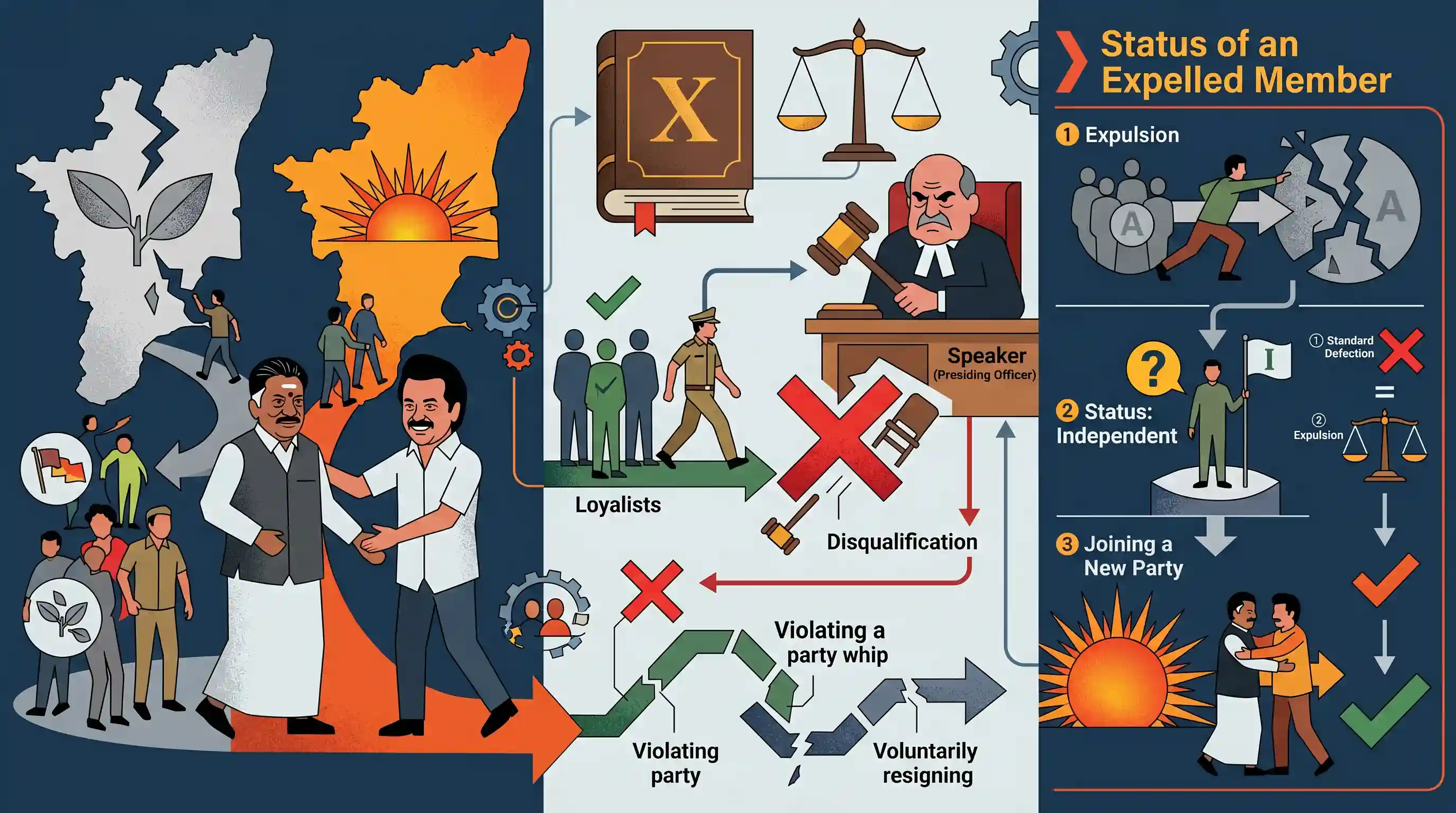
Former Tamil Nadu Chief Minister and ousted AIADMK leader O Panneerselvam has formally joined the ruling DMK in the presence of Chief Minister MK Stalin. This prominent crossover highlights the evolving political realignments in Tamil Nadu and brings into focus the constitutional intricacies of the Tenth Schedule (Anti-Defection Law), particularly concerning the legislative status of a member who has been expelled from their original party prior to joining a new one.
Key Points
- Former Tamil Nadu Chief Minister O Panneerselvam officially joined the ruling DMK party in the presence of CM MK Stalin.
- Panneerselvam had previously been expelled from the AIADMK, navigating a complex political transition.
- The event highlights the continuous realignment in Tamil Nadu state politics and the changing dynamics between major Dravidian parties.
- Such political crossovers frequently invoke debates surrounding the Tenth Schedule (Anti-Defection Law) of the Constitution, particularly regarding the status of expelled lawmakers joining a new party.
Important Terms
Tenth Schedule (Anti-Defection Law)

Added by the 52nd Amendment (1985), this schedule provides for the disqualification of MPs and MLAs on grounds of defection, aimed at ensuring political stability and party discipline.
UPSC context
GS Paper II: Essential for topics on Parliament, State Legislatures, and the integrity of democratic institutions.
Dravida Munnetra Kazhagam (DMK)
A major regional party in Tamil Nadu founded by C.N. Annadurai in 1949. It advocates for social justice, state autonomy, and Dravidian identity, currently leading the state government.
UPSC context
GS Paper II: Significant for studying regional parties, federalism, and the evolution of Dravidian politics.
All India Anna Dravida Munnetra Kazhagam (AIADMK)
A regional party in Tamil Nadu formed by M.G. Ramachandran in 1972 after splitting from the DMK. It has historically focused on welfare schemes and a strong central outlook.
UPSC context
GS Paper II: Relevant for understanding factionalism in regional parties and their impact on state governance.
91st Constitutional Amendment Act, 2003
This 2003 amendment strengthened the Tenth Schedule by removing the 'split' exception (1/3rd members) and limiting the size of the Council of Ministers to 15% of the House strength.
UPSC context
GS Paper II: Tests knowledge of constitutional amendments aimed at curbing executive overreach and political instability.
Presiding Officer (Speaker/Chairman)
The final authority for deciding disqualification under the Tenth Schedule. Their decisions are subject to judicial review for mala fide intent as per the Kihoto Hollohan case.
UPSC context
GS Paper II: Critical for topics on the impartiality of constitutional offices and the separation of powers.
Expelled Member Status
Under the Tenth Schedule, an expelled member is still treated as belonging to their original party. Joining another party can be deemed 'voluntarily giving up membership,' leading to disqualification.
UPSC context
GS Paper II: Tests understanding of legal nuances and Supreme Court interpretations like the G. Viswanathan case.
Prelims Trap
An expelled legislator is treated as an independent and is immune from Tenth Schedule disqualification if they join a new party.
Under the SC's G. Viswanathan ruling (1996), an expelled member remains legally tied to their original party under the Tenth Schedule. Joining another party triggers disqualification.
Static Concepts Connected
How does the Tenth Schedule treat expelled legislators?
- G. Viswanathan ruling: The Supreme Court held that an expelled member continues to legally belong to their original political party for the purposes of the Tenth Schedule.
- Disqualification trigger: If an expelled member subsequently joins another political party, they attract disqualification for 'voluntarily giving up membership' of their original party.
How did the 91st Constitutional Amendment Act (2003) change the Anti-Defection Law?
- Split provision removed: It completely omitted the provision that previously protected legislators from disqualification if a 'split' by at least one-third of the legislature party occurred.
- Merger threshold: Currently, exemption from disqualification is only permitted if a party 'merges' with another, provided at least two-thirds of its legislative party members agree.
- Council size capped: The amendment simultaneously capped the total size of the Council of Ministers (including the PM/CM) at 15% of the total strength of the Lower House.
Cross-Topic Patterns
Speaker's Defection powers vs ECI's Symbol allocation
While the Speaker exclusively decides Tenth Schedule defection matters, the Election Commission independently adjudicates which faction retains the official party symbol under the Election Symbols (Reservation and Allotment) Order, 1968.
Judicial review of the Speaker's inaction
Stemming from the Kihoto Hollohan (1992) ruling, the Supreme Court has increasingly intervened to compel Speakers to decide defection petitions within a reasonable timeframe (typically 3 months), curbing partisan delays.

Prelims 2026 will likely test the contrasting Tenth Schedule rules for an 'expelled member' versus a 'nominated member' joining a party.
Linked PYQs · 3
Linked PYQs · 3
- 2014PrelimsGS1
Which one of the following Schedules of the Constitution of India contains provisions regarding anti-defection?
- 2025PrelimsGS1
Consider the following statements : I. If any question arises as to whether a Member of the House of the People has become subject to disqualification under the 10th Schedule, the President's decision in accordance with the opinion of the Council of Union Ministers shall be final. II. There is no mention of the word 'political party' in the Constitution of India. Which of the statements given above is/are correct?
- 2023MainsGS2
Discuss the role of Presiding Officers of state legislatures in maintaining order and impartiality in conducting legislative work and in facilitating best democratic practices.
