Rule of Law Crucial for Economic Growth and Level Playing Field
Source:Indian Express ↗
આ શા માટે મહત્વનું છે
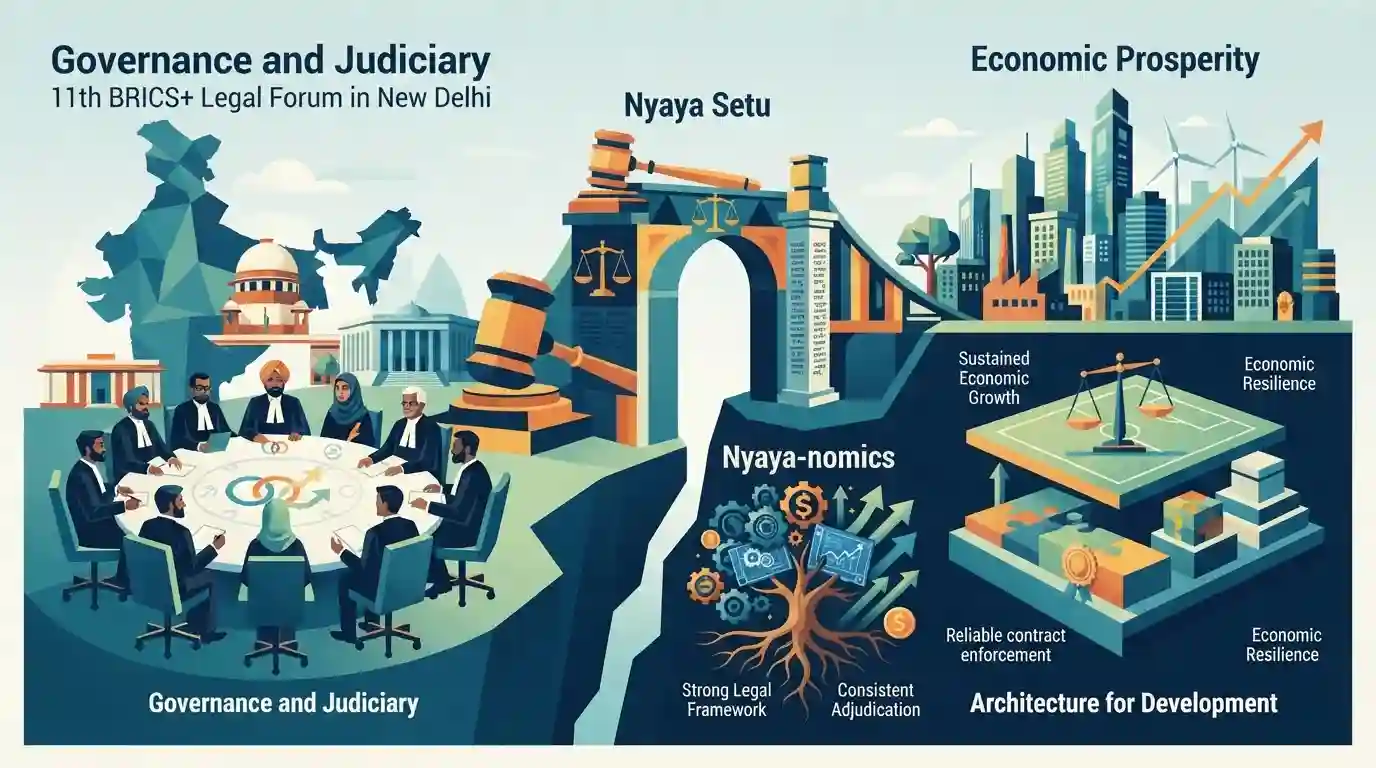
The concept of 'Nyaya-nomics' bridges GS2 (Judiciary/Governance) and GS3 (Economy), underscoring how contract enforcement, institutional capacity, and the rule of law are prerequisites for economic growth and attracting investment. Additionally, the BRICS+ Legal Forum highlights India's engagement in multilateral platforms.
સારાંશ
Speaking at the 11th BRICS+ Legal Forum in New Delhi, Supreme Court judge Justice Surya Kant coined the terms "Nyaya-nomics" (economics of justice) and "Nyaya Setu" (bridge of justice) to highlight the critical intersection between law and economic prosperity. He asserted that a strong legal framework, consistent adjudication, and reliable enforcement of commitments are indispensable for sustained economic growth. Moving beyond natural resources and geographic advantages, Justice Kant emphasized that the rule of law and institutional capacity serve as the permanent "architecture" for development, ensuring a level playing field for economic resilience.
મુખ્ય મુદ્દા
- Supreme Court judge Justice Surya Kant addressed the 11th BRICS+ Legal Forum, introducing the concepts of "Nyaya-nomics" (economics of justice) and "Nyaya Setu" (bridge of justice).
- He emphasized that reliable contract enforcement, consistent adjudication, and legal predictability are critical drivers of long-term economic growth.
- While natural resources and geography provide early advantages, sustained prosperity requires a robust rule of law to ensure a level playing field.
- Institutions and a strong legal framework act as the foundational "architecture" of economic development, rather than just temporary "scaffolding".
મહત્વપૂર્ણ શબ્દો
BRICS+ Legal Forum

A high-level legal diplomacy platform facilitating cooperation, professional exchange, and legal alignment among BRICS+ member nations to support cross-border dispute resolution and economic integration.
UPSC context
GS Paper II: Bilateral/Global groupings. Tests mechanisms of international judicial cooperation, dispute resolution, and cross-border trade framework.
Supreme Court of India
The apex judicial authority established under Article 124 of the Indian Constitution, acting as the ultimate court of appeal, protector of fundamental rights, and final interpreter of the Constitution.
UPSC context
GS Paper II: Structure, organization, and functioning of the Judiciary. Tests judicial review, constitutional interpretation, and landmark verdicts.
Nyaya-nomics
A term coined by Chief Justice Surya Kant referring to the "economics of justice," emphasizing that consistent, predictable judicial adjudication reduces transaction costs and forms the foundational architecture for sustained economic growth.
UPSC context
GS Paper II & III: Judicial & Economic Development. Tests understanding of rule of law, institutional trust, and ease of doing business.
Nyaya Setu
A conceptual "bridge of justice" proposed to systematically connect the diverse legal traditions of BRICS+ countries, establishing collaborative frameworks for shared jurisprudence and deliberate, structured judicial cooperation.
UPSC context
GS Paper II: International Relations/Judiciary. Tests mechanisms for global legal harmonisation, cross-border dispute resolution, and mutual diplomatic trust.
Rule of Law
A constitutional principle wherein all citizens, institutions, and state entities are accountable to publicly promulgated, equally enforced laws that are independently and fairly adjudicated.
UPSC context
GS Paper II: Indian Polity & Governance. Tests basic structure of the Constitution, judicial oversight, and democratic governance frameworks.
પ્રિલિમ્સ ટ્રેપ
"Nyaya-nomics is a concept introduced by the Economic Survey to quantify the economic cost of judicial pendency."
Because of the "-nomics" suffix, aspirants may assume it is a Finance Ministry/Economic Survey term. It was actually coined by the CJI at a BRICS legal forum.
સંલગ્ન સ્થિર ખ્યાલો
How is Alternate Dispute Resolution (ADR) statutorily recognized in India?
- Arbitration & Conciliation: Governed by the Arbitration and Conciliation Act, 1996; arbitral awards are generally binding on parties.
- Mediation Act: Formalized under the Mediation Act, 2023, promoting collaborative settlement before or during litigation.
- Lok Adalats: Granted statutory status under the Legal Services Authorities Act, 1987 to facilitate amicable dispute resolution.
What are the recent expansions defining the BRICS+ grouping?
- Original Five: Brazil, Russia, India, China, and South Africa form the core foundation of the bloc.
- 2024 Expansion: Egypt, Ethiopia, Iran, and the UAE were officially admitted as full members in January 2024.
- 2025 Addition: Indonesia officially joined the grouping in January 2025, bringing the total number of full members to 11.
આંતર-વિષય પેટર્ન
ADR complementing Ease of Doing Business
Delays in contract enforcement directly hurt foreign investment. Initiatives like the BRICS Arbitration Centre connect India's judicial reform goals with broader Ease of Doing Business (EoDB) targets.
BRICS institutionalizing the Global South
A BRICS Arbitration Centre aligns with the New Development Bank (NDB) and Contingent Reserve Arrangement (CRA) in creating alternative, non-Western multilateral institutions for the Global South.

Prelims will likely test BRICS+ expansion (Indonesia's 2025 entry) paired with non-financial initiatives like the BRICS Arbitration Centre.
સંલગ્ન PYQ · 3
સંલગ્ન PYQ · 3
- 2025MainsGS2
Comment on the need of administrative tribunals as compared to the court system. Assess the impact of the recent tribunal reforms through rationalization of tribunals made in 2021.
- 2012MainsGS2
Compare the significance of IBSA and BRICS in the context of India's multilateral diplomacy.
- 2025PrelimsGS1
Consider the following statements with regard to BRICS : I. 16th BRICS Summit was held under the Chairship of Russia in Kazan. II. Indonesia has become a full member of BRICS. III. The theme of the 16th BRICS Summit was Strengthening Multiculturalism for Just Global Development and Security. Which of the statements given above is/are correct?
