Impact of US Export Controls on AI Chips to China
Source:The Hindu ↗
Why It Matters
The article illustrates the unintended consequences of technology export controls and underscores the strategic importance of semiconductor self-reliance—a critical insight for India's own ambitions under the India Semiconductor Mission to build a robust domestic electronics supply chain.
Summary
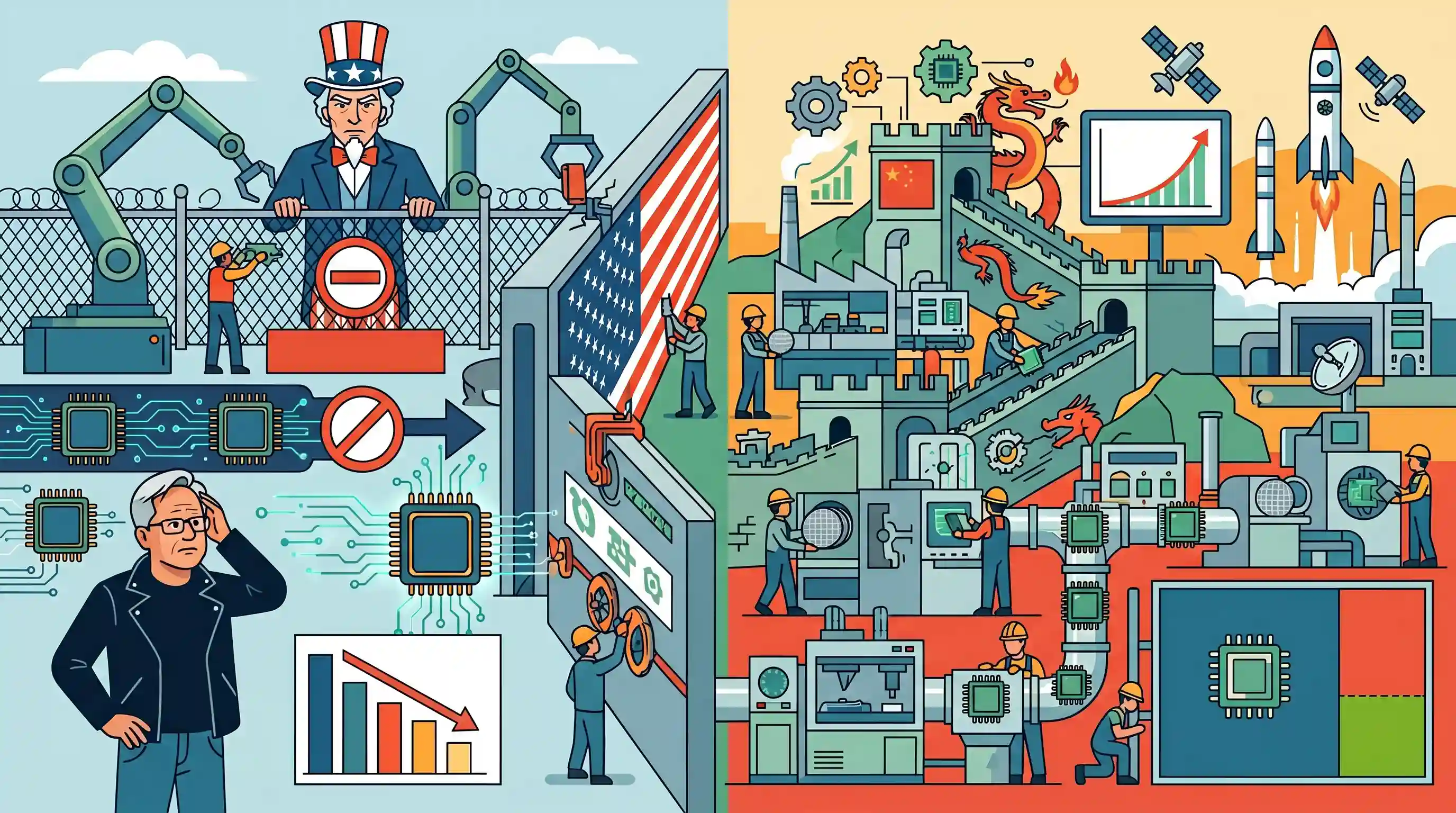
Nvidia CEO Jensen Huang stated that US export controls designed to restrict China's access to advanced AI chips have ultimately failed. Rather than stifling Chinese capabilities, the restrictions have accelerated China's drive for technological self-reliance, leading to the rapid development of indigenous semiconductor supply chains and causing a significant drop in Nvidia's market share in the region.
Key Points
- Nvidia's market share for advanced AI chips in China plummeted from 95% to under 50% following strict US export restrictions.
- US export controls aimed to prevent China from accessing cutting-edge technology for AI development, but instead spurred a massive drive for indigenous innovation in China.
- Chinese tech companies, notably Huawei with its Ascend AI chips, have rapidly developed competing domestic semiconductor supply chains.
- The technological decoupling is causing friction in bilateral trade talks and highlights the geopolitical race for AI supremacy.
Important Terms
US export controls

Strategic trade regulations, primarily under the Export Administration Regulations (EAR), used by the US to restrict China's access to advanced semiconductors and manufacturing equipment for national security reasons.
UPSC context
GS II (International Relations) & GS III (Technology policy); tests knowledge of trade wars and technology-led diplomacy.
Semiconductors
Silicon-based integrated circuits that serve as the fundamental building blocks of AI and modern electronics. They are critical strategic assets in global geoeconomic competition.
UPSC context
GS III (Science & Tech); essential for topics on Indigenization of Technology and the India Semiconductor Mission.
Huawei
A Chinese telecommunications and AI giant that acts as a 'national champion' for China's technological self-reliance, developing domestic alternatives (e.g., Ascend chips) to Western-controlled supply chains.
UPSC context
GS III (Internal Security); relevant to discussions on 5G security, indigenous development, and global tech rivalry.
Technological Indigenisation
The process of developing, designing, and manufacturing advanced technologies domestically to replace foreign imports and ensure strategic autonomy in critical sectors like defense and AI.
UPSC context
GS III (Indigenization of Technology); tests understanding of Atmanirbhar Bharat and the reduction of strategic import dependency.
Dual-use Technology
Goods or software, such as high-end GPUs, that have both legitimate commercial applications and potential military or intelligence-gathering uses, often making them targets for export restrictions.
UPSC context
GS II (International Relations); linked to global regimes like the Wassenaar Arrangement and strategic trade control frameworks.
Prelims Trap
"US semiconductor export controls on China are mandated by the Wassenaar Arrangement."
These are unilateral US measures under its domestic Export Administration Regulations (EAR), not multilateral mandates. Wassenaar is a voluntary regime, not a binding treaty.
Static Concepts Connected
What are the three key stages of the global semiconductor manufacturing value chain?
- Design Phase: Involves creating the chip architecture (e.g., Nvidia, ARM). Highly R&D intensive and historically dominated by companies in the United States.
- Fabrication (Foundry): The complex physical manufacturing of chips on silicon wafers. Dominated globally by specialized foundries in Taiwan (TSMC) and South Korea.
- ATMP / OSAT: Assembly, Testing, Marking, and Packaging. Less capital-intensive than fabrication; currently a primary entry-point focus for the India Semiconductor Mission (ISM).
What is the Wassenaar Arrangement and its relevance to technology controls?
- Core Mandate: A multilateral export control regime promoting transparency and responsibility in transfers of conventional arms and dual-use goods and technologies (including advanced electronics).
- Membership Status: India was admitted as the 42nd participating state in 2017. Notably, China is not a member of this arrangement.
Cross-Topic Patterns
Tech denial as an indigenisation catalyst
Similar to how the historical denial of cryogenic technology accelerated India's indigenous space program, current US semiconductor bans are rapidly driving China toward end-to-end hardware sovereignty.
Chip wars and critical mineral weaponisation
US semiconductor export controls directly triggered Chinese retaliation in global supply chains, specifically targeted export restrictions on critical chip-making minerals like Gallium and Germanium.

Dual-use AI chips, unilateral tech embargoes, and the Wassenaar Arrangement will likely combine into a multi-statement Prelims question.
Linked PYQs · 3
Linked PYQs · 3
- 2025MainsGS3
India aims to become a semiconductor manufacturing hub. What are the challenges faced by the semiconductor industry in India? Mention the salient features of the India Semiconductor Mission.
- 2021MainsGS2
“The USA is facing an existential threat in the form of a China, that is much more challenging than the erstwhile Soviet Union.” Explain.
- 2020PrelimsGS1
With the present state of development, Artificial Intelligence can effectively do which of the following? 1. Bring down electricity consumption in industrial units 2. Create meaningful short stories and songs 3. Disease diagnosis 4. Text-to-Speech Conversion 5. Wireless transmission of electrical energy Select the correct answer using the code given below:
