US Export Controls on AI Chips and Geopolitical Technology Wars
Source:The Hindu ↗
Why It Matters
It highlights the geopolitical weaponisation of critical technologies like AI and semiconductors. Understanding these global supply chain disruptions and trade wars is crucial for evaluating India's strategic push to become a semiconductor manufacturing hub and self-reliant in advanced computing.
Summary
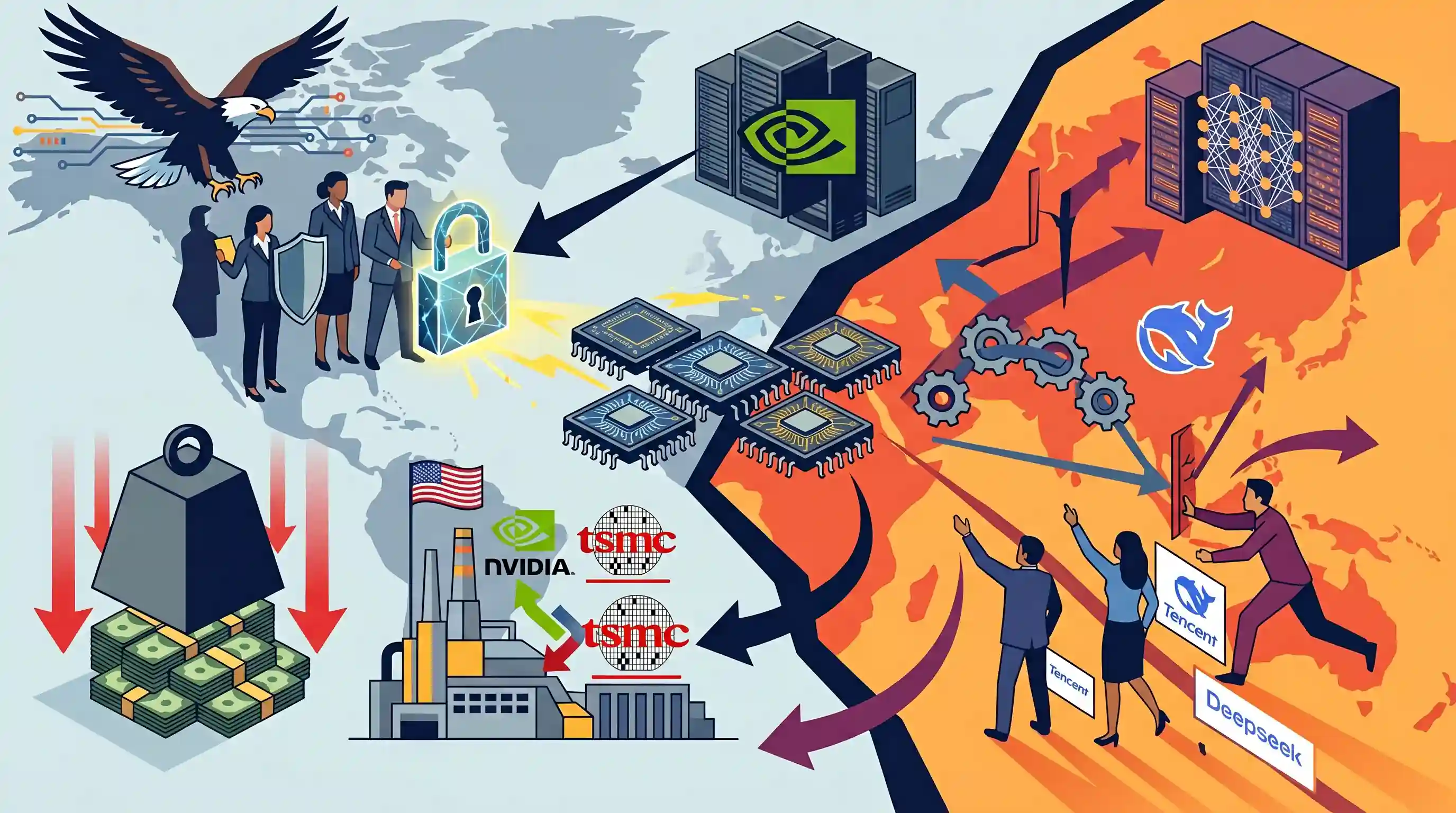
Nvidia faces a $5.5 billion charge following the U.S. government's decision to restrict exports of its H20 artificial intelligence chip to China. The U.S. Commerce Department introduced these export controls citing national security concerns, specifically the risk that the chips' high-speed connectivity could be used to build advanced supercomputers by Chinese firms like Tencent and DeepSeek. Simultaneously, Nvidia is aligning with the U.S. push for domestic manufacturing by planning a massive investment in local AI server production in partnership with TSMC, underscoring the intensifying US-China technology and trade war.
Key Points
- The U.S. Commerce Department imposed new licensing requirements indefinitely restricting the export of Nvidia's H20 and AMD's MI308 AI chips to China.
- Nvidia incurred a $5.5 billion charge linked to inventory and purchase commitments for the H20 chip, which had seen heavy demand from Chinese tech giants like Tencent, Alibaba, and ByteDance.
- The restrictions aim to prevent China from using the H20's high-speed connectivity and memory capabilities to build advanced supercomputers, thereby safeguarding U.S. national and economic security.
- In parallel, Nvidia plans to build AI servers worth up to $500 billion in the U.S. over the next four years with TSMC, aligning with the U.S. administration's push for domestic manufacturing.
Important Terms
Export Controls

Regulatory measures used by governments to restrict the sale or transfer of specific technologies, such as AI chips, to foreign nations for national security reasons.
UPSC context
Relevant for GS Paper 2 (International Relations) and GS Paper 3 (Science & Technology); focuses on trade diplomacy and technology sovereignty.
US-China Tech War
The strategic geopolitical and economic competition between the United States and China for leadership in emerging technologies like artificial intelligence, semiconductors, and 5G.
UPSC context
Important for GS Paper 2 (Global Geopolitics) and the impact of major powers' policies on India’s interests.
Semiconductors
The fundamental building blocks of modern electronics; global supply chain disruptions and "chip diplomacy" make them a focal point of national security and economic policy.
UPSC context
Tests knowledge of industrial policy (GS Paper 3) and India's Semicon India Mission for domestic self-reliance.
Bureau of Industry and Security (BIS)
The agency within the U.S. Department of Commerce that manages export controls on dual-use items to safeguard national security and economic interests.
UPSC context
Significant for GS Paper 2 as an example of regulatory frameworks that shape international trade and security dynamics.
TSMC (Taiwan Semiconductor Manufacturing Company)
A Taiwanese company that is the world’s largest contract chip manufacturer, essential for the production of advanced AI processors used by Nvidia and Apple.
UPSC context
Crucial for GS Paper 3 (Supply Chain Resilience) and understanding the "silicon shield" in Indo-Pacific geopolitics.
DeepSeek
A prominent Chinese AI company whose high-efficiency models (like DeepSeek-V3) have intensified concerns regarding the effectiveness of U.S. restrictions on advanced computing hardware.
UPSC context
GS Paper 3 topic on developments in Artificial Intelligence and international competition in frontier technology.
Institute for Progress (IFP)
A Washington-based think tank that provides policy recommendations on scientific and industrial progress, specifically influencing U.S. decisions on AI export control enforcement.
UPSC context
Example of how non-state actors and think tanks influence international policy frameworks (GS Paper 2).
Prelims Trap
"The WTO strictly prohibits countries from imposing unilateral export bans on technology products under all circumstances."
GATT Article XXI (Security Exception) allows countries to bypass WTO obligations and impose unilateral export controls if necessary to protect essential national security interests.
Static Concepts Connected
What are Dual-Use Technologies and how are they regulated?
- Definition: Products, software, or tech (like advanced AI chips) that have both civilian and military applications.
- Wassenaar Arrangement: A multilateral export control regime (India is a member) promoting transparency and responsibility in the transfer of conventional arms and dual-use goods.
- SCOMET List: India's regulatory framework (Special Chemicals, Organisms, Materials, Equipment, and Technologies) which aligns with global regimes to regulate dual-use exports.
What are the three core stages of the semiconductor manufacturing supply chain?
- Design: The R&D phase creating the integrated circuit architecture. "Fabless" companies like Nvidia and AMD specialize exclusively in this stage.
- Fabrication (Fabs): The capital-intensive physical manufacturing process where circuits are printed onto silicon wafers. TSMC is the dominant global player.
- OSAT / ATMP: Outsourced Semiconductor Assembly and Test; the final phase where manufactured chips are packaged, tested, and prepped for integration into electronics.
Cross-Topic Patterns
Tech Decoupling and US-India iCET
The US-China tech war accelerates "friend-shoring", elevating the US-India Initiative on Critical and Emerging Technology (iCET) to secure semiconductor supply chains, AI infrastructure, and bypass geopolitical adversaries.
Semiconductors & Critical Mineral Geopolitics
US chip export controls frequently trigger retaliatory measures, such as China's export restrictions on gallium and germanium—critical minerals that are indispensable for semiconductor fabrication and electronics.

Expect a multi-statement prelims question linking dual-use tech export regimes (Wassenaar) with semiconductor supply chains (OSAT/Fabs).
Linked PYQs · 4
Linked PYQs · 4
- 2025MainsGS3
India aims to become a semiconductor manufacturing hub. What are the challenges faced by the semiconductor industry in India? Mention the salient features of the India Semiconductor Mission.
- 2023MainsGS3
Introduce the concept of Artificial Intelligence (AI). How does Al help clinical diagnosis? Do you perceive any threat to privacy of the individual in the use of Al in healthcare?
- 2021MainsGS2
“The USA is facing an existential threat in the form of a China, that is much more challenging than the erstwhile Soviet Union.” Explain.
- 2018MainsGS2
What are the key areas of reform if the WTO has to survive in the present context of "Trade War', especially keeping in mind the interest of India?
