India Artificial Intelligence Summit and Semiconductor Ecosystem Goals
Source:Indian Express ↗
Why It Matters
The India AI Impact Summit highlights India's strategic push towards becoming a global hub for artificial intelligence and semiconductor manufacturing. Nvidia's involvement underscores the importance of global technology partnerships in building robust digital infrastructure and framing AI governance policies.
Summary
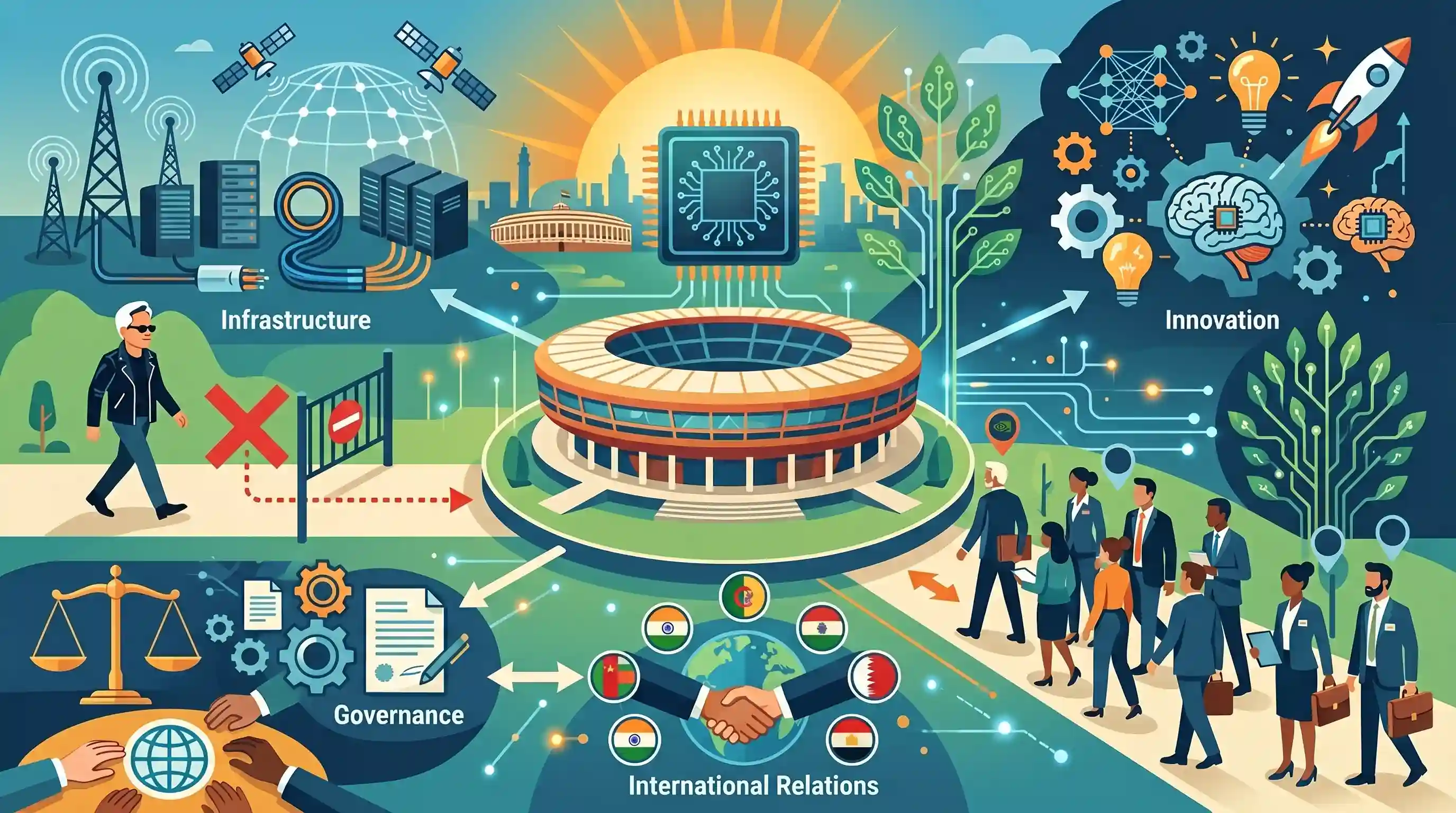
Nvidia CEO Jensen Huang has cancelled his visit to the India AI Impact Summit 2026 in New Delhi due to unforeseen circumstances. Despite his absence, Nvidia remains committed to India's AI ecosystem and will send a senior delegation led by Executive Vice President Jay Puri. The summit, scheduled for February 16-20 at Bharat Mandapam, is a major event focusing on long-term AI governance, infrastructure, and innovation, reflecting India's growing ambitions in semiconductor capabilities and artificial intelligence.
Key Points
- Nvidia CEO Jensen Huang cancelled his planned visit to the India AI Impact Summit 2026 citing unforeseen circumstances.
- A senior Nvidia delegation led by Executive VP Jay Puri will attend the summit in his place.
- The AI Impact Summit 2026, held in New Delhi, aims to discuss long-term AI governance objectives and foster global collaboration.
- India is increasingly focusing on building AI infrastructure, semiconductor capabilities, and homegrown large language models.
Important Terms
India AI Impact Summit 2026

A landmark 2026 summit in New Delhi focusing on AI democratization and developmental impact. It is the first global AI summit hosted in the Global South, emphasizing the "People, Planet, Progress" framework.
UPSC context
GS Paper 3 (S&T). Tests India's leadership in global technology governance and its advocacy for Global South interests in digital infrastructure.
Bletchley Declaration
The first international agreement (2023) on AI safety, signed by 28 countries including India. it addresses risks posed by "frontier AI" through shared understanding and international cooperation.
UPSC context
GS Paper 2 (International Relations) & GS 3 (S&T). Focuses on global regulatory frameworks and ethics in emerging technologies.
IndiaAI Mission
A national program with a ₹10,300 crore outlay to build sovereign AI infrastructure, including compute capacity (GPUs), datasets, and indigenous frontier models to foster a robust domestic startup ecosystem.
UPSC context
GS Paper 3 (Economic Development/S&T). Crucial for topics on digital sovereignty, technological self-reliance, and high-performance computing (HPC).
India Semiconductor Mission (ISM)
A specialized nodal agency under the Digital India Corporation that oversees the ₹76,000 crore incentive scheme to establish a sustainable semiconductor and display manufacturing ecosystem in India.
UPSC context
GS Paper 3 (Industrial Policy/S&T). Relevant for "Atmanirbhar Bharat" and India's position in the global electronics supply chain.
Ministry of Electronics and Information Technology (MeitY)
The nodal Union Ministry responsible for formulating and implementing policies related to information technology, electronics manufacturing, and digital governance in India.
UPSC context
GS Paper 2 (Governance/Policies). Tests knowledge of the institutional framework driving India's digital and technological missions.
Nvidia
A global leader in GPUs and AI computing that serves as a critical strategic partner for India’s compute infrastructure and national AI-driven industrial transformation.
UPSC context
GS Paper 3 (S&T). Illustrates the impact of private-sector partnerships and global supply chains on national technology goals.
Prelims Trap
The national Artificial Intelligence compute grid is fully state-owned and operated by MeitY.
The compute grid under the India AI Mission is being established under a public-private partnership (PPP) model, not exclusive government ownership.
Static Concepts Connected
What is "Sovereign AI" and how is India building its compute capacity?
- Sovereign AI: Developing domestic AI foundational models using local datasets and indigenous infrastructure to reduce reliance on foreign cloud providers.
- National Compute Grid: The India AI Mission aims to establish a GPU-based computational network via a public-private partnership to democratize access for startups.
- Project BHASHINI: An AI-powered public digital platform utilizing Natural Language Processing (NLP) to break language barriers and foster localized language models.
What are the key focus areas of the GPAI New Delhi Declaration?
- Trustworthy AI Framework: Advocates for a balanced global AI framework that promotes innovation while actively mitigating risks like algorithmic bias and privacy violations.
- Sectoral Priority: Specifically highlights and prioritizes the integration of AI solutions into critical socio-economic sectors like agriculture.
Cross-Topic Patterns
Semiconductors & Strategic Autonomy
AI compute relies on advanced hardware. India's AI ambitions are deeply intertwined with the India Semiconductor Mission (ISM), which offers 50% capital subsidies to localize fabrication and reduce import reliance.
AI as the next DPI layer
Sovereign AI projects like BHASHINI will serve as the AI layer for existing Digital Public Infrastructure (DPI), enabling voice-driven, localized access to platforms like UPI and ONDC.

Expect a multi-statement Prelims question linking the PPP model of the AI Compute Grid with BHASHINI and GPAI's New Delhi Declaration.
Linked PYQs · 5
Linked PYQs · 5
- 2020PrelimsGS1
With the present state of development, Artificial Intelligence can effectively do which of the following? 1. Bring down electricity consumption in industrial units 2. Create meaningful short stories and songs 3. Disease diagnosis 4. Text-to-Speech Conversion 5. Wireless transmission of electrical energy Select the correct answer using the code given below:
- 2025PrelimsGS1
Consider the following statements: I. It is expected that Majorana 1 chip will enable quantum computing. II. Majorana 1 chip has been introduced by Amazon Web Services (AWS). III. Deep learning is a subset of machine learning. Which of the statements given above are correct?
- 2018PrelimsGS1
When the alarm of your smartphone rings in the morning, you wake up and tap it to stop the alarm which causes your geyser to be switched on automatically. The smart mirror in your bathroom shows the day's weather and also indicates the level of water in your overhead tank. After you take some groceries from your refrigerator for making breakfast, it recognises the shortage of stock in it and places an order for the supply of fresh grocery items. When you step out of your house and lock the door, all lights, fans, geysers and AC machines get switched off automatically. On your way to office, your car warns you about traffic congestion ahead and suggests an alternative route, and if you are late for a meeting, it sends a message to your office accordingly. In the context of emerging communication technologies, which one of the following terms best applies to the above scenario ?
- 2021MainsGS3
Discuss how emerging technologies and globalisation contribute to money laundering. Elaborate measures to tackle the problem of money laundering both at national and international levels.
- 2025MainsGS2
India-Africa digital partnership is achieving mutual respect, co-development and long-term institutional partnerships. Elaborate.
