Nvidia and semiconductor export controls in US China tech war
Source:The Hindu ↗
Why It Matters
For UPSC aspirants, this issue perfectly illustrates the intersection of geopolitics, economics, and emerging technologies. It is crucial for understanding GS2 topics like US-China rivalry and global groupings, as well as GS3 topics regarding indigenization of technology, the India Semiconductor Mission, and the strategic importance of AI and critical supply chains.
Summary
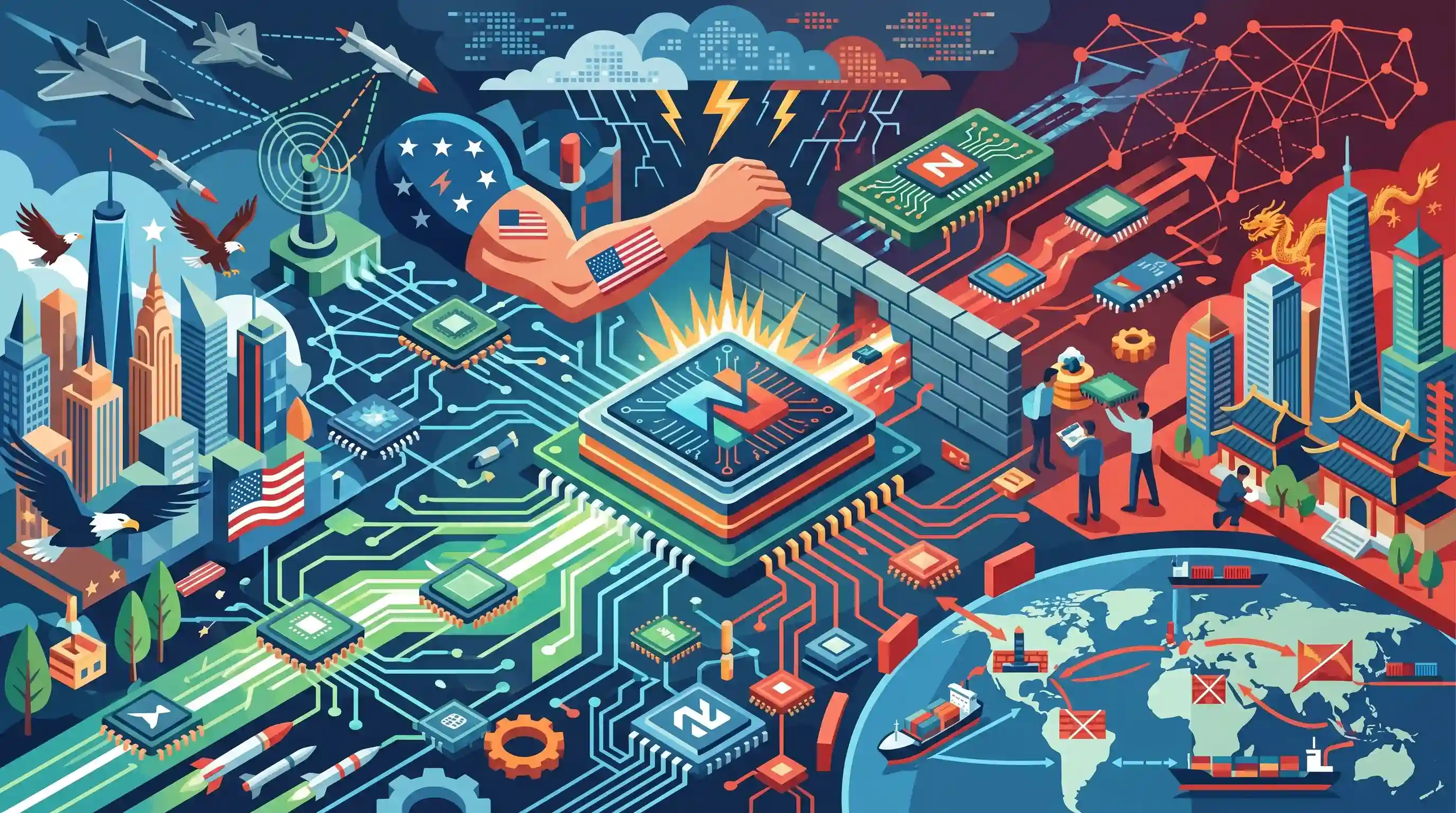
The article examines Nvidia's challenging position amidst the intensifying 'tech cold war' between the United States and China. As the preeminent designer of advanced graphics processing units (GPUs) essential for artificial intelligence, Nvidia is subject to aggressive US export controls aimed at denying Beijing access to cutting-edge AI capabilities for military and strategic use. The US strategy leverages chokepoints in the global semiconductor supply chain, forcing Nvidia to navigate a complex regulatory environment while attempting to preserve its market share in China through the development of specialized, downgraded chips. This scenario underscores the increasing weaponization of critical technologies, the fragmentation of global tech ecosystems, and the broader geopolitical struggle for technological supremacy.
Key Points
- Nvidia finds itself at the epicenter of the escalating tech cold war between the US and China, primarily due to its dominance in AI-powering GPUs.
- The US has implemented stringent export controls to restrict China's access to advanced semiconductors (like Nvidia's A100 and H100 chips) to curb its military and AI advancement.
- To maintain its presence in the lucrative Chinese market without violating US sanctions, Nvidia has developed modified, lower-capability chips, though these are also subject to shifting regulatory goalposts.
- The situation highlights a broader trend of technological decoupling, where supply chains and critical emerging technologies (like AI and semiconductors) are being weaponized for geopolitical leverage.
- This tech rivalry accelerates the global race for semiconductor self-reliance, presenting both challenges for tech multinationals and strategic opportunities for countries like India aiming to build alternative supply chains.
Important Terms
TSMC

The world's largest contract chip manufacturer (foundry), based in Taiwan, producing over 90% of the world's most advanced semiconductors. It is a critical 'chokepoint' in the global AI and electronics supply chain.
UPSC context
GS Paper III: Supply Chain Resilience. Tests understanding of 'Silicon Shield' geopolitics and global dependency on high-end manufacturing.
CHIPS and Science Act
A 2022 US federal law providing $52.7 billion in subsidies to revitalize domestic semiconductor manufacturing and research. It aims to reduce reliance on foreign supply chains and counter China's technological advancement.
UPSC context
GS Paper II & III: Industrial Policy/IR. Tests knowledge of state-led technology competition and its impact on global trade norms.
US Export Administration Regulations (EAR)
US regulations administered by the Bureau of Industry and Security (BIS) that control the export, re-export, and transfer of 'dual-use' technologies (items with both civilian and military applications) for national security.
UPSC context
GS Paper II: International Relations. Relevant for understanding 'technology denial regimes' and strategic trade controls affecting India-US tech partnerships (e.g., iCET).
US Department of Commerce
A US executive department responsible for managing trade policies, export controls, and the 'Entity List.' It serves as the primary enforcement arm for US technology restrictions against foreign strategic competitors.
UPSC context
GS Paper II: International Relations. Tests understanding of how non-military institutions implement 'weaponized interdependence' in modern geopolitical struggles.
Nvidia
An American technology giant and world leader in AI-focused graphics processing units (GPUs). Its chips are central to the US-China tech war due to their essential role in training advanced AI models.
UPSC context
GS Paper III: Science & Technology (AI). Illustrates the geopolitical leverage held by private firms in critical technology sectors.
Prelims Trap
"The Wassenaar Arrangement is a legally binding UN treaty regulating dual-use technologies like AI chips."
It is a voluntary, multilateral export control regime, not a legally binding UN treaty. Members retain national discretion on export denials.
Static Concepts Connected
What is "Dual-Use Technology" and how is it regulated globally?
- Definition: Technologies possessing both civilian commercial applications and strategic military utility (e.g., advanced AI chips, nuclear materials, GPS).
- Wassenaar Arrangement: Regulated primarily by the Wassenaar Arrangement, a 42-member voluntary multilateral regime controlling the export of conventional arms and dual-use goods.
- India's Status: India became a member of the Wassenaar Arrangement in 2017, boosting its non-proliferation credentials and access to high-tech goods.
How do GPUs differ from standard CPUs in AI applications?
- Core Architecture: CPUs have a few powerful cores designed for sequential processing, while GPUs have thousands of smaller cores designed for simultaneous, parallel processing.
- AI Utility: GPUs excel at massive, repetitive matrix multiplications, making them essential for training complex neural networks and Large Language Models (LLMs).
Cross-Topic Patterns
Semiconductor Geopolitics + India's PLI
The weaponization of chip supply chains accelerates 'China Plus One' strategies, making India’s $10Bn India Semiconductor Mission and PLI scheme crucial for both economic growth and strategic autonomy.
Tech Cold War + Critical Minerals
US export controls on semiconductors are directly linked to China's retaliatory export curbs on critical minerals like Gallium and Germanium, a dynamic heavily monitored by the Quad.

Expect a 2026 GS-3 question linking AI dual-use export controls, semiconductor supply chain chokepoints, and India's PLI scheme.
Linked PYQs · 4
Linked PYQs · 4
- 2021MainsGS2
“The USA is facing an existential threat in the form of a China, that is much more challenging than the erstwhile Soviet Union.” Explain.
- 2024MainsGS2
‘The West is fostering India as an alternative to reduce dependence on China's supply chain and as a strategic ally to counter China's political and economic dominance.’ Explain this statement with examples.
- 2025MainsGS3
India aims to become a semiconductor manufacturing hub. What are the challenges faced by the semiconductor industry in India? Mention the salient features of the India Semiconductor Mission.
- 2024PrelimsGS1
Consider the following statements: I. It is expected that Majorana 1 chip will enable quantum computing. II. Majorana 1 chip has been introduced by Amazon Web Services (AWS). III. Deep learning is a subset of machine learning. Which of the statements given above are correct?
