CPCB Reports Slight Reduction in Polluted River Sites Across India
Source:The Hindu ↗
Why It Matters
River pollution and environmental governance are persistent UPSC topics. Understanding key metrics like Biological Oxygen Demand (BOD) is crucial for Prelims (often tested conceptually), while data on polluted stretches and NGT-led action plans form essential fodder for Mains answers on water management, institutional roles, and mitigating industrial or urban pollution.
Summary
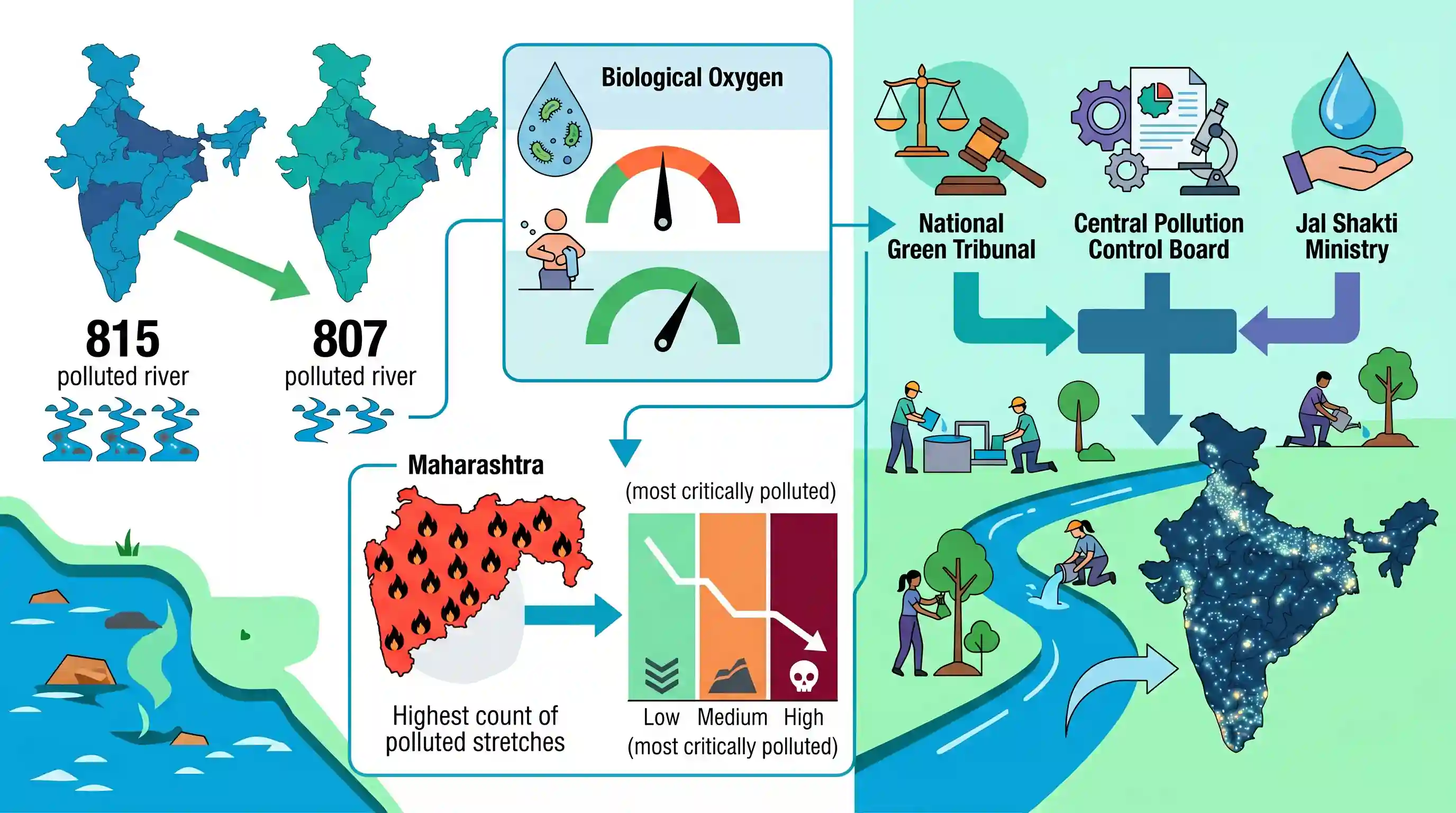
A recent Central Pollution Control Board (CPCB) report indicates a slight reduction in the number of polluted river sites across India, from 815 in 2022 to 807 in 2023. The CPCB identifies pollution using Biological Oxygen Demand (BOD), where readings above 3 mg/L indicate that water is unfit for bathing. While Maharashtra continues to record the highest number of polluted river stretches, the count of the most critically polluted 'Priority 1' stretches (BOD > 30 mg/L) dropped nationally. Mandated by the National Green Tribunal, the CPCB and the Jal Shakti Ministry are overseeing Action Plans to restore water quality across 4,736 monitoring locations.
Key Points
- The number of polluted river locations across India saw a marginal decline to 807 in 2023 from 815 in 2022, according to the CPCB.
- Water pollution is measured using Biological Oxygen Demand (BOD); a BOD greater than 3 mg/L renders water unfit for bathing.
- A total of 296 'polluted river stretches' (PRS) were identified across 271 rivers. Maharashtra reported the highest number of PRS (54), followed by Kerala and Madhya Pradesh.
- The most severely polluted 'Priority 1' stretches (BOD > 30 mg/L) decreased from 45 in 2022 to 37 in 2023, though 'Priority 2' stretches increased.
- The CPCB and state authorities monitor water quality under mandates from the National Green Tribunal (NGT), driving the implementation of state-level Action Plans for river remediation.
Important Terms
Central Pollution Control Board (CPCB)

A statutory body under the MoEFCC, established in 1974 to provide technical services for the prevention and control of air and water pollution.
UPSC context
GS II (Statutory Bodies) & GS III (Pollution). Tests understanding of environmental regulatory frameworks and standard-setting powers.
National Green Tribunal (NGT)
A specialized judicial body established under the NGT Act 2010 for the effective and expeditious disposal of cases relating to environmental protection.
UPSC context
GS II & III (Environmental Governance). Tests knowledge of specialized mechanisms for environmental justice and the Polluter Pays principle.
Biological Oxygen Demand (BOD)
The amount of dissolved oxygen required by aerobic microorganisms to decompose organic matter in water; higher levels indicate greater organic pollution.
UPSC context
GS III (Pollution/Environment). A key water quality indicator vital for Prelims (science/ecology) and Mains (evaluating ecosystem health).
Ministry of Jal Shakti
An Indian government ministry formed in 2019 to ensure integrated and sustainable management of water resources, including drinking water and river rejuvenation.
UPSC context
GS II (Government Policies). Focuses on institutional frameworks for water governance and flagship programs like Namami Gange.
Priority 1 Stretches
The most critically polluted river segments identified by the CPCB, where Biological Oxygen Demand (BOD) levels exceed 30 mg/L.
UPSC context
GS III (Pollution/Conservation). Tests understanding of pollution categorization and targeted policy interventions for restoring degraded river ecosystems.
Prelims Trap
"Under CPCB classification, Priority 1 rivers represent the cleanest and least polluted stretches."
Priority 1 actually denotes the most critically polluted river stretches requiring immediate remediation, characterized by a Biological Oxygen Demand (BOD) exceeding 30 mg/L.
Static Concepts Connected
How do BOD, COD, and DO measure water pollution?
- Biological Oxygen Demand (BOD): Measures oxygen consumed by bacteria decomposing organic matter. Higher BOD indicates higher organic pollution and lower water quality.
- Chemical Oxygen Demand (COD): Measures the oxygen needed to chemically oxidize all organic and inorganic compounds in water. COD is typically higher than BOD.
- Dissolved Oxygen (DO): The actual oxygen present in water, vital for aquatic life. High BOD/COD depletes DO, leading to aquatic dead zones.
What are the statutory origins of the CPCB and NGT?
- CPCB: A statutory organization constituted in 1974 under the Water (Prevention and Control of Pollution) Act. It also exercises powers under the Air Act, 1981.
- NGT: A specialized body established under the NGT Act, 2010, for the effective and expeditious disposal of cases relating to environmental protection.
Cross-Topic Patterns
Urban sewage, agriculture and high BOD
Maharashtra and Kerala's high polluted river counts link directly to rapid urbanization and agricultural runoff, tying BOD metrics to untreated municipal sewage and fertilizer-induced eutrophication.
River pollution and interstate water disputes
Remediation action plans often overlap with river basin disputes. NGT mandates push states to act, but downstream pollution frequently inflames interstate river water sharing conflicts (Article 262).

Expect a 2026 Prelims multi-statement question contrasting BOD vs DO vs COD, coupled with CPCB's statutory mandate under the 1974 Water Act.
Linked PYQs · 3
Linked PYQs · 3
- 2017PrelimsGS1
Biological Oxygen Demand (BOD) is a standard criterion for
- 2024MainsGS3
Industrial pollution of river water is a significant environmental issue in India. Discuss the various mitigation measures to deal with this problem and also the government's initiatives in this regard.
- 2013MainsGS3
Enumerate the National Water Policy of India. Taking river Ganges as an example, discuss the strategies which may be adopted for river water pollution control and management. What are the legal provisions of management and handling of hazardous wastes in India?
