Report reveals rise in regional disparities across Karnataka
Source:The Hindu ↗
Why It Matters
This article provides an excellent case study for Mains answers on 'Inclusive Growth' (GS3) and 'Regionalism/Regional Disparities' (GS1). It practically illustrates the phenomenon of 'growth without development'—where high aggregate GDP figures (driven by localized sectors like IT) mask extreme intra-state inequalities and failing human development indicators.
Summary
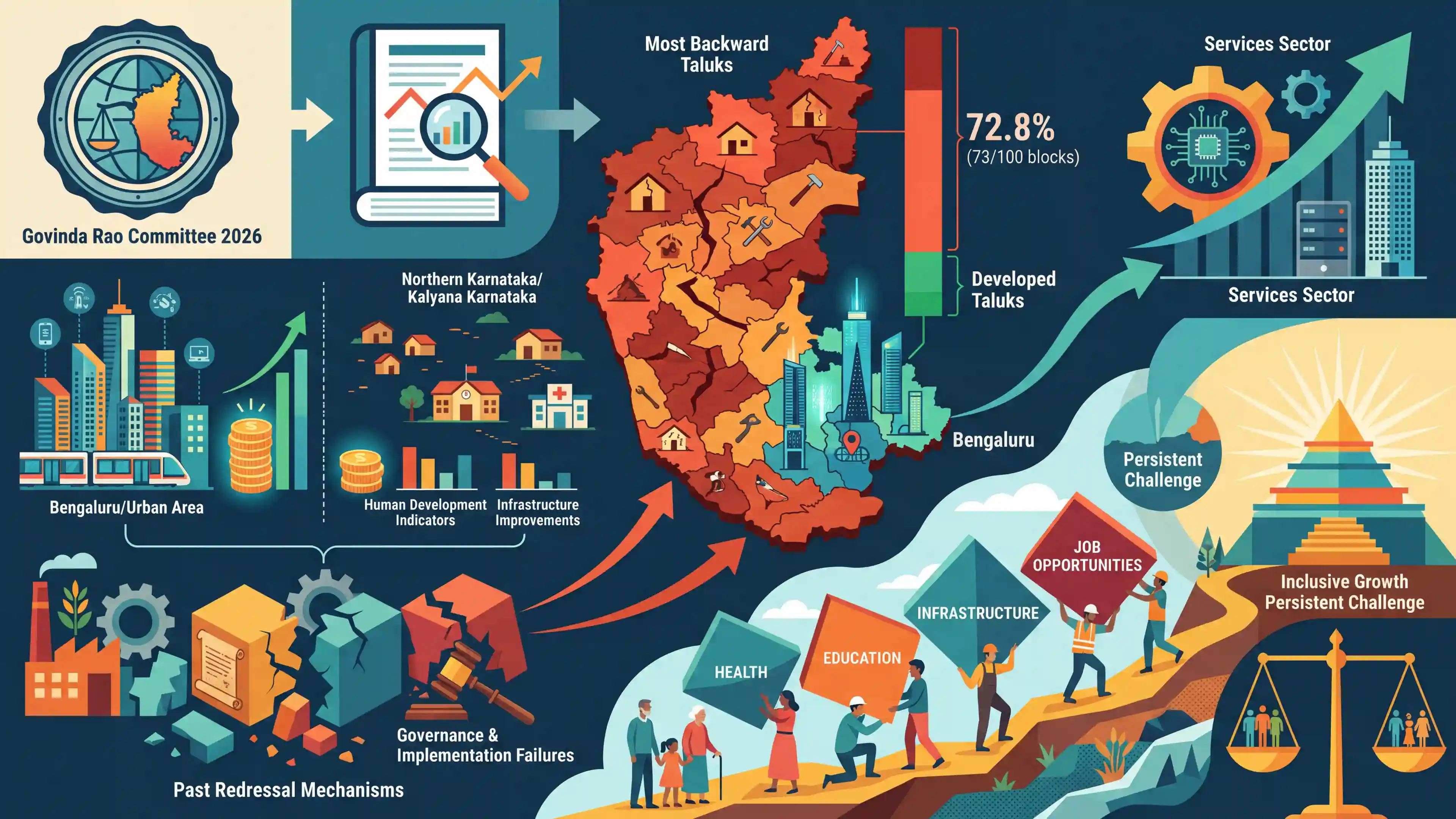
A report by the Karnataka Regional Imbalances Redressal Committee (2026), headed by M. Govinda Rao, reveals an alarming rise in intra-state regional disparities, with 72.8% of the state's taluks now classified as backward. Despite Karnataka's strong overall economic performance, the growth is heavily skewed by the services sector in a few urban districts (like Bengaluru), leading to high per capita income inequality. Consequently, this growth has failed to translate into commensurate human development or infrastructure improvements in northern regions like Kalyana Karnataka. The findings underscore critical governance and implementation failures in past redressal mechanisms (such as the D.M. Nanjundappa Committee recommendations) and highlight the persistent challenge of achieving inclusive growth.
Key Points
- The proportion of backward taluks in Karnataka has increased from 65% in 2001-02 to 72.8% in 2022-23, with 172 out of 236 taluks now classified as backward.
- Regional disparities are acute, with the Kalaburagi division (Kalyana Karnataka) accounting for 40 of the state's 93 'most backward' taluks.
- The M. Govinda Rao Committee observed that the state's robust economic growth is driven largely by the modern services sector concentrated in a few districts, leading to high inter-district income inequality.
- Economic growth has not translated proportionally into improvements in social indicators due to implementation failures and poor targeting of public expenditure.
- The committee recommends a ₹43,914 crore special development grant to bridge these gaps, highlighting the failure of the earlier D.M. Nanjundappa Committee's framework due to administrative apathy.
Important Terms
Karnataka Regional Imbalances Redressal Committee (Govinda Rao Committee)

A 2026 panel that found 72.8% of Karnataka's taluks are backward. It highlighted that services-led growth in urban hubs (like Bengaluru) masks deepening intra-state inequality and human development gaps.
UPSC context
GS Paper III (Inclusive Growth/Inequality). Tests understanding of regional disparities despite high GSDP and the failure of trickle-down economics.
D.M. Nanjundappa Committee
A landmark 2002 high-power committee that identified 114 backward taluks in Karnataka. It used a 'Comprehensive Deprivation Index' to measure disparities and recommended a massive Special Development Plan.
UPSC context
GS Paper II (Governance). A classic case study for decentralized planning and institutional frameworks used to tackle historical regional backwardness.
Special Development Plan (SDP)
A targeted fiscal mechanism launched in 2007-08 to bridge developmental gaps in identified backward taluks through extra-budgetary allocations, primarily focusing on physical infrastructure and essential services.
UPSC context
GS Paper III (Government Budgeting/Planning). Analyzes the efficacy of targeted funding vs. human capital investment in long-term poverty alleviation.
Article 371(J)
A constitutional provision granting special status to the Kalyana Karnataka region (North Karnataka), allowing for a Regional Development Board and local reservations in education and public employment.
UPSC context
GS Paper II (Polity). Essential for questions on federalism, special constitutional provisions, and balancing regional aspirations within a state.
Kalyana Karnataka
The region comprising six North-Eastern Karnataka districts (formerly Hyderabad-Karnataka). It remains the state’s focal point for poverty and infrastructure deficits, receiving special constitutional and developmental attention.
UPSC context
GS Paper I (Geography/Social Issues). Used to discuss intra-state regionalism, historical underdevelopment, and the geography of poverty in India.
Prelims Trap
Article 371J grants special developmental status and quotas to all backward taluks within the state of Karnataka.
Article 371J applies exclusively to the districts of the Kalyana-Karnataka (formerly Hyderabad-Karnataka) region, not to every backward taluk across the entire state.
Static Concepts Connected
What are the key provisions of Article 371J for Karnataka?
- Special Development Board: Empowers the Governor to establish a separate development board for the Kalyana-Karnataka (Hyderabad-Karnataka) region.
- Fund Allocation: Ensures equitable allocation of funds for developmental expenditure specifically targeted at the region.
- Local Reservations: Provides constitutional backing for reservations in educational institutions and state government jobs for local residents.
What drives intra-state regional disparity in India?
- Sectoral Skew: Concentration of high-growth sectors (like IT and modern services) in a few urban hubs, leaving agrarian hinterlands stagnant.
- Infrastructure Deficit: Historical neglect of transport, power, and social infrastructure in remote areas, preventing industrial dispersal and investment.
- Governance Failures: Poor targeting of public expenditure, administrative apathy, and failure to implement special development plans effectively over time.
Cross-Topic Patterns
Services-led growth vs Inclusive Development
Karnataka highlights a macro-economic paradox where IT-driven high GSDP obscures severe intra-state agrarian and manufacturing stagnation in northern districts like Kalaburagi.
Article 371J vs Administrative Apathy
Despite Constitutional backing for Kalyana Karnataka, reliance on committees like Nanjundappa and Govinda Rao proves statutory provisions alone cannot overcome persistent implementation failures.

Expect a GS3 Mains question linking services-sector skew with intra-state regional disparities, using Karnataka as a prime case study.
Linked PYQs · 4
Linked PYQs · 4
- 2016MainsGS1
What is the basis of regionalism? Is it that unequal distribution of benefits of development on regional basis eventually promotes regionalism? Substantiate your answer.
- 2024MainsGS3
Examine the pattern and trend of public expenditure on social services in the post-reforms period in India. To what extent this has been in consonance with achieving the objective of inclusive growth?
- 2025MainsGS3
Distinguish between the Human Development Index (HDI) and the Inequality-adjusted Human Development Index (IHDI) with special reference to India. Why is the IHDI considered a better indicator of inclusive growth?
- 2020MainsGS3
Explain intra-generational and inter-generational issues of equity from the perspective of inclusive growth and sustainable development.
