Wildlife Conservation Status and Species Reintroduction in India
Source:Indian Express ↗
Why It Matters
Species reintroduction programmes like Project Cheetah and the protection status of critically endangered species like the gharial are recurrent core themes in UPSC Prelims and Mains environmental questions.
Summary
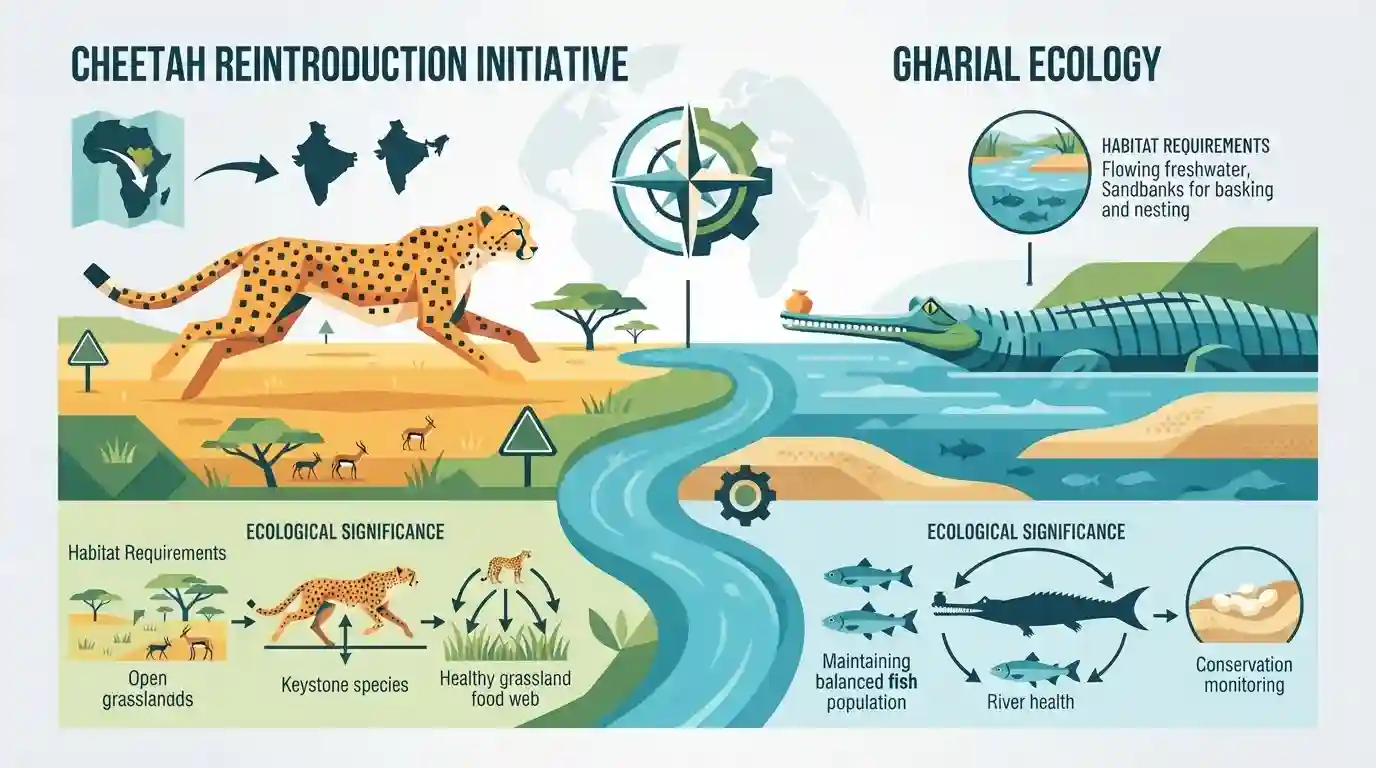
This article highlights key wildlife conservation updates focusing on cheetah reintroduction initiatives and gharial ecology. It explores species adaptation, habitat requirements, and ecological significance relevant to biodiversity management and UPSC syllabus requirements.
Key Points
- Project Cheetah in India involves the transcontinental reintroduction of the cheetah (Acinonyx jubatus) to Kuno National Park, Madhya Pradesh, following its local extinction in 1952.
- The gharial (Gavialis gangeticus), a critically endangered crocodilian species native to the Indian subcontinent, relies heavily on river systems like the Chambal River for survival.
- Both species highlight critical themes in Indian wildlife conservation, species recovery plans, and protected area management under the Wildlife Protection Act, 1972.
Important Terms
Project Cheetah

India's ambitious species-recovery initiative launched in 2022 to reintroduce the extinct cheetah from Africa into protected Indian habitats such as Kuno National Park.
UPSC context
UPSC Prelims/Mains: Environment and Biodiversity, Wildlife Conservation, species translocation, and ecosystem restoration.
Wildlife Protection Act 1972
India's primary statutory legislation enacted in 1972 to protect wildlife, regulate hunting, control trade, and manage sanctuaries and national parks through graded schedules.
UPSC context
UPSC Prelims/Mains: Core environment law, statutory bodies, conservation frameworks, and protected areas.
International Union for Conservation of Nature (IUCN)
Global membership union assessing conservation status via the Red List of Threatened Species to guide worldwide biodiversity protection policies.
UPSC context
UPSC Prelims/Mains: International environmental organizations, species extinction risk categories, and global conservation governance.
Prelims Trap
Project Cheetah successfully reintroduced the native Asiatic cheetah subspecies back into Kuno National Park from Iran.
The cheetah was declared extinct in India in 1952, but it is the African cheetah subspecies (Acinonyx jubatus jubatus) being translocated under Project Cheetah, not the extinct Asiatic cheetah.
Static Concepts Connected
What are the key schedules and protections under the Wildlife Protection Act, 1972?
- Schedule Structure: Reorganized into 4 schedules after the 2022 amendment, replacing the older 6 schedules to streamline species protection.
- Absolute Protection: Schedule 1 provides absolute legal protection with highest penalties for endangered species like the tiger and gharial.
- Regulatory Authority: State Chief Wildlife Warden permission is required for any capture, translocation, or elimination of scheduled problematic wildlife.
Cross-Topic Patterns
Species Translocation & International Law
Transcontinental reintroduction under Project Cheetah intersects with international CITES guidelines and domestic wildlife translocation protocols.
Riverine Ecology & National Aquatic Species
Gharial habitat protection in the Chambal River ties riverine biodiversity directly to National Aquatic Animal declarations and river interlinking debates.

Project Cheetah mechanics + Gharial riverine habitat requirements will likely be tested via a multi-statement Wildlife Act 1972 matching question.
Linked PYQs · 2
Linked PYQs · 2
- 2024PrelimsGS1
Consider the following statements: 1. Lions do not have a particular breeding season. 2. Unlike most other big cats, cheetahs do not roar. 3. Unlike male lions, male leopards do not proclaim their territory by scent marking. Which of the statements given above are correct?
- 2017PrelimsGS1
If you want to see gharials in their natural habitat, which one of the following is the best place to visit?
