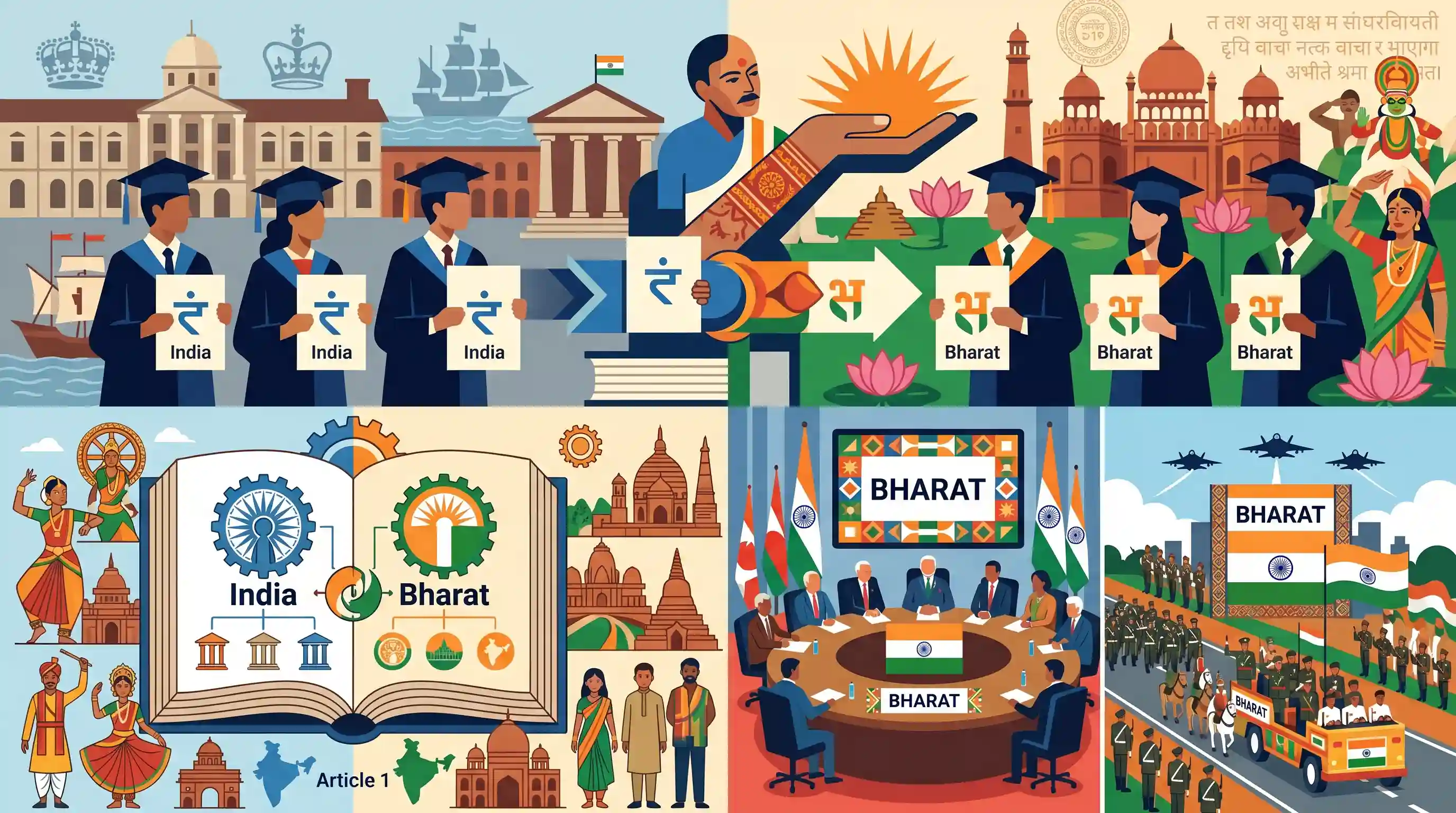
Universities Replace India with Bharat on Degrees and Marksheets
Source:Indian Express ↗
Why It Matters
The debate over 'India' vs 'Bharat' is highly relevant for UPSC aspirants as it intersects with Constitutional provisions (Article 1), the legacy of colonialism, cultural nationalism, and the ideological direction of educational institutions. It highlights the dynamic nature of national identity and language politics in contemporary governance.
Summary
A growing number of universities across India, prompted by the RSS-linked Shiksha Sanskriti Utthan Nyas, are replacing the name 'India' with 'Bharat' on degrees and official documents. Advocates argue that 'India' is a colonial or foreign-bestowed name, whereas 'Bharat' aligns with the country's indigenous cultural identity. This move reflects a broader national trend of decolonizing names and symbols, as seen in the recent official usage of 'Bharat' during the G20 summit and in Republic Day communications, invoking debates around Article 1 of the Constitution and India's cultural nationalism.
Key Points
- Several state and central universities in India are replacing the word 'India' with 'Bharat' in degrees, marksheets, and other official documents.
- The change is largely driven by campaigns from the Shiksha Sanskriti Utthan Nyas, an RSS-affiliated organization.
- Proponents argue that 'India' is a name imposed by foreigners (such as the British or historical invaders), while 'Bharat' reflects the nation's true cultural and indigenous identity.
- This academic shift aligns with a broader political and cultural push for decolonization, mirrored by recent official actions like using 'Bharat' in G20 summit invitations and Republic Day communications.
- The debate inherently references Article 1 of the Indian Constitution, which states 'India, that is Bharat', bringing constitutional interpretation into focus.
Important Terms
Constitution of India (Article 1)

The foundational legal document's first article stating "India, that is Bharat, shall be a Union of States." It establishes the country's dual official names and defines its federal character.
UPSC context
GS Paper 2 (Polity); essential for understanding Article 1, the historical Constituent Assembly debates, and contemporary identity politics.
Shiksha Sanskriti Utthan Nyas (SSUN)
An RSS-linked educational organization advocating for an "India-centric" education system. It campaigns for character-building, value-based learning, and replacing colonial nomenclature like "India" with "Bharat" in academic documents.
UPSC context
GS Paper 2 (Governance/Education); relevant for pressure groups and their influence on National Education Policy and institutional reforms.
Rashtriya Swayamsevak Sangh (RSS)
A Hindu nationalist volunteer organization founded in 1925. It promotes "Hindutva" and serves as the ideological mentor to several organizations (Sangh Parivar), influencing social, cultural, and educational policies.
UPSC context
GS Paper 1/2 (Society/Polity); tests understanding of influential socio-cultural movements and their impact on national identity and symbols.
Bharatiya Bhasha Manch
A specialized wing of the Shiksha Sanskriti Utthan Nyas (SSUN) dedicated to promoting Indian languages and campaigning for the use of indigenous names in academic and official settings.
UPSC context
GS Paper 2 (Social Justice/Education); focuses on the promotion of regional languages and decolonization within the Indian academic framework.
Cultural Nationalism
A form of nationalism where the nation is defined by shared heritage and culture. It emphasizes reclaiming indigenous symbols and names (like Bharat) to assert a distinct civilizational identity.
UPSC context
GS Paper 1 (Culture/Society); tests the evolution of Indian nationalism and the shift from civic to cultural identity markers.
Decolonization (in Education)
The process of removing colonial-era influences and structures. In education, it involves replacing foreign-bestowed names and pedagogical models with indigenous linguistic, historical, and cultural perspectives.
UPSC context
GS Paper 1/2 (Society/Governance); examines post-independence consolidation and efforts to reform colonial systems to reflect indigenous heritage.
Prelims Trap
The Constitution officially designates 'Bharat' as the Hindi name and 'India' as the English name.
Article 1(1) explicitly states 'India, that is Bharat' in the English text of the Constitution itself. Both names are constitutionally equivalent, not segregated by language.
Static Concepts Connected
What is the constitutional and legal status of the names 'India' and 'Bharat'?
- Article 1(1): Declares 'India, that is Bharat, shall be a Union of States', establishing equal constitutional validity for both terms.
- Supreme Court Stance: In 2016 and 2020, the SC dismissed PILs seeking to drop 'India', noting the Constitution already recognizes both terms interchangeably.
- Amendment Requirement: To exclusively use 'Bharat' and completely drop 'India' from official constitutional phrasing, Parliament must pass a Constitutional Amendment under Article 368.
How did the Constituent Assembly debate the naming of the nation?
- Traditionalist View: Members like Seth Govind Das and H.V. Kamath advocated for 'Bharat' or 'Bharatvarsha' to reflect civilizational ethos and indigenous roots.
- Pragmatic View: B.R. Ambedkar supported retaining 'India' to ensure administrative continuity, international recognition, and legacy under UN treaties inherited from the British.
Cross-Topic Patterns
NEP 2020 and Indian Knowledge Systems
The university renaming drive mirrors NEP 2020's push to mainstream the 'Indian Knowledge System' (IKS), moving higher education away from colonial frameworks toward indigenous pedagogical identities.
Decolonization of colonial legacy markers
Connects directly to the wider executive push for 'symbolic decolonization', seen in the overhaul of the IPC to Bharatiya Nyaya Sanhita (BNS) and renaming Rajpath to Kartavya Path.

Expect a 2026 Prelims MCQ testing the exact text of Article 1(1) and the Supreme Court's stance on recent 'India vs Bharat' PILs.
Linked PYQs · 3
Linked PYQs · 3
- 2020PrelimsGS1
Consider the following statements: 1. The Constitution of India defines its 'basic structure' in terms of federalism, secularism, fundamental rights and democracy. 2. The Constitution of India provides for 'judicial review' to safeguard the citizens' liberties and to preserve the ideals on which the Constitution is based. Which of the statements given above is/are correct?
- 2023MainsGS1
Discuss the impact of post-liberal economy on ethnic identity and communalism.
- 2015MainsGS2
The quality of higher education in India requires major improvements to make it internationally competitive. Do you think that the entry of foreign educational institutions would help improve the quality of higher and technical education in the country? Discuss.
