Global Non-Proliferation Architecture and Counterproliferation
Source:Indian Express ↗
Why It Matters
Helps candidates critically evaluate the structural weaknesses in global non-proliferation institutions (NPT, IAEA), the implications of US unilateralism, and the specific geopolitical contexts of Middle Eastern nuclear controversies (Iran/Iraq) for GS2 IR.
Summary
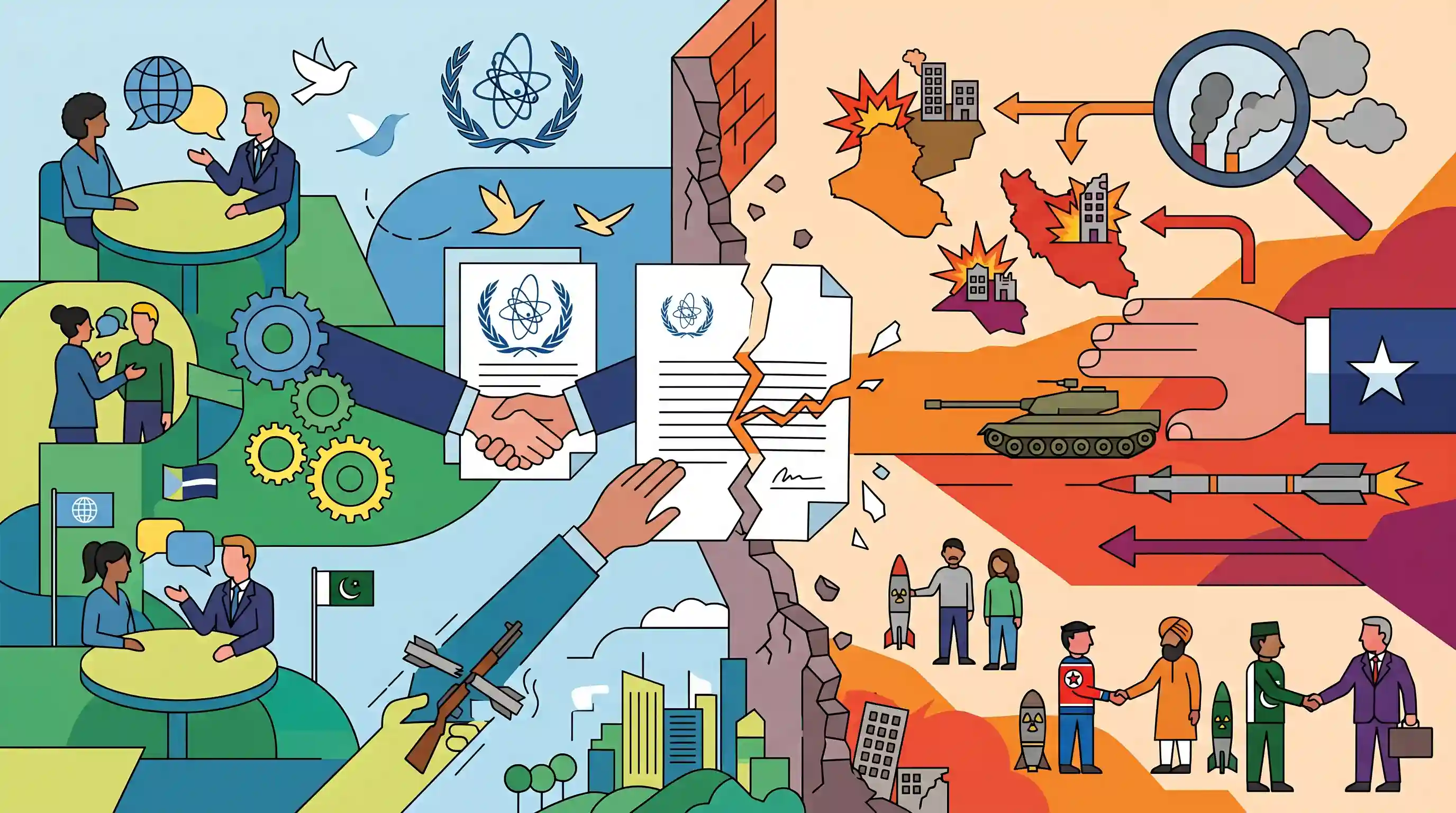
The article critiques the shift in the global nuclear order from diplomacy-led "non-proliferation" to force-led "counterproliferation," heavily driven by American unilateralism. Citing the Iraq War and ongoing pressure on Iran as case studies, it highlights how selective coercion undermines the foundational Treaty on the Non-Proliferation of Nuclear Weapons (NPT). In contrast, states like North Korea, India, and Pakistan face accommodation rather than force, exposing a glaring double standard. The author argues that restoring the consensus between nuclear and non-nuclear weapon states requires genuine diplomacy and adherence to international institutions like the IAEA, rather than leveraging unverified intelligence for military preemption.
Key Points
- The global nuclear non-proliferation architecture is being undermined by a shift toward unilateral "counterproliferation" policies, notably spearheaded by the US.
- The 2003 invasion of Iraq and shifting policies regarding Iran's nuclear program illustrate the dangers of replacing international institutional consensus (like IAEA verifications) with intelligence-based coercion.
- There is a visible inconsistency in how nuclear proliferation is handled globally; while Iran faces heavy coercion and sabotage, countries like North Korea, India, and Pakistan are approached with accommodation or limited sanctions.
- Unilateral counterproliferation strategies violate core tenets of the NPT, specifically Article IV which guarantees states the right to peaceful nuclear technology, ultimately risking the collapse of the voluntary non-proliferation regime.
- Restoring stability requires returning to diplomacy, empowering the IAEA, and honoring multilateral agreements rather than resorting to military preemption or punitive sanctions.
Important Terms
Treaty on the Non-Proliferation of Nuclear Weapons (NPT)

A landmark 1968 international treaty aimed at preventing the spread of nuclear weapons, promoting disarmament, and fostering cooperation for the peaceful use of nuclear energy.
UPSC context
GS Paper II: International Agreements. Relevant for understanding the global nuclear order and India's critique of the treaty as being discriminatory.
International Atomic Energy Agency (IAEA)
An autonomous international organization within the UN system that serves as a global nuclear watchdog, promoting peaceful nuclear technology and verifying that states do not develop weapons.
UPSC context
GS Paper II: International Institutions. Essential for safeguards, inspections, and the implementation of civil nuclear deals like India’s 123 Agreement.
Joint Comprehensive Plan of Action (JCPOA)
A 2015 agreement between Iran and world powers (P5+1) that restricted Iran's nuclear enrichment and stockpiles in exchange for the lifting of economic sanctions.
UPSC context
GS Paper II: Regional Groups/Agreements. Significant for India's energy security and strategic interests in West Asia (e.g., Chabahar Port).
Additional Protocol
A voluntary legal instrument granting the IAEA expanded inspection rights and broader access to a state's nuclear facilities to verify the absence of undeclared nuclear activities.
UPSC context
GS Paper II/III: Security and IR. Tests knowledge of the technical verification regime and India's specific 2014 commitment.
Tehran Declaration (2010)
A 2010 tripartite agreement between Iran, Turkey, and Brazil for a nuclear fuel swap, often cited as a diplomatic alternative to Western-led sanctions and preemption.
UPSC context
GS Paper II: Global Diplomacy. Illustrates the role of emerging powers in mediation and the tension between diplomacy and unilateral force.
EU-3
An informal negotiating group consisting of France, Germany, and the United Kingdom that initiated diplomatic efforts with Iran regarding its nuclear program in 2003.
UPSC context
GS Paper II: International Relations. Relevant for tracing the historical evolution of multilateral diplomacy and European foreign policy in West Asia.
Prelims Trap
"The NPT strictly prohibits all non-nuclear weapon states from developing indigenous uranium enrichment capabilities."
Article IV of the NPT explicitly guarantees all member states the inalienable right to develop nuclear energy for peaceful purposes, including uranium enrichment.
Static Concepts Connected
What defines a "Nuclear Weapon State" (NWS) under the NPT?
- Cut-off date: A state must have manufactured and exploded a nuclear weapon or device prior to January 1, 1967.
- Exclusive club: Recognized NWS status is restricted exclusively to the US, Russia, UK, France, and China (the P5).
- Non-signatories: India, Pakistan, and Israel possess nuclear weapons but are not recognized as NWS; hence, they remain non-signatories to the treaty.
What is the IAEA's Additional Protocol?
- Expanded access: It grants IAEA inspectors broader access to a state's undeclared nuclear sites and information, beyond standard safeguards.
- Voluntary basis: It is not automatically binding on NPT members; states must separately negotiate and sign the Protocol.
- India's status: India signed a customized Additional Protocol in 2014, restricted strictly to its civilian nuclear facilities already under IAEA safeguards.
Cross-Topic Patterns
India's civil nuclear exceptionalism
India's accommodation (e.g., 2008 NSG waiver despite being non-NPT) contrasts sharply with the coercive counterproliferation faced by Iran, highlighting how geopolitical leverage often overrides treaty rigidities.
Extraterritorial sanctions vs. Multilateralism
Unilateral US counterproliferation heavily relies on CAATSA and SWIFT weaponization, raising questions in Mains about the strategic autonomy of middle powers navigating global institutional decay.

Expect a multi-statement Prelims question contrasting NPT's Article IV (peaceful enrichment rights) with IAEA Additional Protocol mandates.
Linked PYQs · 4
Linked PYQs · 4
- 2018MainsGS2
In what ways would the ongoing US-Iran Nuclear Pact Controversy affect the national interest of India? How should India respond to this situation?
- 2015PrelimsGS1
Consider the following countries: 1. China 2. France 3. India 4. Israel 5. Pakistan Which among the above are Nuclear Weapons States as recognized by the Treaty on the Non-Proliferation of Nuclear Weapons, commonly known as Nuclear Non-Proliferation Treaty (NPT)?
- 2018PrelimsGS1
What is/are the consequence/consequences of a country becoming the member of the 'Nuclear Suppliers Group'? 1. It will have access to the latest and most efficient nuclear technologies. 2. It automatically becomes a member of "The Treaty on the Non-Proliferation of Nuclear Weapons (NPT)". Which of the statements given above is/are correct?
- 2018PrelimsGS1
In the Indian context, what is the implication of ratifying the 'Additional Protocol' with the 'International Atomic Energy Agency (IAEA)'?
