Nuclear Legislation and Parliamentary Accountability of the Opposition
Source:The Hindu ↗
Why It Matters
This article bridges GS-II (Polity) and GS-III (Energy/Science & Tech). For UPSC aspirants, it provides a practical case study of how the Opposition and Parliamentary Committees hold the executive accountable, specifically in the complex and strategic domain of nuclear energy liability and governance.
Summary
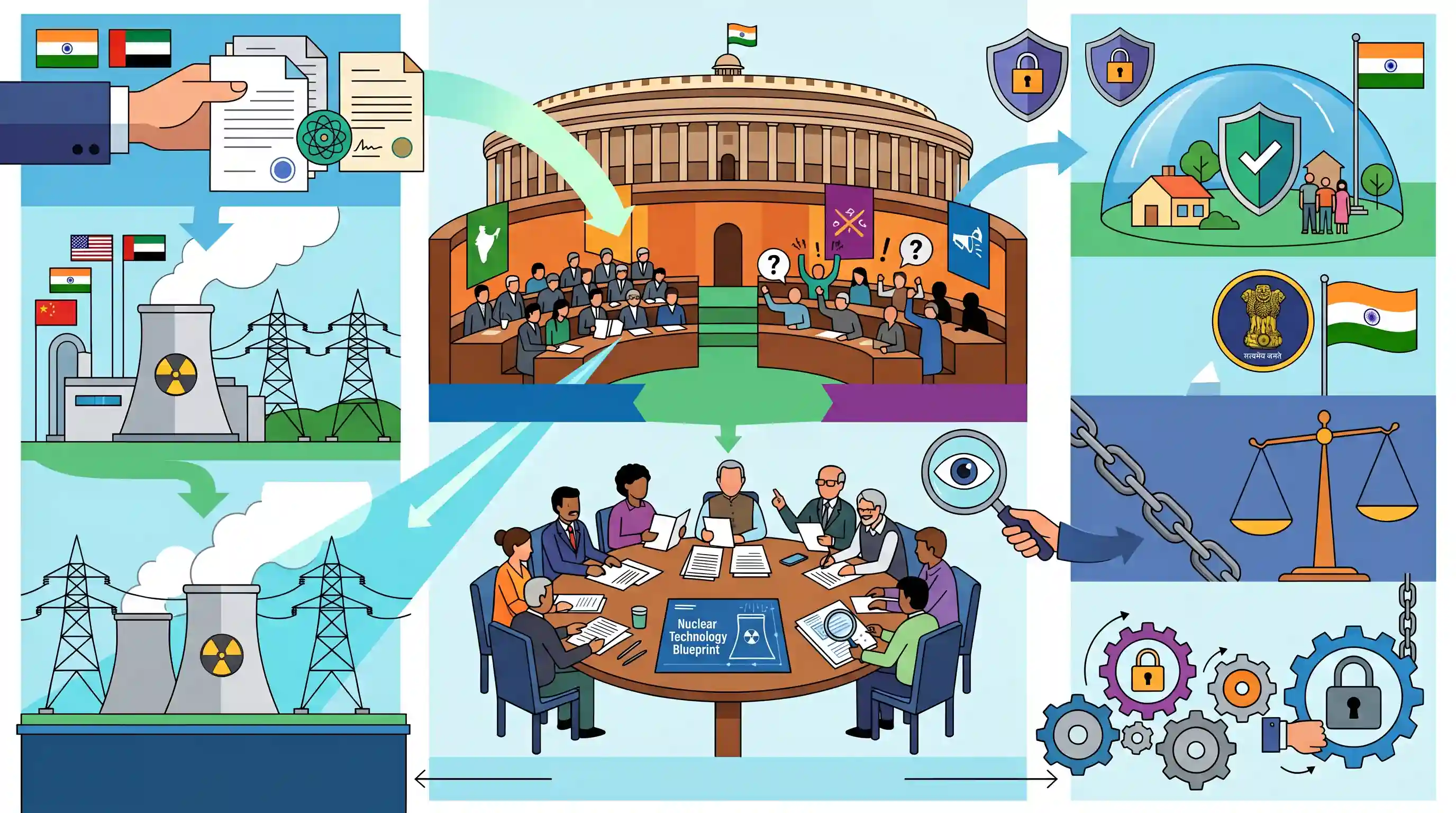
The article examines the indispensable role of the political Opposition and parliamentary mechanisms in shaping India's nuclear legislation. Focusing on laws like the Civil Liability for Nuclear Damage (CLND) Act, it highlights how robust debates and scrutiny by Parliamentary Standing Committees ensure that international nuclear agreements and domestic policy shifts do not compromise public safety or national interests. The piece underscores that executive actions in sensitive and highly technical sectors like atomic energy must remain strictly accountable to the legislature, thereby balancing India's growing energy security needs with stringent liability standards and democratic checks and balances.
Key Points
- The Opposition plays a crucial role in maintaining democratic checks and balances, ensuring that sensitive strategic policies, such as nuclear agreements, are debated thoroughly in Parliament.
- The drafting and passage of laws like the Civil Liability for Nuclear Damage (CLND) Act illustrate the importance of parliamentary scrutiny in protecting domestic interests, ensuring public safety, and defining supplier liability.
- Parliamentary Standing Committees provide a vital platform for cross-party consensus, technical evaluation, and detailed scrutiny of atomic energy policies.
- Reforms in the nuclear sector, such as discussions around private sector participation or international partnerships, require transparent legislative processes to balance India's energy security needs with strict liability protocols.
Important Terms
Civil Liability for Nuclear Damage (CLND) Act, 2010

A 2010 law establishing a framework for nuclear accident liability and victim compensation. It features a 'no-fault' regime where the plant operator is primarily liable up to a specified cap.
UPSC context
GS Paper II & III; tests legal frameworks for energy security, liability standards, and public safety in high-technology sectors.
Atomic Energy Act, 1962
The principal legislation regulating the development and use of atomic energy in India. It empowers the Central Government to control nuclear research, mineral mining, and power production.
UPSC context
GS Paper III; fundamental for understanding the statutory basis of India’s nuclear policy and government control over strategic energy sectors.
Parliamentary Standing Committee
Permanent committees of MPs that provide detailed scrutiny of bills and policies. The Committee on Science & Technology was instrumental in revising nuclear liability laws based on Opposition input.
UPSC context
GS Paper II; crucial for understanding legislative oversight, executive accountability, and the influence of the Opposition in the law-making process.
Right of Recourse
A provision in Section 17(b) of the CLND Act allowing operators to claim damages from suppliers if a nuclear incident results from defective equipment or sub-standard services.
UPSC context
GS Paper II & III; tests awareness of specific legal controversies that impact India's international civil nuclear trade and foreign policy.
International Atomic Energy Agency (IAEA)
The global 'Atoms for Peace' organization within the UN family. It promotes safe nuclear technology and conducts inspections to ensure facilities are used for peaceful purposes.
UPSC context
GS Paper II; relevant for global governance, international safety standards, and India’s adherence to non-proliferation safeguards and civil nuclear deals.
Prelims Trap
The CLND Act, 2010 aligns with global norms by placing exclusive, absolute liability on nuclear operators, exempting equipment suppliers.
India’s CLNDA diverges from international frameworks by including Section 17(b), which explicitly grants operators a 'right of recourse' against suppliers for defective equipment.
Static Concepts Connected
What is the mandate and composition of DRSCs?
- Composition: 31 members (21 Lok Sabha, 10 Rajya Sabha), proportionally nominated by the Speaker and Chairman respectively from various parties.
- Core Mandate: Examine demands for grants, bills referred to them by presiding officers, annual reports, and national basic long-term policy documents.
- Limitations: They do not consider day-to-day administrative matters, and their recommendations are advisory in nature, not binding on Parliament or the executive.
What are the core provisions of the Atomic Energy Act, 1962?
- State Monopoly: Vests exclusive control over nuclear power generation with the Central Government, legally barring private entities from ownership of nuclear installations.
- Private Sector Role: Private companies are restricted to peripheral roles like equipment supply, construction, and engineering services, rather than operating nuclear plants as Independent Power Producers (IPPs).
Cross-Topic Patterns
CLNDA vs. Private Sector Expansion
The supplier liability clause in the CLND Act has historically deterred foreign and domestic private players from supplying nuclear equipment, bottlenecking India's transition to a 500 GW non-fossil fuel capacity.
LoP in Statutory Committees
The Leader of Opposition’s role extends beyond parliamentary debates; they are structurally embedded in selection panels for bodies like CBI, CVC, and NHRC, acting as a direct check on executive appointments.

Expect a 2026 Prelims question contrasting India's CLND Act (supplier liability) with the Atomic Energy Act (private ownership restrictions).
Linked PYQs · 3
Linked PYQs · 3
- 2021MainsGS2
To what extent, in your view, the Parliament is able to ensure accountability of the executive in India?
- 2021MainsGS2
Do Department-related Parliamentary Standing Committees keep the administration on its toes and inspire reverence for parliamentary control? Evaluate the working of such committees with suitable examples.
- 2020PrelimsGS1
In India, why are some nuclear reactors kept under "IAEA Safeguards" while others are not?
