India Pakistan conflict remains conventional without nuclear signaling
Source:Indian Express ↗
Why It Matters
It provides an official assessment of the India-Pakistan security dynamic, reassuring that hostilities are not escalating to nuclear threats. It also serves as a practical example of parliamentary committees executing their oversight functions on critical external affairs issues.
Summary
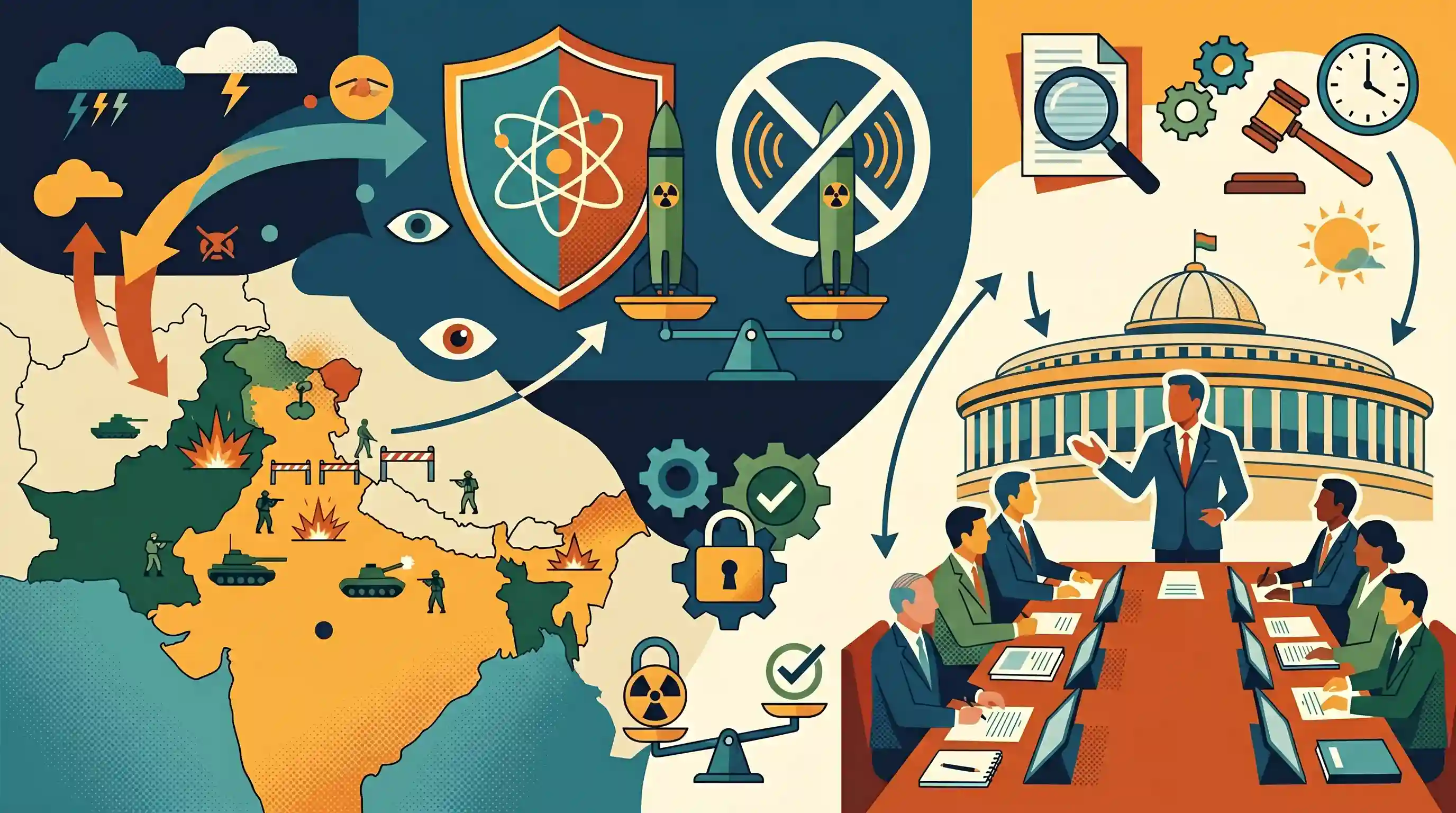
Foreign Secretary Vikram Misri briefed the Parliamentary Standing Committee on External Affairs on India-Pakistan relations, asserting that the ongoing conflict remains strictly within the conventional domain. He emphasized that there is currently no "nuclear signalling" between the two nations, suggesting that despite persistent issues such as cross-border terrorism and bilateral distrust, the threat of nuclear escalation remains at bay. The briefing highlights the stability of India's deterrence posture and showcases the vital oversight role of parliamentary committees in matters of foreign policy.
Key Points
- Foreign Secretary Vikram Misri briefed the Parliamentary Standing Committee on External Affairs regarding the current state of India-Pakistan relations.
- He stated that the conflict and friction between the two countries currently remain confined to the conventional domain.
- Misri clarified that there is no "nuclear signalling" from either side, indicating that despite ongoing tensions, the threshold for nuclear escalation has not been breached.
- The briefing underscores the role of Parliamentary Standing Committees in maintaining oversight and seeking transparency on sensitive foreign policy and national security issues.
Important Terms
Parliamentary Standing Committee on External Affairs

A 31-member permanent legislative body (21 Lok Sabha, 10 Rajya Sabha) providing specialized oversight of India's foreign policy and the Ministry of External Affairs' operations.
UPSC context
GS Paper II: Parliamentary Committees and executive accountability; tests understanding of legislative oversight in foreign affairs.
Nuclear Signalling
The use of overt threats, subtle diplomatic cues, or movement of nuclear assets to communicate strategic intent and deter an adversary during a crisis.
UPSC context
GS Paper III: Security challenges and India’s nuclear doctrine; tests awareness of strategic communication and escalation management.
Conventional Domain
The sphere of military conflict involving traditional non-nuclear forces (Army, Navy, Air Force) and weaponry, separate from the nuclear threshold.
UPSC context
GS Paper III: Internal security and border management; tests understanding of the threshold between localized conflict and all-out war.
No First Use (NFU) Policy
A key pillar of India's nuclear doctrine stating that nuclear weapons will only be used in retaliation for a nuclear, biological, or chemical attack.
UPSC context
GS Paper III: Science & Technology and Security; fundamental for questions on India's strategic stability and international posture.
Credible Minimum Deterrence
The strategic requirement to maintain a small but sufficient and survivable nuclear arsenal to ensure an effective retaliatory strike against any aggressor.
UPSC context
GS Paper III: Security challenges; tests understanding of how India balances defense needs with regional stability and non-proliferation goals.
Nuclear Command Authority (NCA)
The civilian-led body responsible for command, control, and operational decisions regarding India's nuclear weapons, chaired by the Prime Minister.
UPSC context
GS Paper II & III: Governance and Security; tests knowledge of the institutional framework governing strategic weapons and civilian-military relations.
Stability-Instability Paradox
A strategic theory suggesting that nuclear weapons create stability at the high-intensity level while encouraging low-intensity conventional or proxy conflicts.
UPSC context
GS Paper II & III: International Relations and Internal Security; explains the persistence of sub-conventional warfare between nuclear states.
Prelims Trap
"India's No First Use policy strictly prohibits any first use of nuclear weapons under all circumstances."
India's 2003 doctrine actually retains the option of nuclear retaliation in the event of a major attack against India, or Indian forces anywhere, by biological or chemical weapons.
Static Concepts Connected
What are the core pillars of India's 2003 Nuclear Doctrine?
- NFU & Exceptions: Strict No First Use against non-nuclear weapon states, but retains the nuclear option against major biological or chemical attacks.
- Massive Retaliation: Nuclear retaliation to a first strike will be massive and designed to inflict unacceptable damage to the adversary.
- Civilian Control: Nuclear retaliatory attacks can only be authorized by the civilian political leadership through the Nuclear Command Authority (NCA).
How are Department-Related Standing Committees (DRSCs) structured for oversight?
- Composition: Consists of 31 members (21 from Lok Sabha, 10 from Rajya Sabha) nominated by their respective presiding officers.
- Mandate: Examines demands for grants, bills, and national policies (like MEA strategies) without discussing day-to-day administration.
- Nature of Advice: Their recommendations are persuasive and advisory, not binding on the executive.
Cross-Topic Patterns
Nuclear Doctrine + Emerging Tech
AI and hypersonic glide vehicles challenge traditional 'Credible Minimum Deterrence' by drastically reducing decision times, potentially prompting a review of static NFU doctrines globally.
DRSCs + Executive Privilege
While parliamentary committees ensure executive accountability, the government often restricts sharing sensitive nuclear or defense details with DRSCs, citing national security and executive privilege.

India's Nuclear Doctrine exceptions + DRSC powers to summon officials likely to form a dual-statement polity/IR question in 2026.
Linked PYQs · 3
Linked PYQs · 3
- 2015MainsGS2
Terrorist activities and mutual distrust have clouded India-Pakistan relations. To what extent the use of soft power like sports and cultural exchanges could help generate goodwill between the two countries? Discuss with suitable examples.
- 2021MainsGS2
Do Department-related Parliamentary Standing Committees keep the administration on its toes and inspire reverence for parliamentary control? Evaluate the working of such committees with suitable examples.
- 2023MainsGS2
Explain the structure of the Parliamentary Committee system. How far have the financial committees helped in the institutionalisation of Indian Parliament?
