Parliamentary panel briefed on conventional domain India Pakistan ties
Source:Indian Express ↗
Why It Matters
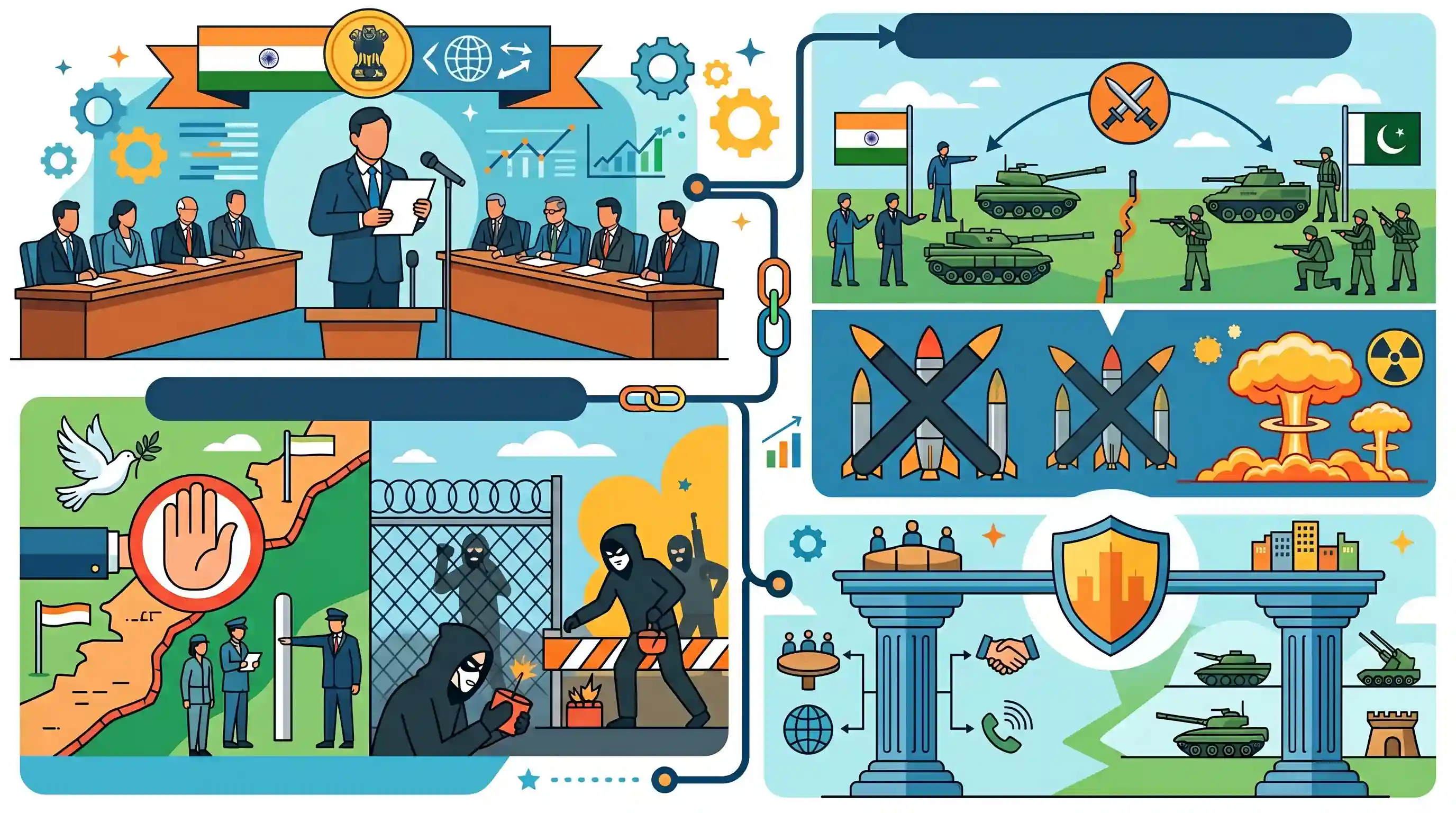
It illustrates the operational threshold of India's deterrence posture against Pakistan—proving that conventional responses to terrorism do not automatically cross the nuclear threshold. It also highlights the active role of parliamentary oversight mechanisms in ensuring executive accountability in foreign policy.
Summary
Foreign Secretary Vikram Misri briefed the Parliamentary Standing Committee on External Affairs, stating that current conflicts and tensions between India and Pakistan are strictly confined to the conventional domain. He emphasized that there is no nuclear signalling or posturing from either side. The discussion also highlighted the status of the Line of Control (LoC) ceasefire and ongoing challenges with cross-border terrorism, underlining the importance of diplomatic and conventional deterrence in managing bilateral relations.
Key Points
- Foreign Secretary Vikram Misri assured lawmakers that despite strained relations, India-Pakistan friction remains strictly within the conventional military domain without any nuclear posturing.
- The briefing underscored the ongoing relevance of the Line of Control (LoC) ceasefire, which was reaffirmed by both sides in 2021, in maintaining regional stability.
- Highlights the deliberate separation of conventional skirmishes (such as responses to cross-border terrorism) from the nuclear threshold in India's strategic and military calculations.
- Emphasizes the critical oversight role of Department-related Parliamentary Standing Committees in reviewing the executive's handling of sensitive foreign policy and national security matters.
Important Terms
Parliamentary Standing Committee on External Affairs

A permanent Department-Related Standing Committee of the Indian Parliament (21 Lok Sabha, 10 Rajya Sabha members) that exercises legislative oversight over the Ministry of External Affairs' policies, budgets, and conduct.
UPSC context
GS Paper 2: Parliament—Structure and functioning of committees; Executive accountability to the legislature in foreign policy.
2003 Ceasefire Agreement
A bilateral truce between India and Pakistan along the Line of Control (LoC). Reaffirmed in 2021, it aims to halt cross-border firing and reduce civilian casualties in border villages.
UPSC context
GS Paper 2: India and its neighborhood—relations; bilateral agreements and peace-building measures in South Asia.
Nuclear Signalling
Verbal or non-verbal communication (e.g., troop movements, missile tests) by nuclear-armed states to indicate intent, resolve, or escalation thresholds to deter an adversary during a crisis.
UPSC context
GS Paper 3: Security challenges; Nuclear Doctrine and strategic deterrence; managing escalation in regional conflicts.
Conventional Domain
A sphere of warfare utilizing traditional military forces, such as infantry, armor, and air power, while remaining below the threshold of using non-conventional (nuclear, biological, or chemical) weapons.
UPSC context
GS Paper 3: Internal Security; military strategy and the distinction between traditional warfare and nuclear escalation.
Cross-border Terrorism
A form of proxy warfare where one state uses its soil or support to launch terrorist activities against a neighbor, aimed at causing instability and avoiding direct full-scale war.
UPSC context
GS Paper 3: Security challenges and their management in border areas; role of non-state actors in asymmetric warfare.
Line of Control (LoC)
The 740 km de facto military boundary dividing Jammu and Kashmir between India and Pakistan, established after the 1971 war and codified in the 1972 Simla Agreement.
UPSC context
GS Paper 3: Border management; sovereignty disputes and geographical challenges in national security.
Prelims Trap
"India's 'No First Use' nuclear policy is absolute and applies universally against all non-nuclear threats."
India retains the option of nuclear retaliation in response to major biological or chemical weapon attacks, making the NFU policy conditional, not strictly absolute.
Static Concepts Connected
What are the key pillars of India's 2003 Nuclear Doctrine?
- No First Use: Nuclear weapons will only be used in retaliation against a nuclear attack on Indian territory or forces anywhere.
- Massive Retaliation: Nuclear retaliation to a first strike will be massive and designed to inflict unacceptable damage.
- CBW Exception: India retains the option of nuclear retaliation in the event of a major biological or chemical weapons attack.
What are the rules governing Department-Related Standing Committees (DRSCs)?
- Composition: Each of the 24 committees consists of 31 members: 21 from the Lok Sabha and 10 from the Rajya Sabha.
- Minister Restriction: A Minister is expressly prohibited from being nominated as a member of any DRSC.
- Core Mandate: They examine Demands for Grants, review bills referred by the Presiding Officers, and scrutinize annual reports of Ministries.
Cross-Topic Patterns
Sub-conventional war vs. Nuclear thresholds
Pakistan's use of cross-border terrorism seeks to exploit the space below India's conventional response threshold, testing the limits of India's nuclear deterrence and its Cold Start doctrine.
Legislative oversight of Foreign Policy
While foreign policy is heavily executive-driven under the Union List, DRSCs provide the crucial parliamentary mechanism to ensure executive accountability without compromising state secrets.

Expect a 2026 Prelims statement mixing the 'biological/chemical weapon' exception of India's Nuclear Doctrine with DRSC membership rules.
Linked PYQs · 4
Linked PYQs · 4
- 2021MainsGS2
Do Department-related Parliamentary Standing Committees keep the administration on its toes and inspire reverence for parliamentary control? Evaluate the working of such committees with suitable examples.
- 2015MainsGS2
Terrorist activities and mutual distrust have clouded India-Pakistan relations. To what extent the use of soft power like sports and cultural exchanges could help generate goodwill between the two countries? Discuss with suitable examples.
- 2016MainsGS2
Increasing cross-border terrorist attacks in India and growing interference in the internal affairs of several member-states by Pakistan are not conducive for the future of SAARC (South Asian Association for Regional Cooperation)." Explain with suitable examples.
- 2020MainsGS3
For effective border area management, discuss the steps required to be taken to deny local support to militants and also suggest ways to manage favourable perception among locals.
