Nuclear Energy Expansion and Human Resource Development Challenges
Source:Indian Express ↗
Why It Matters
The article provides a crucial interdisciplinary linkage between India's clean energy transition (GS3) and the practical challenges of education and skill development (GS2/GS3). It is highly relevant for mains answers analyzing the constraints in India's nuclear power program and evaluating human resource policies.
Summary
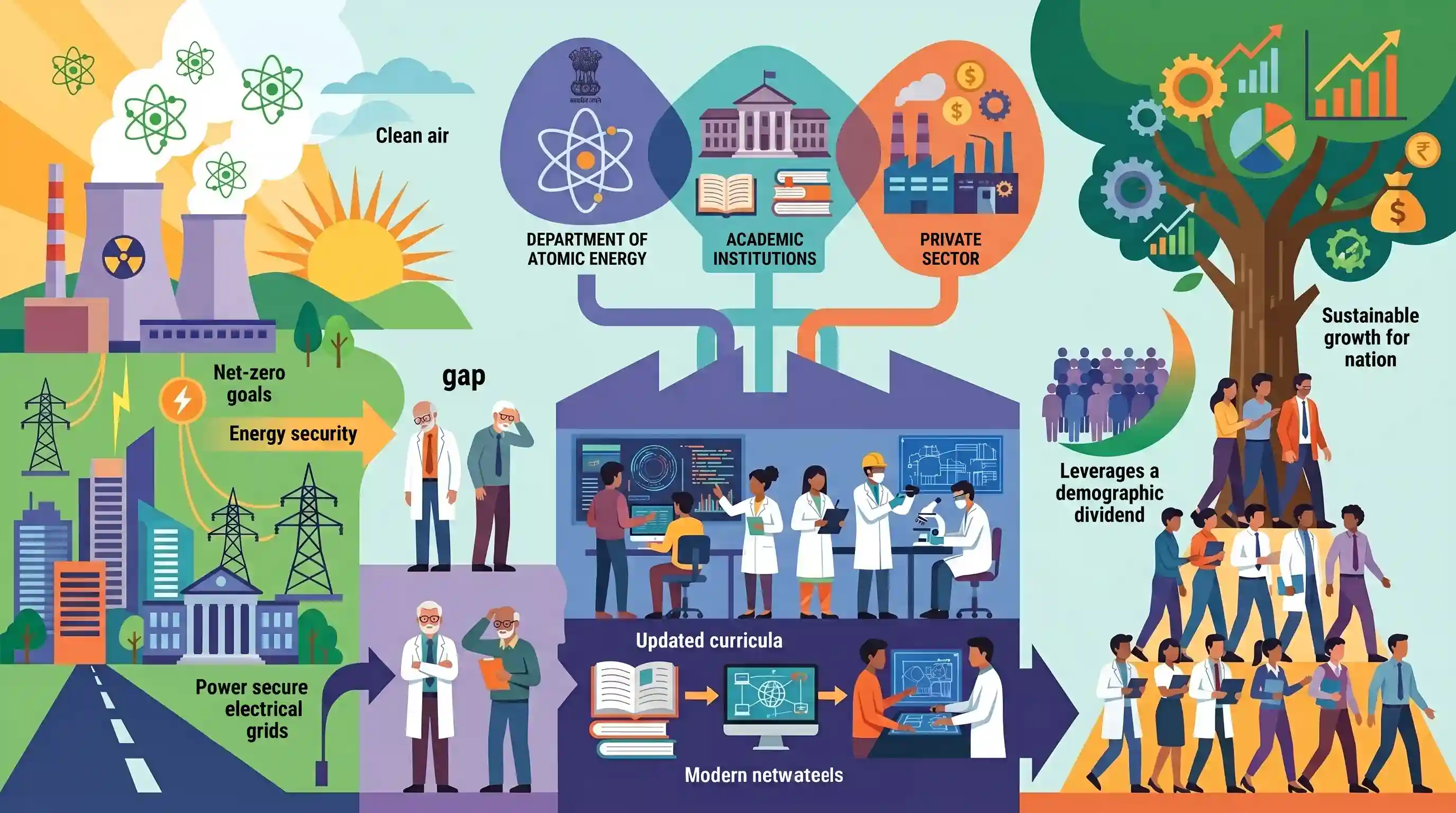
The article underscores that India's ambitious plans to expand nuclear energy—crucial for achieving net-zero goals and energy security—must be matched by an equally robust initiative to build human capital. While securing technology and financial investments is important, the sector faces a pressing need for a highly skilled workforce, including nuclear scientists, engineers, and safety experts. The author calls for revamping educational curricula and fostering stronger synergies between the Department of Atomic Energy, academic institutions, and the private sector to bridge the talent gap. Aligning skill development with this high-tech sector is presented as essential to leveraging India's demographic dividend for long-term sustainable growth.
Key Points
- India's objective to significantly expand its nuclear energy capacity is a vital component of its strategy to ensure energy security and meet the net-zero emissions target by 2070.
- The ambitious nuclear push is constrained by a potential shortfall in specialized human capital, necessitating a surge in trained nuclear engineers, safety personnel, and researchers.
- There is an urgent need to revamp university curricula to include specialized academic and vocational courses tailored to nuclear technology, radiation physics, and reactor operations.
- Fostering strong institutional linkages between the government (e.g., DAE), the private sector, and academia is critical to developing targeted skill-building programs.
- Channelling India's demographic dividend into high-technology, skill-intensive sectors like nuclear energy will drive innovation and sustainable economic growth.
Important Terms
Three-Stage Nuclear Power Programme

A strategic framework (PHWRs, FBRs, Thorium reactors) envisioned by Homi Bhabha to achieve energy independence by utilizing India's vast thorium reserves.
UPSC context
GS Paper III (Science & Tech); crucial for understanding India's unique nuclear energy roadmap and indigenization.
Net Zero 2070
India's COP26 commitment to balance total greenhouse gas emissions released with those removed from the atmosphere by 2070.
UPSC context
GS Paper III (Environment); tests knowledge of climate targets, 'Panchamrit' strategy, and sustainable development.
Demographic Dividend
The economic growth potential resulting from a shift in a population's age structure, specifically when the working-age population (15-64) exceeds the dependent population.
UPSC context
GS Paper I (Society) & GS III (Economy); focuses on human capital, employability, and socio-economic challenges.
Department of Atomic Energy (DAE)
A department under the Prime Minister's Office responsible for nuclear technology, power generation, and research in radiation applications (est. 1954).
UPSC context
GS Paper III (S&T); tests institutional structures and the executive control of strategic sectors.
Skill India Mission
A flagship government initiative launched in 2015 to unify the skilling ecosystem and provide market-relevant vocational training to the youth.
UPSC context
GS Paper II (Social Justice/Governance); evaluates strategies for human resource development and addressing the skill gap.
Nuclear Power Corporation of India Limited (NPCIL)
A Public Sector Enterprise under the DAE responsible for the design, construction, commissioning, and operation of India's commercial nuclear power reactors.
UPSC context
GS Paper III (Infrastructure/Economy); focuses on the role of PSUs in energy security and industrial growth.
Prelims Trap
Private sector companies are now permitted to operate commercial nuclear power plants in India.
Under the Atomic Energy Act, private entities can invest in technology and supply components, but only government-owned entities (like NPCIL) can operate plants.
Static Concepts Connected
What are Small Modular Reactors (SMRs) and their advantages?
- Capacity & Design: They have a capacity of up to 300 MW per unit and are factory-built in modules, making them highly portable and scalable.
- Passive Safety: They rely on natural phenomena like gravity and convection for cooling, significantly reducing the risk of core meltdowns without requiring external power.
- Grid Flexibility: They can provide stable baseload power to complement intermittent renewables, making them ideal for remote or off-grid locations.
What is the legal framework governing India's nuclear sector?
- Atomic Energy Act 1962: Grants the Central Government a monopoly over the production, development, and control of atomic energy, effectively barring private operations.
- Civil Liability Act 2010: Places strict, no-fault liability on the nuclear plant operator (PSUs), but includes a controversial right of recourse against equipment suppliers.
Cross-Topic Patterns
Demographic Dividend + Green Transition
Shifting from coal to nuclear creates structural unemployment risks. India's demographic dividend must be actively upskilled in high-tech fields like reactor operations to enable a just green transition.
Space vs. Nuclear Privatization
Unlike the space sector's full privatization push via IN-SPACe, nuclear energy retains a strict PSU monopoly on operations, restricting the private sector to component supply and co-financing.

Expect a 2026 Mains question linking the deployment of Small Modular Reactors (SMRs) to India's specialized skill deficit and private R&D.
Linked PYQs · 5
Linked PYQs · 5
- 2025MainsGS3
The fusion energy programme in India has steadily evolved over the past few decades. Mention India's contributions to the international fusion energy project International Thermonuclear Experimental Reactor (ITER). What will be the implications of the success of this project for the future of global energy?
- 2022MainsGS3
Do you think India will meet 50 percent of its energy needs from renewable energy by 2030 ? Justify your answer. How will the shift of subsidies from fossil fuels to renewables help achieve the above objective ? Explain.
- 2018MainsGS3
“Access to affordable, reliable, sustainable and modern energy is the sine qua non to achieve Sustainable Development Goals (SDGs).” Comment on the progress made in India in this regard.
- 2023MainsGS2
Skill development programmes have succeeded in increasing human resources supply to various sectors. In the context of the statement analyse the linkages between education, skill and employment.
- 2016MainsGS2
Demographic Dividend in India will remain only theoretical unless our manpower becomes more educated, aware, skilled and creative." What measures have been taken by the government to enhance the capacity of our population to be more productive and employable?
