NTPC commissions additional solar capacity for round the clock energy
Source:bioenergytimes ↗
Why It Matters
Highlights the role of major Central PSUs like NTPC and ONGC in India's green energy transition. The focus on Round-The-Clock (RTC) renewable energy projects is highly significant for resolving the intermittency issues of solar and wind power, ensuring uninterrupted grid stability. Furthermore, it reinforces Rajasthan's position as a premier hub for large-scale solar and renewable power generation.
Summary
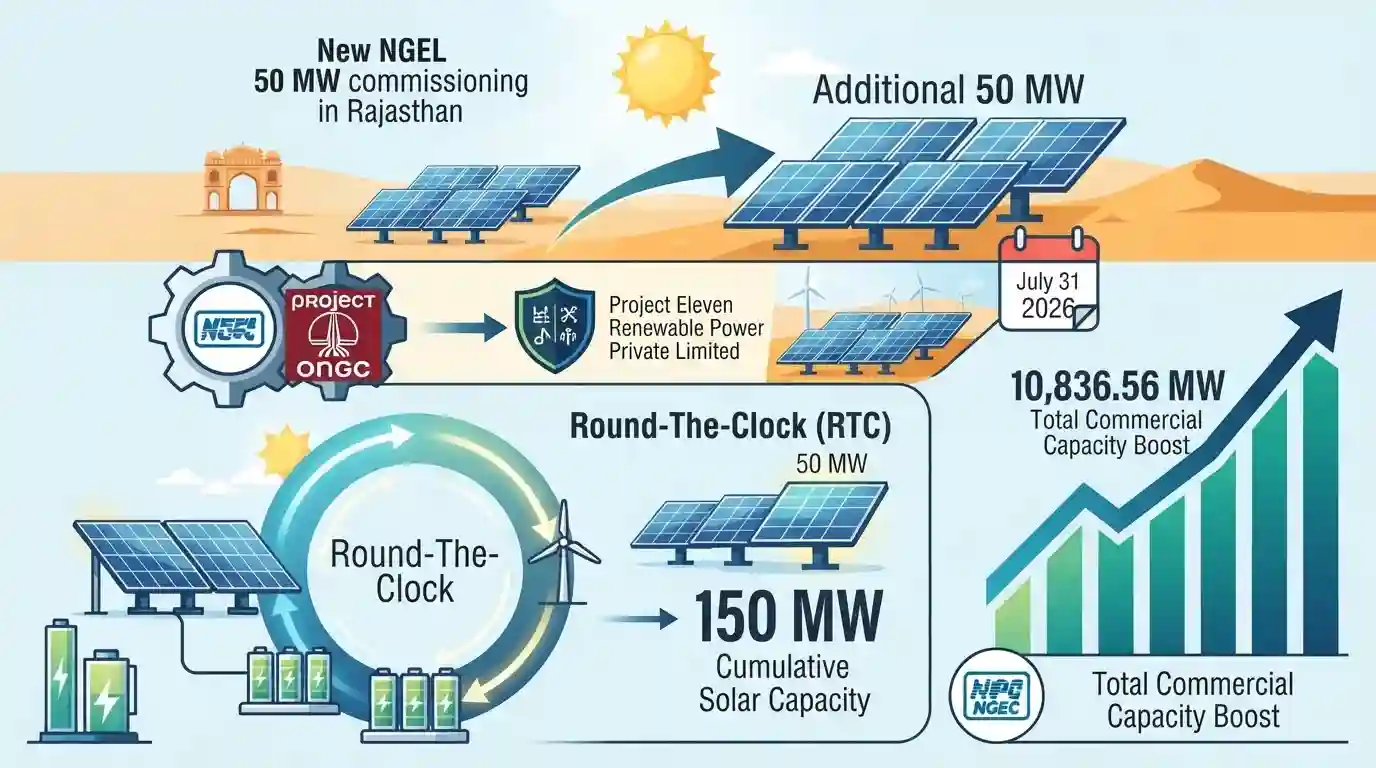
NTPC Green Energy Limited (NGEL) has commissioned an additional 50 MW of solar capacity in Rajasthan, effective July 31, 2026. The project was developed by Project Eleven Renewable Power Private Limited, a subsidiary of the NGEL and ONGC joint venture. This expansion is part of a 100 MW Renewable Energy Round-The-Clock (RTC) project, bringing its cumulative solar component to 150 MW and boosting NGEL's total commercial capacity to 10,836.56 MW.
Key Points
- NTPC Green Energy Limited (NGEL) commissioned an additional 50 MW of solar capacity in Rajasthan on July 31, 2026.
- The commissioning was executed by Project Eleven Renewable Power Private Limited, a subsidiary of ONGC NTPC Green Private Limited.
- This addition marks the third part of the solar component under NGEL\'s 100 MW Renewable Energy Round-The-Clock (RTC) project in Rajasthan.
- The cumulative solar component of this RTC renewable energy project has now reached 150 MW.
- The total commercial capacity of the NGEL group has increased to 10,836.56 MW following this commissioning.
Important Terms
NTPC Green Energy Limited (NGEL)

A subsidiary of NTPC Limited focused on developing and managing large-scale utility renewable energy capacities, including solar and wind, across India.
UPSC context
GS Paper 3 (Energy). Demonstrates the role of central Public Sector Undertakings in achieving India's clean energy targets.
Round-the-Clock (RTC) Renewable Energy
A clean energy model combining renewable generation (like solar and wind) with energy storage to guarantee firm, continuous, and reliable power supply 24/7 without intermittency.
UPSC context
GS Paper 3 (Infrastructure). Tests knowledge on resolving renewable energy intermittency and transitioning to dispatchable green power.
ONGC NTPC Green Private Limited
A 50:50 joint venture between Maharatna PSUs ONGC Green Limited and NTPC Green Energy Limited to collaboratively develop massive renewable energy projects.
UPSC context
GS Paper 3 (Indian Economy). Highlights strategic public-sector consolidation and collaboration driving India's energy transition initiatives.
Project Eleven Renewable Power Private Limited
A step-down subsidiary and special purpose vehicle under the ONGC-NTPC joint venture, created specifically to implement targeted hybrid renewable energy and round-the-clock power projects in India.
UPSC context
GS Paper 3 (Investment Models). Showcases the use of Special Purpose Vehicles (SPVs) for executing large-scale infrastructure projects.
Prelims Trap
Round-the-Clock (RTC) solar power projects generate zero-emission energy continuously 24/7 without needing external storage or energy bundling.
RTC is a bundling/hybrid model. Solar power itself cannot be generated at night; the 24/7 supply is achieved by integrating storage or conventional energy.
Static Concepts Connected
What is Round-the-Clock (RTC) Renewable Energy?
- Addressing Intermittency: Bundles solar and wind with storage systems (BESS/pumped hydro) or conventional power to ensure continuous, non-intermittent power supply.
- Regulatory Threshold: Ministry of Power guidelines mandate that at least 51% of energy supplied annually under RTC power contracts must come from renewable sources.
- Grid Balancing: Reduces reliance on coal-based peaking plants and ensures voltage/frequency stability across the National Grid.
What are the financial criteria for Maharatna CPSE status?
- Prior Status: The Central Public Sector Enterprise (CPSE) must already hold Navratna status and be listed on Indian stock exchanges.
- Financial Thresholds: Requires an average annual net profit > Rs 5,000cr, net worth > Rs 15,000cr, and turnover > Rs 25,000cr over the preceding 3 years.
- Autonomy Benefit: Grants financial autonomy to invest up to Rs 5,000 crore or 15% of their net worth in a project without government approval.
Cross-Topic Patterns
RTC Power & Grid Infrastructure
Transitioning from standalone solar to Round-the-Clock power links resource geography with GS-3 technology challenges in Battery Energy Storage Systems (BESS).
PSU Diversification & Climate Action
JVs between fossil fuel giants (ONGC) and power majors (NTPC) reflect structural corporate realignments to meet India's COP26 Panchamrit commitments.

Mains 2026 is highly likely to evaluate the economic viability of RTC power tariffs against traditional coal-based baseload power.
Linked PYQs · 3
Linked PYQs · 3
- 2023RPSC_PRELIMSGS1
Which agency has been given the responsibility of implementing the PM-KUSUM scheme (Component A) in Rajasthan, which involves the establishment of solar power plants with a capacity of 0.5 MW to 2 MW?
- 2021RPSC_PRELIMSGS1
In which year was the Rajasthan Solar Energy Policy announced?
- 2013RPSC_PRELIMSGS1
What is the highest installed capacity considered for the current supercritical power plant in Rajasthan?
