New South Wales and Maharashtra Sister-State Partnership Renewal
Source:nsw-gov-au ↗
Why It Matters
Sub-national diplomacy and sister-state agreements like the one between Maharashtra and New South Wales play a critical role in expanding trade, cross-border investments, educational exchange, and bilateral technological collaboration between India and Australia.
Summary
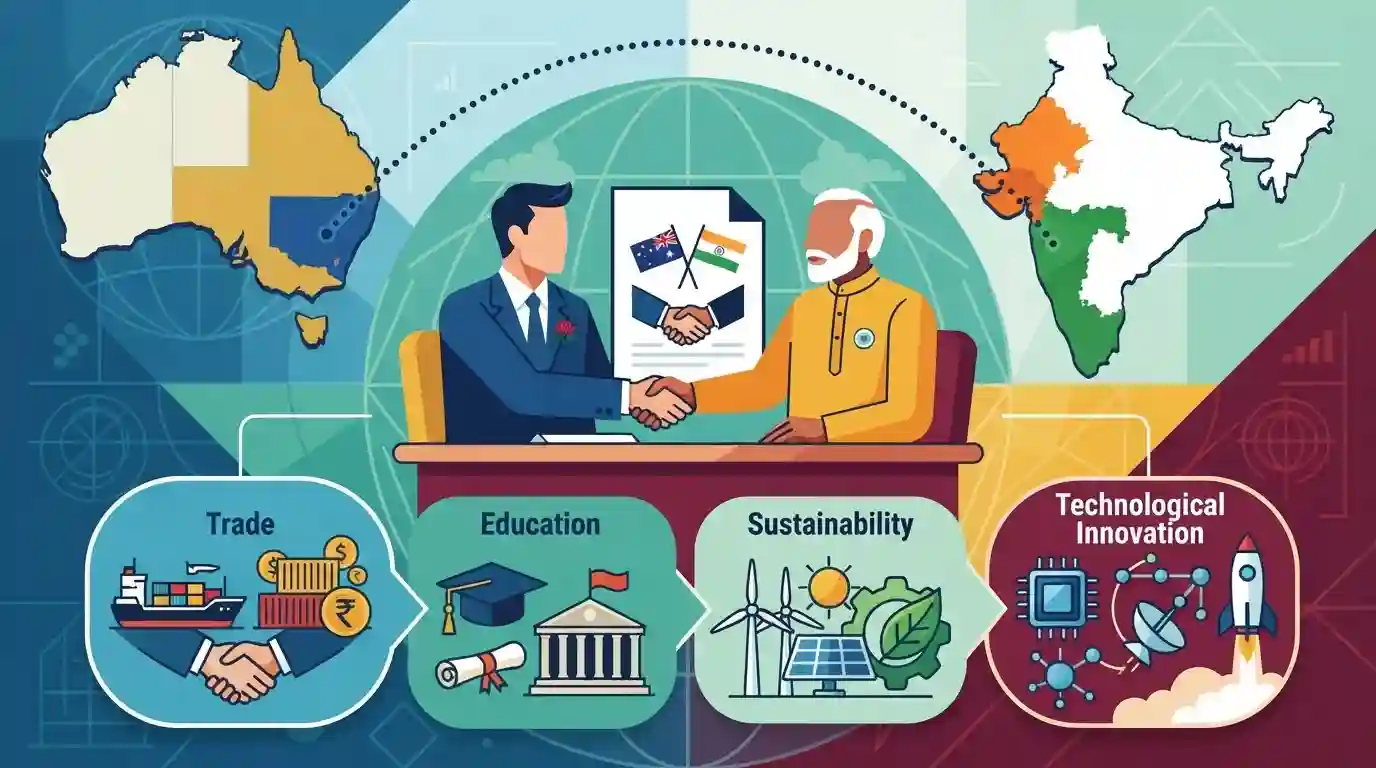
New South Wales and Maharashtra have formally renewed their long-standing sister-state partnership, aiming to boost collaboration across trade, education, sustainability, and technological innovation, thereby strengthening economic and diplomatic ties between Australia and India's Maharashtra state.
Key Points
- New South Wales (NSW) and Maharashtra have renewed their sister-state partnership to foster bilateral cooperation, economic growth, and cultural exchanges.
- The agreement aims to unlock new opportunities in trade, investment, education, sustainability, and technological innovation between Australia's NSW and India's leading economic powerhouse, Maharashtra.
- The renewal emphasizes deepening institutional ties, sharing best practices in governance and urban development, and supporting joint commercial ventures.
Important Terms
Sister State Partnership Agreement

A formal cooperative agreement between sub-national states or provinces of different countries to promote trade, cultural exchange, education, and technical collaboration.
UPSC context
Relevant for MPSC International Relations and Bilateral Groupings, testing sub-national diplomacy and economic cooperation between India and Australia.
Government of New South Wales
The sub-national governing authority of New South Wales, Australia's most populous state, responsible for local governance, state economic strategies, and international partnerships.
UPSC context
Important for MPSC syllabus on international affairs, assessing sub-national diplomatic engagements with Indian states like Maharashtra.
Government of Maharashtra
The executive government of Maharashtra, India's leading industrial and financial hub, which engages in international state-level pacts to boost trade and innovation.
UPSC context
Relevant for MPSC Polity and International Relations, highlighting state-level foreign outreach and economic agreements.
Static Concepts Connected
What are the constitutional provisions regarding states entering into international agreements or treaties in India?
- Union List Control: Entries 10 and 11 of Union List (List I) grant Parliament exclusive power over foreign affairs and diplomatic representation.
- Sub-national Limits: States cannot execute binding international treaties independently; MoUs and sister-state pacts are collaborative arrangements facilitated through central concurrence.
- Article 253 Power: Article 253 empowers Parliament to legislate for implementing international treaties or conventions nationwide.
Cross-Topic Patterns
Sub-national Diplomacy & National Trade Pacts
State-level MoUs operate parallel to national agreements like the India-Australia ECTA, illustrating multi-layered federal diplomacy in foreign policy.
Clean Energy Transition & State Mining Pacts
Critical minerals and green tech collaborations mirror national net-zero commitments while opening sub-national commercial execution pathways.

MPSC may test the year of initial partnership (2012) or key sectors under the renewed NSW-Maharashtra MoU.
Linked PYQs · 2
Linked PYQs · 2
- 2018MPSC_PRELIMSGS1
Government of Maharashtra's Sumatibai Sukalikar Udyogini Mahila Sakshamikaran Yojana is related to
- 2026MPSC_PRELIMSGS1
Observe the following statements. (a) As per the State Mineral Policy 1999, iron, sulphur, gold, copper and lead mineral production was opened to the private sector. (b) Konkan region has the highest mineral availability after Nagpur region. (c) Maharashtra State Mining Corporation was established in 1973.
