National Sample Survey and Economic Planning in India
Source:The Hindu ↗
Why It Matters
Understanding India's statistical machinery is crucial for UPSC aspirants, as data forms the bedrock for analyzing economic issues (GS3), evaluating government policies (GS2), and understanding historical contributions to nation-building post-independence (GS1).
Summary
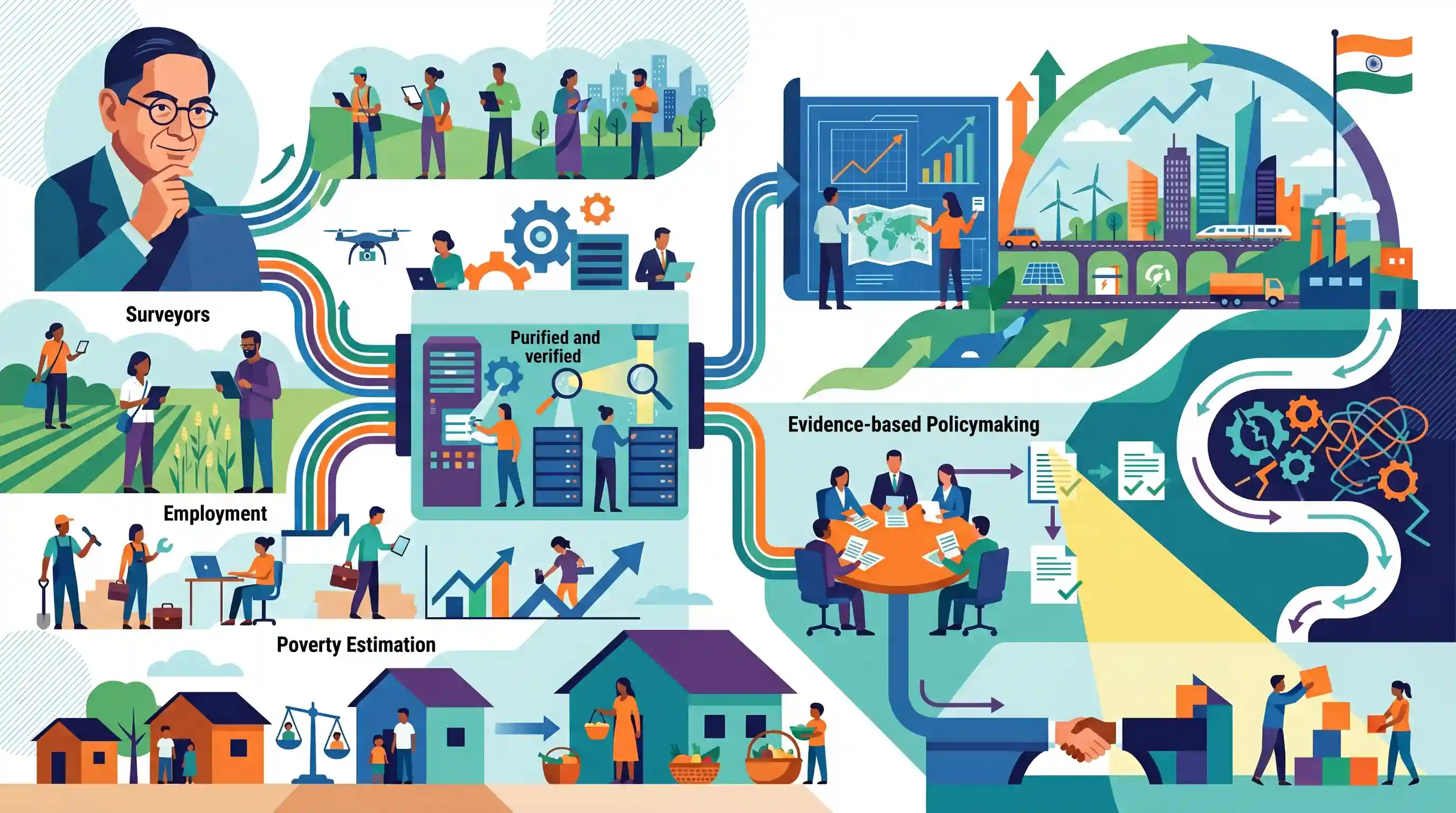
The article underscores the fundamental role of the National Sample Survey (NSS) in shaping India's economic planning and evidence-based policy formulation. Tracing its origins to the vision of P.C. Mahalanobis, it emphasizes how reliable, independently collected statistics on consumption, employment, and poverty are critical for governance. The piece highlights the continued necessity for robust and transparent statistical institutions to effectively track national progress and address structural economic challenges.
Key Points
- The National Sample Survey (NSS) was established to create a robust, independent database essential for national economic planning and calculating national income.
- P.C. Mahalanobis played a foundational role in building India's statistical architecture, prioritizing data collection to inform governance.
- NSS data has historically been the backbone for estimating critical socio-economic indicators like poverty lines, employment rates, and household consumption expenditure.
- Maintaining the autonomy, transparency, and regularity of statistical institutions like the NSSO is vital for formulating accurate, evidence-based policies to tackle structural challenges such as unemployment.
Important Terms
Ministry of Statistics and Programme Implementation (MoSPI)

Nodal ministry responsible for the coverage and quality aspects of statistics released in India. It oversees the implementation of major programs and ensures data-driven governance through the National Statistical Office (NSO).
UPSC context
General Studies Paper III: Economic Development and Governance. Crucial for understanding the institutional framework of India's statistical system.
National Statistical Office (NSO)
The central statistical agency formed in 2019 by merging the NSSO and CSO. It is responsible for compiling National Accounts (GDP), conducting socio-economic surveys, and maintaining statistical standards.
UPSC context
GS III: Indian Economy and issues relating to planning, mobilization of resources, and employment. Essential for official data interpretation.
National Sample Survey Office (NSO)
Formerly the premier body for conducting large-scale periodic socio-economic surveys on employment, consumption, and poverty. It was merged into the NSO in 2019 but remains vital in historic data contexts.
UPSC context
GS III: Poverty and Employment estimation. Tests knowledge of data collection methodologies for welfare schemes and economic planning.
Central Statistics Office (CSO)
The agency previously responsible for coordinating statistical activities and preparing National Account Statistics, including GDP and the Index of Industrial Production (IIP), before its merger into the NSO.
UPSC context
GS III: Economic Growth and Development. Important for understanding the history of national income accounting in India.
Prelims Trap
"The NSSO directly estimates and releases India's official poverty line."
The NSSO (now merged into NSO) only collects consumption data via HCES. NITI Aayog computes the actual poverty line based on expert committee methodologies.
Static Concepts Connected
What is the current structure of India's core statistical bodies?
- NSO Merger: In 2019, the NSSO and Central Statistics Office (CSO) were merged to create a unified NSO.
- Nodal Ministry: The NSO operates directly under the Ministry of Statistics and Programme Implementation (MoSPI).
- Historical Division: Historically, CSO managed National Income (GDP) while NSSO handled large-scale socio-economic surveys like PLFS and HCES. NSO now manages both.
What are the macroeconomic applications of the Household Consumption Expenditure Survey (HCES)?
- CPI Weights: Determines the weighting diagram for commodity groups to calculate the official Consumer Price Index (CPI).
- Poverty Estimation: Provides the base per-capita consumption data utilized by expert panels (e.g., Tendulkar, Rangarajan) to define poverty levels.
- GDP Rebasing: Helps in revising the base year for GDP calculations by accurately reflecting contemporary household consumption patterns.
Cross-Topic Patterns
PLFS and informal sector tracking
The shift from 5-year NSS employment surveys to the annual/quarterly Periodic Labour Force Survey (PLFS) connects directly to recurring exam questions on structural unemployment and informal sector job creation.
Survey Data & Data Protection Act
As national surveys adopt digital data collection and integrate with administrative databases (like U-DISE or EPFO), their intersection with the Digital Personal Data Protection (DPDP) Act becomes a critical GS-2 governance theme.

A multi-statement Prelims question contrasting the roles of NSO, Labour Bureau, and NITI Aayog in employment and poverty tracking is highly probable.
Linked PYQs · 3
Linked PYQs · 3
- 2023MainsGS3
Most of the unemployment in India is structural in nature. Examine the methodology adopted to compute unemployment in the country and suggest improvements.
- 2025MainsGS2
"In contemporary development models, decision-making and problem-solving responsibilities are not located close to the source of information and execution defeating the objectives of development." Critically evaluate.
- 2022PrelimsGS1
In India, which one of the following compiles information on industrial disputes, closures, retrenchments and lay-offs in factories employing workers ?
