Stock exchange initial public offering and capital market regulation
Source:The Hindu ↗
Why It Matters
The public listing of the National Stock Exchange (NSE)—a systemic Market Infrastructure Institution (MII)—is a landmark milestone for Indian financial markets. For UPSC, this highlights the regulatory intersection of corporate governance, public trust in financial markets, the role of SEBI in overseeing market intermediaries, and the structural dynamics of capital mobilization (IPOs vs. OFS). It also underscores how historical regulatory infractions (like the co-location scam) can impact market infrastructure evolution for years.
Summary
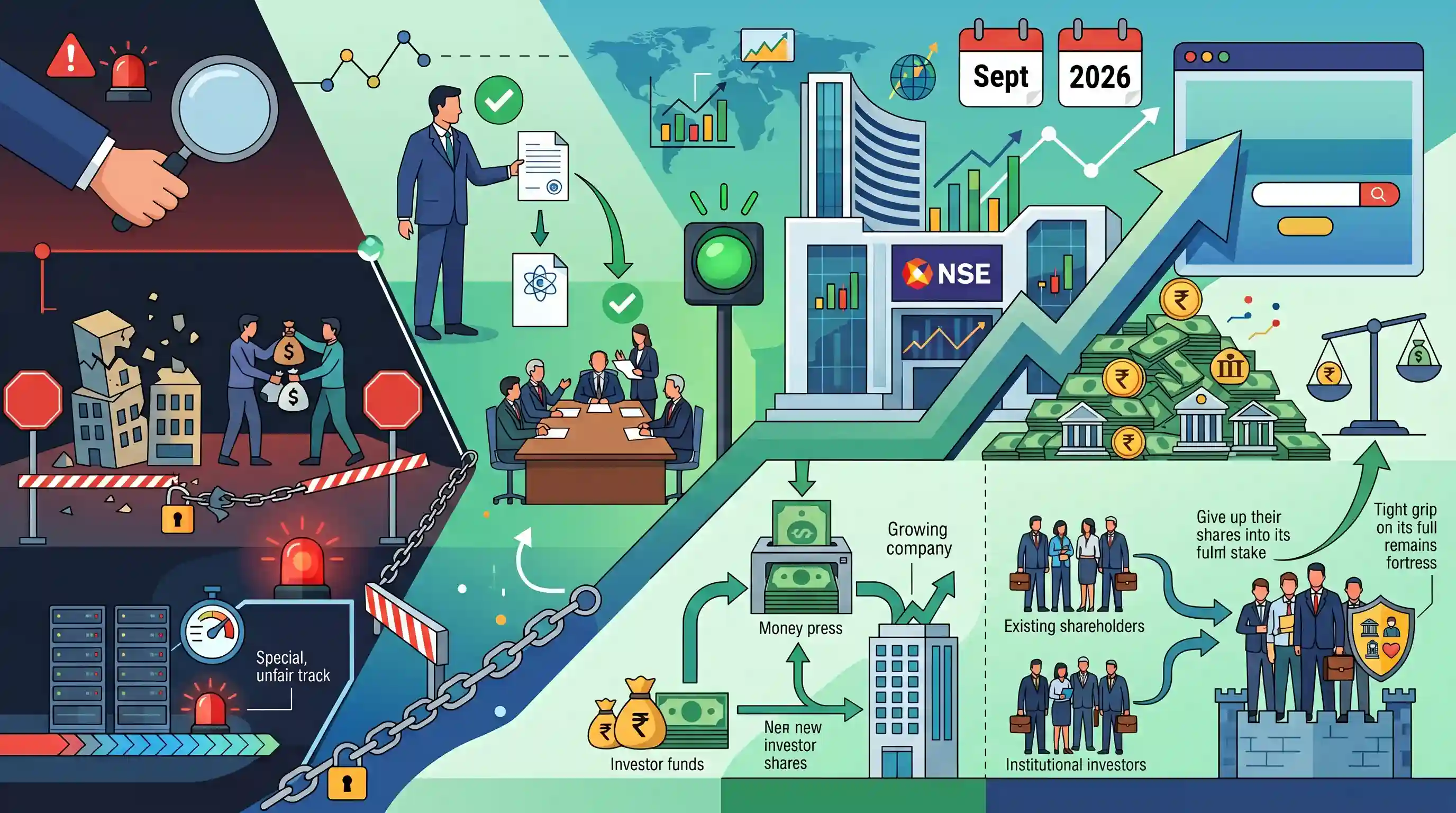
The National Stock Exchange (NSE) is targeting a massive ₹30,000 crore IPO in September 2026 via an Offer for Sale (OFS), valuing India's largest stock exchange at over ₹5 lakh crore. This mega listing, delayed since 2016 due to SEBI's investigations into corporate governance lapses and the co-location scam, was recently greenlit following SEBI's NOC and NSE board approval. Major institutional investors will sell their holdings, while LIC, the largest shareholder, will retain its full stake.
Key Points
- The National Stock Exchange (NSE) is preparing to launch a mega ₹30,000 crore Initial Public Offering (IPO) in September 2026, which is expected to value the exchange at over ₹5 lakh crore.
- The public issue will be entirely structured as an Offer for Sale (OFS) of 14.89 crore equity shares, diluting roughly 6% of the exchange's equity stake.
- Several prominent institutional shareholders (including SBI, CPPIB, Bank of Baroda, GIC, and state-owned insurers) will divest their shares, though the Life Insurance Corporation of India (LIC)—NSE's largest shareholder with a 10.72% stake—is not participating.
- The IPO path was cleared after SEBI issued a No Objection Certificate (NOC) and the NSE board subsequently gave its formal approval in February 2026.
- The NSE's IPO has been delayed since 2016 (when it first filed a DRHP to raise ₹10,000 crore) because SEBI blocked the listing due to investigations into the co-location scam and other corporate governance irregularities.
- Financially, the NSE recorded a 15% decline in Profit After Tax (PAT) to ₹10,302 crore in FY26 compared to ₹12,188 crore in FY25, with overall income dipping to ₹18,713 crore.
Important Terms
National Stock Exchange (NSE)

India's largest financial market and stock exchange, established in 1992, which pioneered electronic, screen-based trading and is known for its benchmark index, the NIFTY 50.
UPSC context
GS Paper III (Indian Economy). Tests knowledge of capital market reforms, trading infrastructure, and financial regulation.
Securities and Exchange Board of India (SEBI)
The statutory regulatory authority for India's capital and securities markets, established in 1988 and given statutory powers under the SEBI Act, 1992, to protect investors and regulate market participants.
UPSC context
GS Paper III (Indian Economy). Tests understanding of regulatory bodies, financial market integrity, and corporate governance of market infrastructure institutions.
Stock Holding Corporation of India
India's premier public sector custodian and depository participant, established in 1986 under the government to offer custodial services, demat accounts, and nationwide e-stamping solutions.
UPSC context
GS Paper III (Indian Economy). Relevant for financial market intermediaries, digital financial services, and capital market infrastructure.
GIC
India's national reinsurer, established in 1972 under the GIBNA, which provides reinsurance support to life and non-life insurers, absorbing underwriting risk to maintain system-wide financial stability.
UPSC context
GS Paper III (Indian Economy). Tests knowledge of systemic financial institutions, reinsurance sector, and regulatory frameworks.
SBI
India's largest public sector commercial bank, founded originally as the Bank of Calcutta in 1806 and reconstituted under the SBI Act, 1955; designated a domestic systemically important bank.
UPSC context
GS Paper III (Indian Economy). Tests understanding of banking structures, financial reforms, systemic banking risks, and financial inclusion.
New India Assurance
India's largest multinational public sector general insurance company, founded by Sir Dorabji Tata in 1919 and nationalised in 1973; designated as a Domestic Systemically Important Insurer.
UPSC context
GS Paper III (Indian Economy). Tests understanding of non-life insurance structures and systemically important financial entities.
Prelims Trap
An Initial Public Offering (IPO) always increases a company's paid-up share capital and injects new capital into the company.
An IPO can be 100% an Offer for Sale (OFS), where existing shareholders divest their stakes. This merely transfers ownership, leaving the company's paid-up capital and treasury unchanged.
Static Concepts Connected
What are Market Infrastructure Institutions (MIIs) in India?
- Definition: MIIs are systemically critical institutions providing trading, clearing, settlement, and depository services in the capital market.
- Three Pillars: They comprise Stock Exchanges (BSE, NSE), Depositories (NSDL, CDSL), and Clearing Corporations (e.g., Indian Clearing Corporation).
- Jalan Committee: The Bimal Jalan Committee (2010) recommended treating MIIs as systemically important public utilities due to their contagion risk.
What are the SEBI ownership norms for Stock Exchanges?
- Individual Cap: A single resident individual or non-institutional investor cannot hold more than 5% of equity in a stock exchange.
- Institutional Cap: Specified financial institutions (banks, insurers, public financial entities) can hold up to 15%.
- Foreign Limit: Aggregate foreign shareholding (FDI and FPI) is capped at 49%, ensuring domestic control over critical market infrastructure.
Cross-Topic Patterns
MII governance & regulatory conflicts
The dual role of stock exchanges as profit-driven entities and first-line market regulators creates conflicts of interest, challenging corporate governance frameworks in India.
OFS route & public sector disinvestment
State-owned enterprises using the Offer for Sale route to trim stakes in financial utilities highlights the evolution of non-debt capital receipts for fiscal management.

SEBI's SECC norms on MII ownership limits and the structural difference between Fresh Issues and OFS likely to be tested in 2026.
Linked PYQs · 2
Linked PYQs · 2
- 2023PrelimsGS1
Consider the following markets: 1. Government Bond Market 2. Call Money Market 3. Treasury Bill Market 4. Stock Market How many of the above are included in capital markets?
- 2024PrelimsGS1
With reference to the Indian economy, "Collateral Borrowing and Lending Obligations" are the instruments of:
