NSDL Initial Public Offering and SEBI Regulatory Compliance
Source:The Hindu ↗
Why It Matters
Understanding the distinction between an Offer for Sale (OFS) and a fresh issue is crucial for UPSC Economy. The article also provides a real-world example of SEBI's regulatory oversight on market infrastructure institutions (depositories like NSDL and CDSL) to prevent concentration of ownership.
Summary
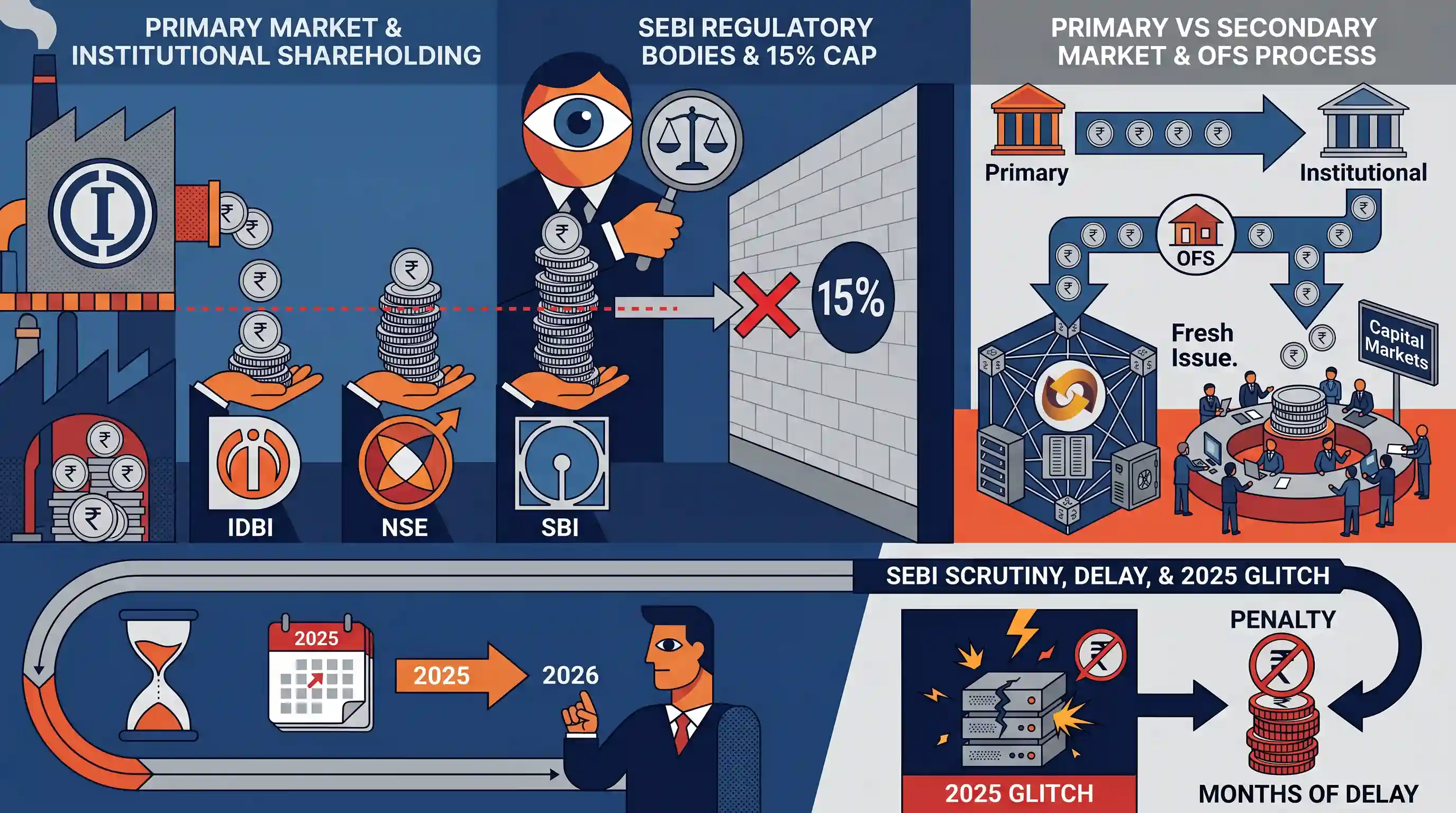
The National Securities and Depositories Ltd. (NSDL) is launching a ₹4,000 crore Initial Public Offering (IPO), structured entirely as an Offer for Sale (OFS). The public listing aims to help existing institutional shareholders like IDBI Bank, NSE, and SBI reduce their stakes to comply with SEBI regulations, which cap individual ownership in a depository at 15%. The IPO follows months of delay caused by SEBI scrutiny, notably concerning penalties related to technical glitches in NSDL's infrastructure in 2025.
Key Points
- The ₹4,000 crore NSDL IPO is entirely an Offer for Sale (OFS), meaning no fresh capital is being raised for the company; proceeds go to the exiting shareholders.
- The OFS is necessary to comply with SEBI regulations, which mandate that no single stakeholder can hold more than a 15% stake in a depository.
- Major financial institutions, including IDBI Bank, NSE, SBI, and HDFC Bank, are diluting their shares to meet the regulatory ceiling.
- The IPO was delayed due to SEBI deliberations, partially related to financial disincentives NSDL paid for technical glitches that impacted market operations in 2025.
- NSDL is one of India's two major depositories holding financial securities in electronic form, alongside CDSL, which previously went public in 2017.
Important Terms
NSDL (National Securities Depository Limited)

India's first and largest depository, established in 1996, that holds securities like shares and bonds in electronic (dematerialized) form, facilitating seamless trading and settlement.
UPSC context
GS3: Indian Economy (Capital Markets). Tests knowledge of financial market intermediaries and the evolution of dematerialization in India.
SEBI (Securities and Exchange Board of India)
The statutory regulatory body for the Indian securities market, established under the SEBI Act, 1992, to protect investors and regulate market participants and infrastructure.
UPSC context
GS2/GS3: Statutory bodies and economic regulation. Fundamental for understanding the governance of India's financial sector.
Market Infrastructure Institutions (MIIs)
Key entities—stock exchanges, clearing corporations, and depositories—that provide the essential platform and systemic infrastructure for the functioning of the capital markets.
UPSC context
GS3: Indian Economy. Important for understanding the 'backbone' of financial markets and SEBI's enhanced governance oversight.
Depository
An institution that holds financial securities in electronic form to enable their safe custody, transfer, and settlement without the need for physical certificates.
UPSC context
GS3: Economic Development. Basic conceptual term regarding how modern stock markets operate in a digital economy.
Offer for Sale (OFS)
A method where existing shareholders (like banks or institutions) sell their shares to the public to reduce their stake, with no new capital entering the company.
UPSC context
GS3: Capital Markets. Differentiates types of primary market offerings (Fresh Issue vs. OFS).
15% Ownership Cap
A SEBI regulation capping individual shareholding in a depository at 15% to ensure diverse ownership and prevent any single entity from controlling critical market infrastructure.
UPSC context
GS3: Governance and Economy. Tests awareness of regulatory measures to prevent 'too big to fail' or concentrated control issues.
Prelims Trap
"An IPO structured entirely as an Offer for Sale (OFS) helps the company raise fresh capital for infrastructure expansion."
An Offer for Sale (OFS) only transfers existing shares from current stakeholders to the public. No new capital is created, and proceeds go to the exiting shareholders, not the company.
Static Concepts Connected
What is the difference between an IPO, OFS, and FPO in capital markets?
- Initial Public Offering: The first time an unlisted company offers its shares to the public, occurring in the primary market.
- Offer for Sale: A mechanism where existing promoters or shareholders sell their shares to the public. It does not inject new capital into the company itself.
- Follow-on Public Offer: When an already listed company issues additional new shares to the public to raise more capital.
What are Market Infrastructure Institutions (MIIs) and what role do Depositories play?
- MII Classification: MIIs include stock exchanges, depositories, and clearing corporations. SEBI classifies them as systemically important because their failure could crash the broader financial ecosystem.
- Role of Depositories: Entities like NSDL and CDSL hold financial securities (shares, bonds) in dematerialized (electronic) form, enabling retail investors to securely trade via Demat accounts.
- Ownership Limits: SEBI caps individual stakeholder ownership in depositories at 15% to prevent monopolies and ensure independent governance of critical market infrastructure.
Cross-Topic Patterns
SEBI ownership caps vs RBI bank promoter limits
SEBI's 15% cap on depository ownership mirrors RBI's progressive dilution norms for private bank promoters. Both regulators use ownership ceilings to decentralize control in systemically important institutions.
MII technical glitches and systemic IT risk
Technical glitches in Market Infrastructure Institutions (MIIs) like NSDL parallel RBI's stringent actions against banks for IT failures, highlighting regulators' zero-tolerance for operational risks in digital finance.

Market Infrastructure Institutions (MIIs) and the distinction between an OFS vs fresh capital issue are prime targets for 2026 Prelims.
Linked PYQs · 4
Linked PYQs · 4
- 2023PrelimsGS1
Consider the following markets: 1. Government Bond Market 2. Call Money Market 3. Treasury Bill Market 4. Stock Market How many of the above are included in capital markets?
- 2021PrelimsGS1
With reference to India, consider the following statements : 1. Retail investors through demat account can invest in 'Treasury Bills' and 'Government of India Debt Bonds' in primary market. 2. The 'Negotiated Dealing System- Order Matching' is a government securities trading platform of the Reserve Bank of India. 3. The 'Central Depository Services Ltd.' is jointly promoted by the Reserve Bank of India and the Bombay Stock Exchange. Which of the statements given above is/are correct?
- 2019PrelimsGS1
Which of the following is issued by registered foreign portfolio investors to overseas investors who want to be part of the Indian stock market without registering themselves directly?
- 2024PrelimsGS1
Consider the following statements : 1. In India, Non-Banking Financial Companies can access the Liquidity Adjustment Facility window of the Reserve Bank of India. 2. In India, Foreign Institutional Investors can hold the Government Securities (G-Secs). 3. In India, Stock Exchanges can offer separate trading platforms for debts. Which of the statements given above is/are correct?
