NSA Ajit Doval Meets Russian President Vladimir Putin in Moscow
Source:Indian Express ↗
Why It Matters
The article is highly relevant for GS Paper 2 (International Relations) as it serves as a live case study of India navigating a multipolar world. It demonstrates the tangible costs (US tariffs) of pursuing strategic autonomy and prioritizing domestic energy security (buying discounted Russian oil), shedding light on the friction points in the India-US strategic partnership.
Summary
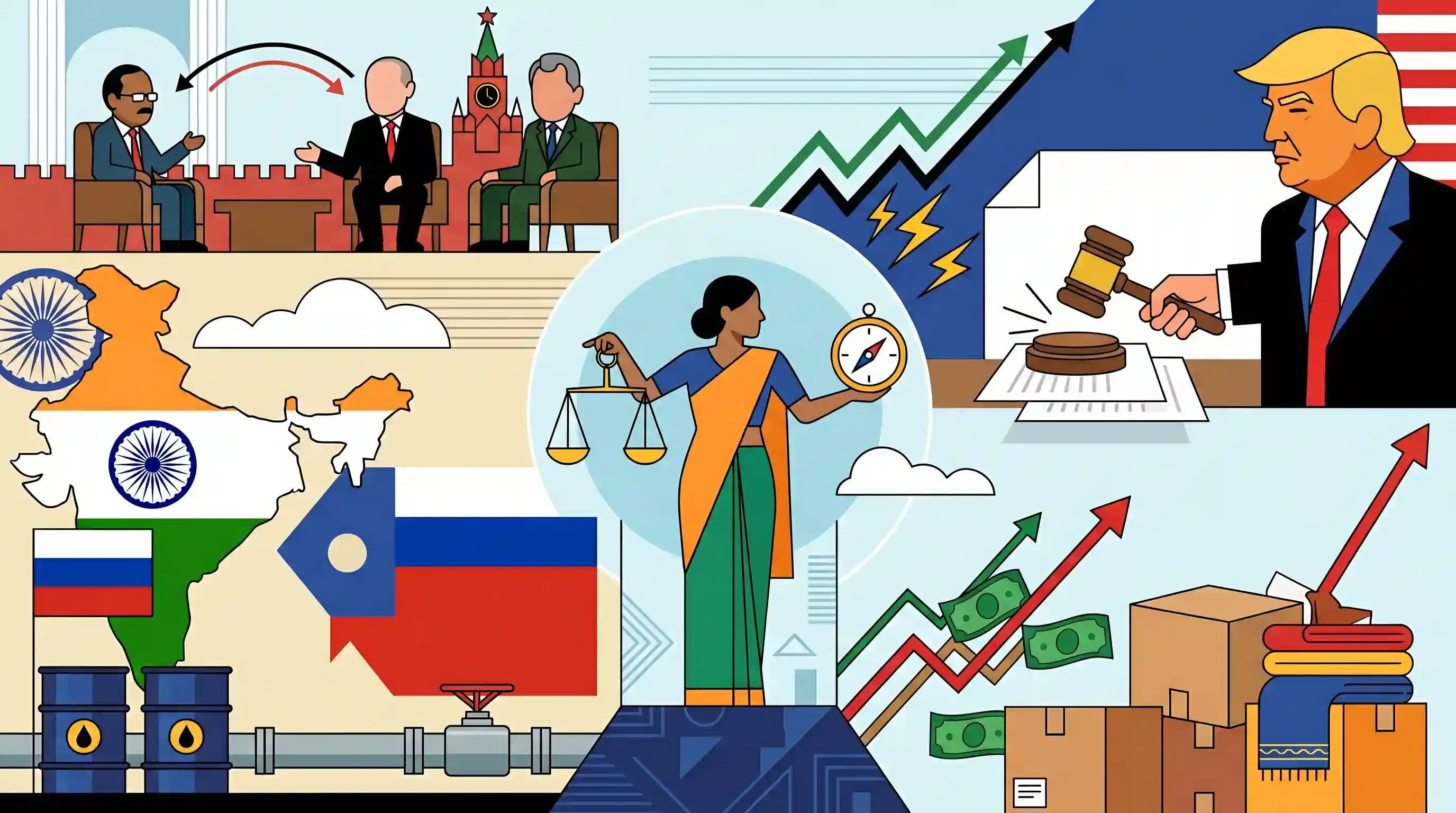
National Security Advisor Ajit Doval met with Russian President Vladimir Putin and Security Council Secretary Sergey Shoigu at the Kremlin, preparing the ground for Putin's proposed visit to India later in the year. Crucially, the visit unfolded against the backdrop of rising tensions between New Delhi and Washington. Prioritizing domestic energy security and strategic autonomy, India has continued purchasing Russian oil, prompting US President Donald Trump to issue an executive order imposing an additional 25% tariff on Indian goods (totaling 50%). This highlights the complexities India faces while balancing its historical strategic partnership with Russia against escalating economic coercion from the US.
Key Points
- National Security Advisor (NSA) Ajit Doval held talks with Russian President Vladimir Putin and Russian Security Council Secretary Sergey Shoigu in Moscow.
- The meeting paves the way for a proposed visit by President Putin to India later in 2025.
- The visit coincided with escalating diplomatic and trade frictions between India and the United States.
- US President Donald Trump imposed an additional 25% tariff on Indian goods (raising total tariffs to 50%) to retaliate against India's ongoing purchases of Russian oil.
- The situation underscores India's commitment to strategic autonomy and energy security despite growing economic pressure from the West.
Important Terms
Strategic Autonomy

A nation's ability to make independent foreign policy and security decisions based on national interest, without being constrained by external powers or alliance obligations.
UPSC context
GS Paper 2 (International Relations); essential for discussing India's shift from non-alignment to pragmatic multi-alignment.
National Security Advisor (NSA)
The chief advisor to the Prime Minister on internal and external security, heading the National Security Council (NSC) and coordinating between intelligence agencies and ministries.
UPSC context
GS Paper 3 (Internal Security); tests knowledge of India's security architecture and institutional executive powers.
Energy Security
The uninterrupted availability of energy sources at an affordable price, involving long-term investment and the ability to respond to supply-demand shocks.
UPSC context
GS Paper 3 (Economy/Environment); relates to India's high import dependency and strategic reserves.
Economic Coercion
The use of economic instruments, such as trade barriers, tariffs, or sanctions, to pressure another state into changing its policies or behavior.
UPSC context
GS Paper 2 (International Relations); tests awareness of the "weaponization of trade" in bilateral diplomacy.
Russian Security Council
A constitutional consultative body of the Russian President that coordinates and integrates national security policy and strategic interests.
UPSC context
GS Paper 2 (International Relations); provides context for India's institutional engagement with major global powers.
Tariff
A tax or duty imposed by a government on imported goods, often used to protect domestic industry or as a strategic trade policy tool.
UPSC context
GS Paper 3 (Economy); relevant for topics on global trade wars and India's trade deficit.
Prelims Trap
US tariffs on India for Russian oil purchases are mandated under the CAATSA framework.
The recent 50% tariff is a unilateral executive trade action, whereas CAATSA specifically targets transactions with Russian defense and intelligence sectors, not general energy purchases.
Static Concepts Connected
How does Strategic Autonomy differ from traditional Non-Alignment?
- Non-Alignment (NAM): Focused on maintaining ideological distance from Cold War blocs and strictly avoiding military alliances.
- Strategic Autonomy: Issue-based multi-alignment where India actively partners with competing global poles simultaneously to maximize its national interest.
- Driver shift: Modern autonomy is driven by hard pragmatism, such as securing affordable domestic energy, rather than Third-World solidarity.
What is the institutional role of India's National Security Advisor (NSA)?
- Executive creation: The NSA is an executive post created in 1998, not a statutory or constitutional body.
- Chief advisor: Serves as the primary advisor to the Prime Minister on internal and external strategic security matters.
- Diplomatic envoy: Increasingly acts as the PM's special envoy for sensitive geopolitical negotiations, bridging intelligence, security, and diplomacy.
Cross-Topic Patterns
Energy security dictates foreign policy
India's willingness to absorb US trade tariffs to secure discounted Russian crude proves that domestic inflation control and energy affordability now override traditional bilateral diplomatic optics.
Weaponization of reciprocal trade tariffs
The US shift from defense-related CAATSA threats to direct executive trade tariffs marks a new strategy, blurring the lines between WTO trade disputes and geopolitical coercion.

Expect a GS-II Mains question evaluating 'Strategic Autonomy' in the context of the India-US trade war and energy dependency on Russia.
Linked PYQs · 2
Linked PYQs · 2
- 2019MainsGS2
‘What introduces friction into the ties between India and the United States is that Washington is still unable to find for India a position in its global strategy, which would satisfy India's national self-esteem and ambitions.’ Explain with suitable examples.
- 2025MainsGS2
"Energy security constitutes the dominant kingpin of India's foreign policy, and is linked with India's overarching influence in Middle Eastern countries.” How would you integrate energy security with India's foreign policy trajectories in the coming years?
