Global Gujarati Diaspora Aids Navsari Flood Relief Operations
Source:vibes-of-india ↗
આ શા માટે મહત્વનું છે
It illustrates the socio-economic impact of regional flooding in Gujarat and underscores the significant contribution of the Indian diaspora (NRIs) in domestic disaster relief and rehabilitation, an important aspect of GS2 (Diaspora) and GS1/GS3 (Disaster Management).
સારાંશ
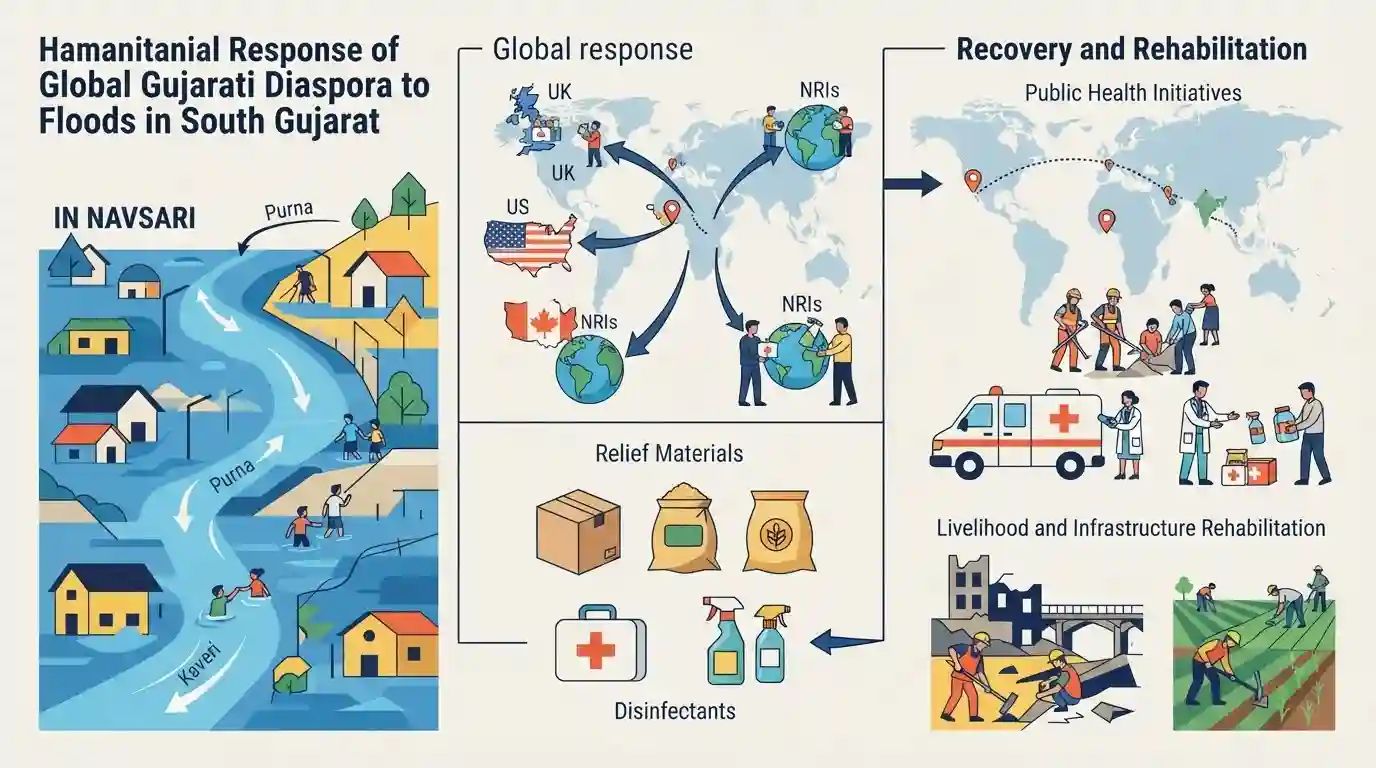
The severe flooding in South Gujarat's Navsari district, triggered by the swelling of the Purna and Kaveri rivers, has drawn a substantial humanitarian response from the global Gujarati diaspora. Non-Resident Indians (NRIs) across the UK, US, Canada, and Gulf countries have provided crucial financial aid and relief materials, including food, medical kits, and disinfectants. Beyond immediate relief, recovery initiatives are focusing on public health through mobile medical camps to prevent water-borne diseases and on the rehabilitation of local livelihoods and infrastructure. This highlights the vital role of the Indian diaspora in supporting their homeland during natural disasters.
મુખ્ય મુદ્દા
- Severe flooding hit the Navsari district in South Gujarat following the swelling of the Purna and Kaveri rivers.
- The global Gujarati diaspora (NRIs) based in the UK, US, Canada, and Gulf nations mobilized significant financial and material support for the affected region.
- Relief supplies distributed include dry rations, medical kits, and disinfectants to aid immediate survival and hygiene needs.
- Post-disaster recovery efforts focus on deploying mobile medical camps to prevent water-borne diseases and rehabilitating farmers and small shopkeepers.
મહત્વપૂર્ણ શબ્દો
Gujarati Diaspora

The global community of migrants and descendants from Gujarat, comprising nearly a third of the global Indian diaspora. They are characterized by entrepreneurial success, strong philanthropy, and persistent cultural ties to their homeland.
UPSC context
GS Paper II (International Relations); tests understanding of regional diaspora contributions to soft power, philanthropy, and disaster response.
Indian Diaspora
The global community of Indian citizens residing abroad and foreign citizens of Indian origin. It represents a vital economic and diplomatic asset, contributing remittances and cultural soft power.
UPSC context
GS Paper II (International Relations/Bilateral Relations); tests knowledge of diaspora policy, remittances, and its role as a strategic foreign policy tool.
Disaster Management
The systematic process of planning, organizing, coordinating, and implementing measures to prevent, mitigate, prepare for, respond to, and recover from natural or man-made disasters.
UPSC context
GS Paper III (Disaster and Disaster Management); tests capacity to design pre-disaster preparedness, post-disaster rehabilitation, and risk reduction frameworks.
Non-Resident Indian (NRI)
An Indian citizen who resides outside India for 182 days or more during a financial year. NRIs hold Indian passports, retain citizenship, and enjoy voting rights in India.
UPSC context
GS Paper II (Polity and Governance/IR); tests clarity on legal classifications of overseas citizens, citizenship laws, and their economic impact.
Purna River
A major west-flowing river originating in Maharashtra's Sahyadri range that flows through Gujarat (including Navsari) before emptying into the Arabian Sea. It is highly prone to monsoon flooding.
UPSC context
GS Paper I (Geography of India); tests knowledge of drainage systems, river basins, and physical geography of peninsular India.
Post-Disaster Public Health
The system of medical intervention, disease surveillance, and sanitation management immediately following a natural disaster to prevent the outbreak of water-borne and vector-borne infectious diseases.
UPSC context
GS Paper II (Social Sector/Health); tests understanding of epidemic control, public health administration, and disaster response coordination.
પ્રિલિમ્સ ટ્રેપ
The Kaveri River causing floods in South Gujarat originates in the Brahmagiri hills of Karnataka's Western Ghats.
The southern Kaveri (Cauvery) originates in Karnataka. However, the Kaveri causing Gujarat floods is a distinct, minor west-flowing tributary of the Ambika River in Gujarat.
સંલગ્ન સ્થિર ખ્યાલો
Why do west-flowing rivers in Gujarat form estuaries instead of deltas?
- Silt Deficit: Flowing through hard rocky terrains, they carry minimal silt compared to long east-flowing rivers.
- High Gradient: Their steep slope and swift flow into the Arabian Sea prevent sediment accumulation at the mouth.
How are diaspora disaster donations classified under the Balance of Payments?
- Current Account: They are recorded as Unilateral Transfers or Secondary Income because they represent one-way flows without liability.
- Capital Account Exclusion: Unlike external commercial borrowings or FDI, they do not create asset-liability changes, excluding them from capital accounts.
આંતર-વિષય પેટર્ન
Diaspora Philanthropy + FCRA Compliance
Diaspora disaster aid highlights the intersection of external remittance-led soft power and strict domestic FCRA regulations requiring designated SBI accounts.
Disaster Management + Epidemic Control
Integrating physical flood mitigation with the Epidemic Diseases Act, 1897 shows how post-disaster public health responses are legally enforced during climate crises.

Expect a 2026 prelims question linking west-flowing river geography (Purna/Kaveri) with BoP classification of diaspora relief aid.
સંલગ્ન PYQ · 2
સંલગ્ન PYQ · 2
- 2026GPSC_PRELIMSGS1
Consider the following statements regarding the drainage system of Kutch: 1. Most rivers in the Kutch region are ephemeral and non-perennial, carrying water only during the brief monsoon season. 2. The rivers originating from the central hilly tracts of Kutch invariably drain into the Arabian Sea directly. 3. The Luni River, after traversing through Rajasthan, dissipates into the marshy lands of the Rann of Kutch. Which of the above statements are correct?
- 2025GPSC_PRELIMSGS1
______ initiated its withdrawal from the World Health Organization (WHO) on January 20, 2025 citing mishandling of the COVID-19 pandemic financial disparities and political influence concerns.
