NPCI Merchant Discount Rate Adjustments for UPI Transactions
Source:The Hindu ↗
ఇది ఎందుకు ముఖ్యం
This development directly impacts the economics of India's massive digital payments ecosystem, balancing commercial sustainability for payment service providers with the policy goal of widespread financial inclusion for small businesses and citizens.
సారాంశం
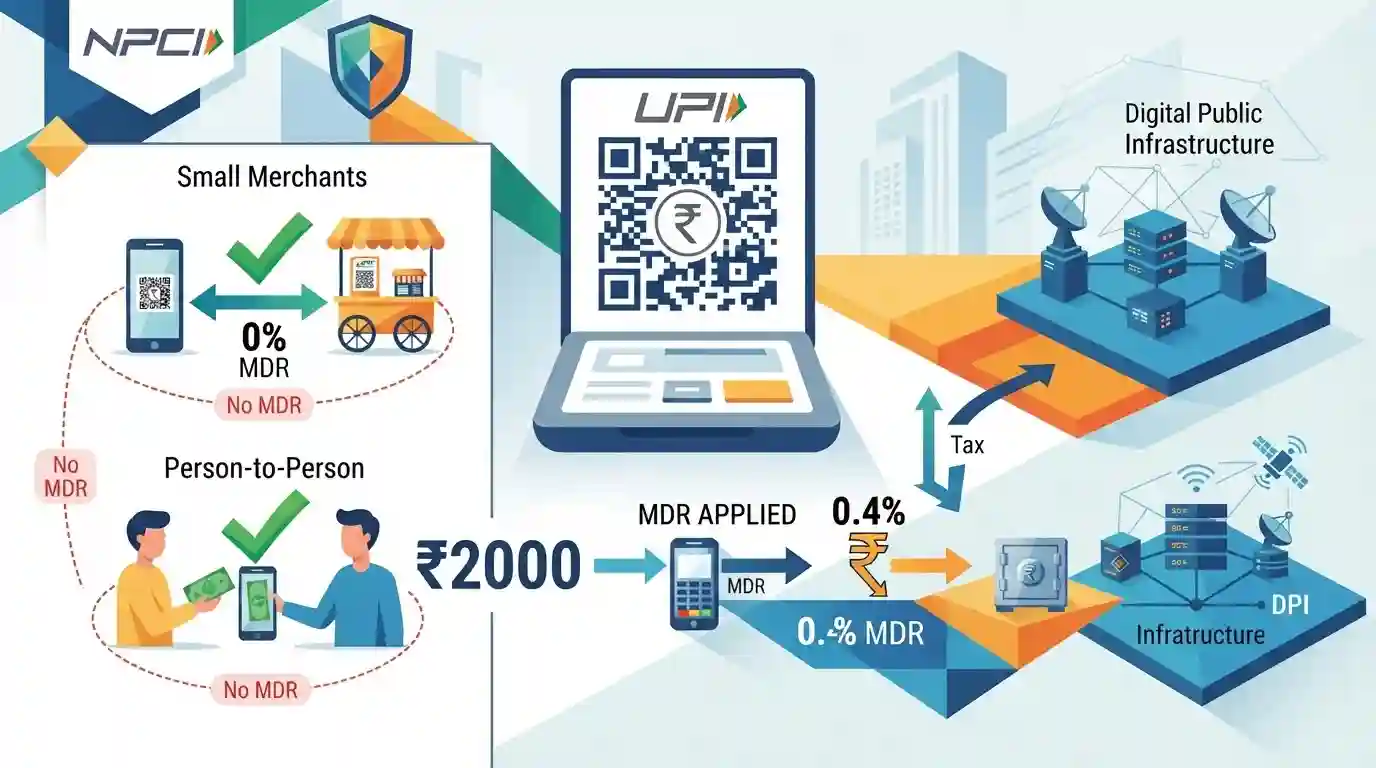
The National Payments Corporation of India (NPCI) has introduced a 0.4% Merchant Discount Rate (MDR) on UPI payments exceeding ₹2,000, while exempting small merchants and person-to-person (P2P) transactions to ensure the long-term economic viability of digital public infrastructure.
ముఖ్య అంశాలు
- NPCI introduced a 0.4% Merchant Discount Rate (MDR) charge on UPI payments exceeding ₹2,000.
- Small merchants and person-to-person (P2P) transfers have been specifically exempted from this charge.
- The move aims to balance the economic viability of digital payment infrastructure with the promotion of financial inclusion.
ముఖ్యమైన పదాలు
Unified Payments Interface

An instant real-time payment system developed by NPCI that facilitates inter-bank transactions through mobile phones using a single virtual payment address.
UPSC context
UPSC CSE Prelims/Mains (Indian Economy): Core topic under digital payments, financial inclusion, and infrastructure.
NPCI
An umbrella organization for operating retail payments and settlement systems in India, promoted by the RBI and Indian Banks' Association.
UPSC context
UPSC CSE Prelims (Banking & Financial Institutions): Tests knowledge of regulatory bodies and payment system infrastructure.
Reserve Bank of India
India's central banking institution that controls the monetary policy of the Indian rupee, regulates the banking system, and oversees payment gateways and NPCI.
UPSC context
UPSC CSE Prelims/Mains (Economy - Monetary Policy): Tests statutory functions and regulatory authority over fintech and digital transactions.
ప్రిలిమ్స్ ఉచ్చు
UPI payments are completely free of any merchant discount rate or transaction charges for all users and merchants.
Aspirants often assume UPI is entirely free for all transactions without exception. However, specific thresholds (like >₹2,000) and merchant categories determine MDR applicability.
అనుసంధానమైన స్థిర భావనలు
What is the Merchant Discount Rate (MDR) and how does it function in digital payments?
- Definition: It is the cost paid by a merchant to a bank for accepting payments via digital modes like cards or UPI.
- Distribution: It is distributed among stakeholder entities including the payment aggregator, acquiring bank, issuing bank, and payment network.
- Policy balance: Zero-MDR policies for certain platforms require government subsidization or alternative revenue models to maintain banking infrastructure viability.
అంతర-అంశ నమూనాలు
UPI monetization vs Financial Inclusion goals
The introduction of MDR on large UPI transactions intersects with fiscal policy debates on subsidizing digital public infrastructure versus ensuring sustainable banking models.
RBI regulatory oversight of payment systems
NPCI's regulatory oversight by the RBI highlights the evolving statutory powers governing retail payment systems under the Payment and Settlement Systems Act.

MDR restructuring on UPI + P2P vs P2M exemptions will likely feature in a multi-statement Prelims question on digital public infrastructure.
అనుసంధాన PYQలు · 3
అనుసంధాన PYQలు · 3
- 2022MainsGS3
Is inclusive growth possible under market economy ? State the significance of financial inclusion in achieving economic growth in India.
- 2018PrelimsGS1
Which one of the following best describes the term "Merchant Discount Rate" sometimes seen in news?
- 2026PrelimsGS1
Which one of the following statements about Unified Payments Interface (UPI) and Central Bank Digital Currency (Digital Rupee) is not correct ?
