Novo Nordisk Launches Once Weekly Insulin Analogue in India
Source:Indian Express ↗
Why It Matters
This development represents a major milestone in applied biotechnology and health economics. It illustrates how genetic engineering (recombinant DNA technology) directly solves real-world clinical hurdles like injection compliance for non-communicable diseases (NCDs). The pricing strategy also provides a crucial case study in making life-saving biotechnology products affordable for low-and-middle-income countries with high out-of-pocket health spending.
Summary
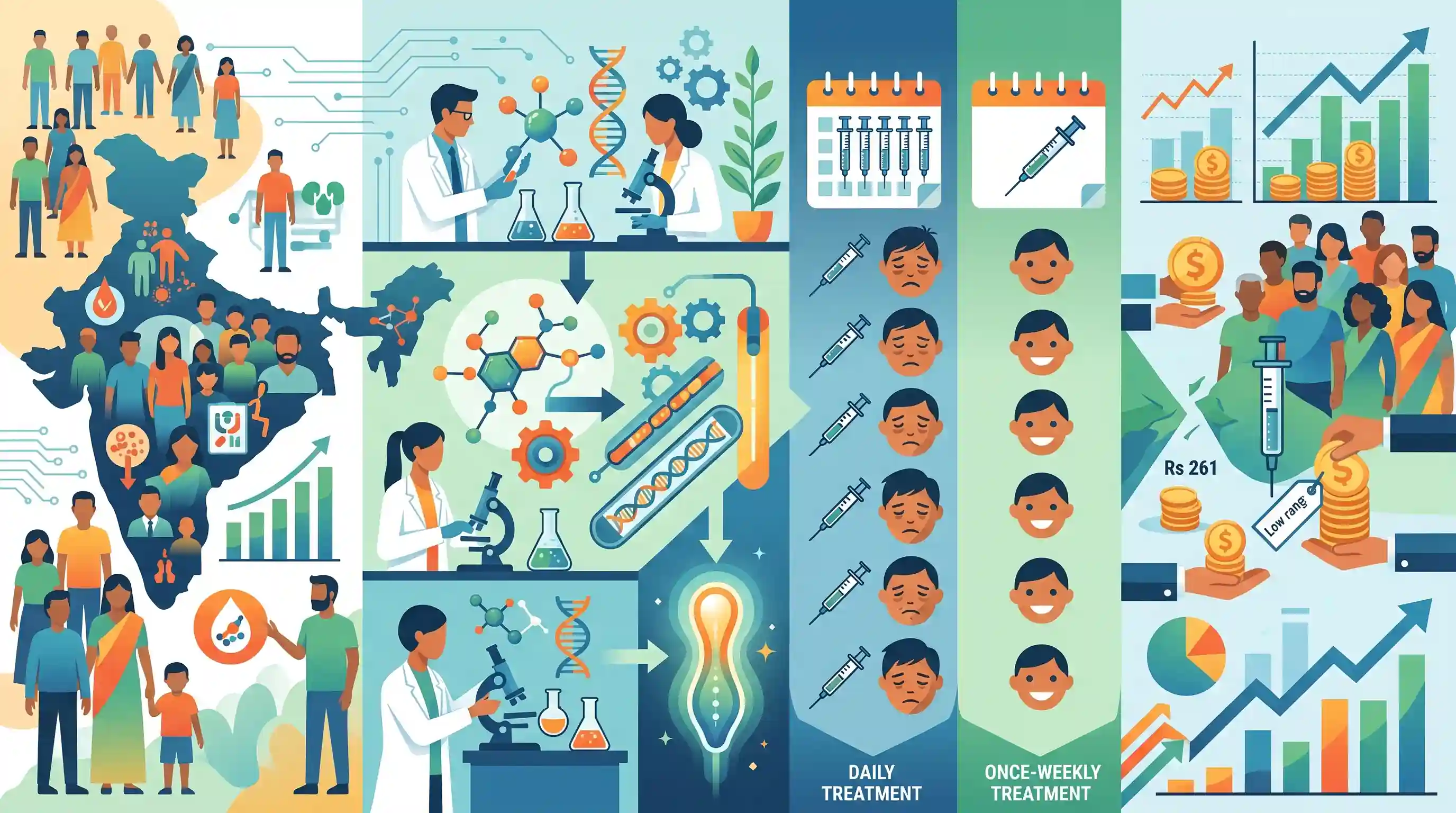
Novo Nordisk has launched Awiqli (insulin icodec), the world's first once-weekly basal insulin analogue, in India. Using genetic engineering to extend insulin life in the body, it reduces daily injections to once-weekly doses, dramatically improving patient compliance. Crucially, its highly competitive pricing of Rs 261 per week makes it cheaper than traditional daily alternatives, directly tackling India's massive diabetes epidemic (101 million affected) and high out-of-pocket health expenditure.
Key Points
- Introduction of Awiqli: Novo Nordisk has launched its once-weekly basal insulin icodec under the brand name Awiqli in India, making it the world's first weekly long-acting insulin shot.
- Biotechnological Modifications: As an insulin analogue, icodec uses recombinant DNA technology modified in two ways: 1) a fatty acid chain is added to increase affinity to the blood protein albumin, creating an inactive, slow-release depot under the skin, and 2) three amino acid substitutions are introduced to lower affinity to insulin receptors, ensuring slow cellular consumption over seven days.
- Enhancing Patient Compliance: By reducing shots from 365 times a year (daily basal) to just 52 (weekly), the drug tackles clinical inertia and injection fatigue, helping diabetics transition from oral pills when required to prevent microvascular/macrovascular organ damage.
- Target Demographic: It is primarily ideal for Type 2 diabetics who cannot control blood sugar with oral drugs. It can also act as basal insulin for Type 1 diabetics, though they still require daily meal-time bolus injections.
- Affordability & Health Economics: Priced at Rs 261 per week, the drug is highly competitive and actually cheaper than existing daily basal insulin analogues in India (Rs 345 to Rs 453/week), directly addressing high out-of-pocket medical expenditure (OOPE).
- Socio-Health Context: India faces a massive burden of non-communicable diseases, with 101 million diabetics and 136 million pre-diabetics. Early and regular insulin control is critical to lower the national average HbA1c levels.
Important Terms
Indian Council of Medical Research (ICMR)

The apex body in India for formulating, coordinating, and promoting biomedical research, functioning under the Department of Health Research, Ministry of Health and Family Welfare.
UPSC context
GS Paper II & III: Key institution for public health policies, medical innovations, and regulatory surveillance standards.
Insulin Icodec (Awiqli)
The world's first once-weekly basal insulin analogue, engineered to extend its half-life, which reduces injection frequency from 365 daily jabs to 52 doses annually.
UPSC context
GS Paper III: Biotech developments, drug delivery innovations, and addressing public health epidemics.
Basal Insulin
A long-acting, background insulin formulated to release slowly, keeping blood glucose levels stable overnight and between meals.
UPSC context
GS Paper III: Science & Technology, biological concepts, and healthcare advancements in managing chronic conditions.
Non-Communicable Diseases (NCDs)
Chronic, non-infectious conditions such as diabetes and cardiovascular diseases, developed slowly over time due to a mix of lifestyle, genetic, and environmental factors.
UPSC context
GS Paper II: Health sector management, tracking changes in national disease burden patterns and SDGs.
Out-of-Pocket Health Expenditure (OOPE)
Direct, non-reimbursed health payments made by individuals at the point of service, often leading to catastrophic health expenses and financial vulnerability.
UPSC context
GS Paper II: Social sector, health equity, public health funding, and financial protection mechanisms.
Novo Nordisk
A Danish multinational pharmaceutical company specializing in diabetes care and biotechnology, which developed and launched the world's first weekly basal insulin.
UPSC context
GS Paper III: Global pharmaceutical landscape, biotechnology industry, and patent/IPR issues in healthcare access.
Prelims Trap
Once-weekly basal insulin analogues completely eliminate the need for daily insulin injections for all diabetic patients.
Type 1 diabetics lack insulin-producing beta cells entirely. While they can use weekly basal insulin for background coverage, they still require multiple daily mealtime (bolus) injections.
Static Concepts Connected
How does recombinant DNA technology differ in producing human insulin versus insulin analogues?
- Host Organisms: Traditional recombinant insulin (e.g., Humulin) uses bacterial hosts like Escherichia coli to produce insulin identical to natural human insulin.
- Advanced Expression: Modern long-acting analogues (like icodec) often utilize eukaryotic yeast (Saccharomyces cerevisiae) to allow complex genetic and chemical modifications prior to purification.
- Structural Modification: Analogues are genetically engineered to alter the amino acid sequence or attach side chains, changing how the drug binds to albumin and receptors to control release speed.
What is Out-of-Pocket Expenditure (OOPE) and its current status in India?
- Definition: Direct payments made by patients to healthcare providers at the point of service, excluding any public or private insurance coverage.
- Recent Trends: According to the National Health Accounts (2021-22), India's OOPE fell to 39.4% of Total Health Expenditure, though it remains significantly higher than the global average.
- Primary Driver: Outpatient purchases of medicines for chronic, non-communicable diseases (like diabetes) constitute the single largest driver of medical impoverishment in Indian households.
Cross-Topic Patterns
Biotech innovations vs drug price control
Examines how India balances importing breakthrough patented foreign biologics with domestic price control mechanisms and TRIPS flexibilities to treat widespread chronic diseases.
Prokaryotic vs eukaryotic expression systems
Highlights the biochemical transition in industrial biomanufacturing from prokaryotes to eukaryotic yeast platforms to enable complex protein modifications.

Science prelims may test the biological differences between standard human insulin and long-acting analogues, including host cell types.
Linked PYQs · 3
Linked PYQs · 3
- 2013PrelimsGS1
Recombinant DNA technology (Genetic Engineering) allows genes to be transferred 1. across different species of plants 2. from animals to plants 3. from microorganisms to higher organisms Select the correct answer using the codes given below.
- 2021MainsGS3
What are the research and developmental achievements in applied biotechnology? How will these achievements help to uplift the poorer sections of the society?
- 2024MainsGS2
In a crucial domain like the public healthcare system the Indian State should play a vital role to contain the adverse impact of marketisation of the system. Suggest some measures through which the State can enhance the reach of public healthcare at the grassroots level.
