Essential Medicine Manufacturing Amidst Global Health Funding Cuts
Source:The Hindu ↗
Why It Matters
The article highlights the vulnerability of global health architectures dependent on donor funding from developed nations. It underscores the critical need for sustainable Public-Private Partnerships and domestic capacity building in developing nations to ensure uninterrupted access to life-saving essential medicines for neglected tropical diseases.
Summary
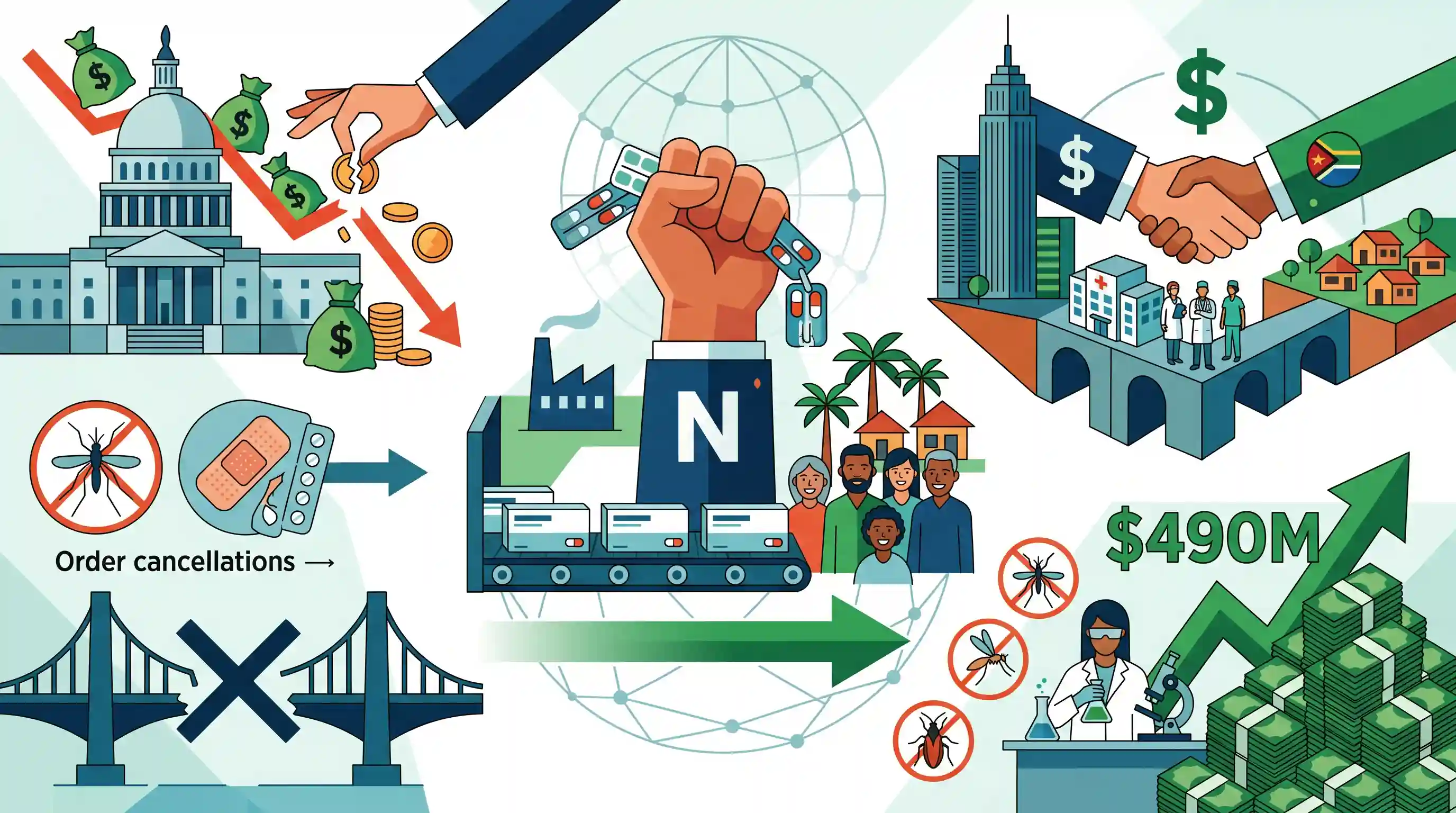
Swiss pharmaceutical company Novartis has pledged to continue manufacturing vital medicines for malaria and leprosy, even in the face of significant cuts in global health funding. Reacting to recent budget reductions by the US President's Malaria Initiative which led to order cancellations, Novartis committed to producing drugs based on patient need rather than donor demand. The company is advocating for a transition from donor-reliant models to public-private partnerships (PPPs) between pharmaceutical firms and low- and middle-income nations. Furthermore, Novartis reaffirmed a $490 million investment in R&D to combat neglected tropical diseases such as dengue, leishmaniasis, and Chagas disease.
Key Points
- Swiss pharmaceutical giant Novartis has committed to producing essential malaria and leprosy drugs despite global health funding cuts and order cancellations.
- The announcement follows significant aid reductions, particularly from the US President's Malaria Initiative, which had previously caused disruptions in drug orders.
- Novartis stated it will base its manufacturing on patient need rather than immediate market demand, seeking creative ways to deliver medicines to patients.
- The company's CEO emphasized the need for public-private partnerships (PPPs) with low- and middle-income countries to replace the declining traditional donor funding model.
- Novartis is investing $490 million in research and development for neglected tropical diseases, including dengue, leishmaniasis, Chagas disease, and new malaria treatments.
Important Terms
Neglected Tropical Diseases (NTDs)

A diverse group of 20 communicable diseases (e.g., dengue, leprosy, leishmaniasis) prevailing in tropical/subtropical regions, primarily affecting impoverished populations with limited access to healthcare and sanitation.
UPSC context
GS Paper II/III: Health issues, social sector management, and science-technology interventions for disease elimination.
Global Fund to Fight AIDS, Tuberculosis and Malaria (GFATM)
An international multistakeholder financing organization founded in 2002 to attract and disburse resources to end HIV/AIDS, tuberculosis, and malaria as epidemics by 2030.
UPSC context
GS Paper II: Important International institutions and their role in social sector development.
US President’s Malaria Initiative (PMI)
A U.S. government initiative launched in 2005 to reduce malaria-related mortality and morbidity through scaled-up interventions like insecticide-treated nets and life-saving drugs.
UPSC context
GS Paper II: International funding agencies and their impact on global health security and development.
Public-Private Partnership (PPP) in Health
A collaborative model where government agencies and private sector entities share resources, risks, and expertise to provide healthcare infrastructure or services.
UPSC context
GS Paper II/III: Government policies and interventions for health sector development and economic models.
Novartis
A Swiss multinational pharmaceutical corporation known for being a major producer of antimalarial drugs and for its long-term commitment to donating leprosy treatments globally.
UPSC context
GS Paper II/III: Role of private sector/MNCs in healthcare R&D and social sector service delivery.
Leprosy
A chronic infectious disease caused by Mycobacterium leprae, primarily affecting the skin and peripheral nerves; India aims for total elimination despite having a high global burden.
UPSC context
GS Paper II: Social sector issues related to health and government programs like NLEP.
Prelims Trap
India has successfully eradicated Leprosy, achieving zero incidence nationwide.
India achieved "elimination as a public health problem" in 2005 (prevalence < 1 per 10,000), but not "eradication" (zero global incidence, like smallpox). India still reports new leprosy cases.
Static Concepts Connected
What defines Neglected Tropical Diseases (NTDs) and why are they termed "neglected"?
- Disease profile: A group of 20 diverse conditions (e.g., Dengue, Chagas, Leprosy, Kala-azar) prevalent mostly in tropical and subtropical regions.
- Demographics: They disproportionately affect impoverished populations with limited access to clean water, sanitation, and robust healthcare infrastructure.
- R&D deficit: Termed "neglected" because they historically attract minimal pharmaceutical R&D funding, as the affected populations offer low commercial profitability.
What are India's elimination targets for major tropical and vector-borne diseases?
- Malaria: Interruption of indigenous transmission by 2027 and complete elimination (zero indigenous cases) nationwide by 2030 under the National Framework for Malaria Elimination.
- Leprosy: Eliminated as a "public health problem" nationally in 2005 (<1 case per 10,000), but district-level transmission interruption efforts continue.
- Kala-Azar: India has been consistently pushing to eliminate Kala-Azar by reducing annual incidence to less than 1 case per 10,000 population at the block level.
Cross-Topic Patterns
TRIPS, IP Rights and Drug Access
As international donor funding shrinks, the Global South's access to vital medicines will increasingly depend on IP flexibilities like compulsory licensing and domestic public-private partnerships.
Changing dynamics of Global Health Aid
US aid reductions signify a broader retreat of traditional Western donor models, pushing lower-middle-income countries toward healthcare self-reliance and domestic PPPs.

NTD pathogens (virus/protozoa/bacteria) matched against India's specific elimination timelines is a highly probable 2026 Prelims question.
Linked PYQs · 3
Linked PYQs · 3
- 2024MainsGS2
In a crucial domain like the public healthcare system the Indian State should play a vital role to contain the adverse impact of marketisation of the system. Suggest some measures through which the State can enhance the reach of public healthcare at the grassroots level.
- 2020MainsGS2
Critically examine the role of WHO in providing global health security during the Covid-19 pandemic.
- 2023PrelimsGS1
'Wolbachia method' is sometimes talked about with reference to which one of the following?
