Lucknow Power Sector Overhaul and No Tripping Zone Plan
Source:hindustan-times ↗
Why It Matters
Upgrading urban power infrastructure with smart grid and SCADA technologies is vital for minimizing distribution losses and ensuring reliable energy access. For UPPSC aspirants, this serves as a key example of state-led technological intervention in urban planning (Lucknow, Noida, Varanasi) and infrastructure modernization.
Summary
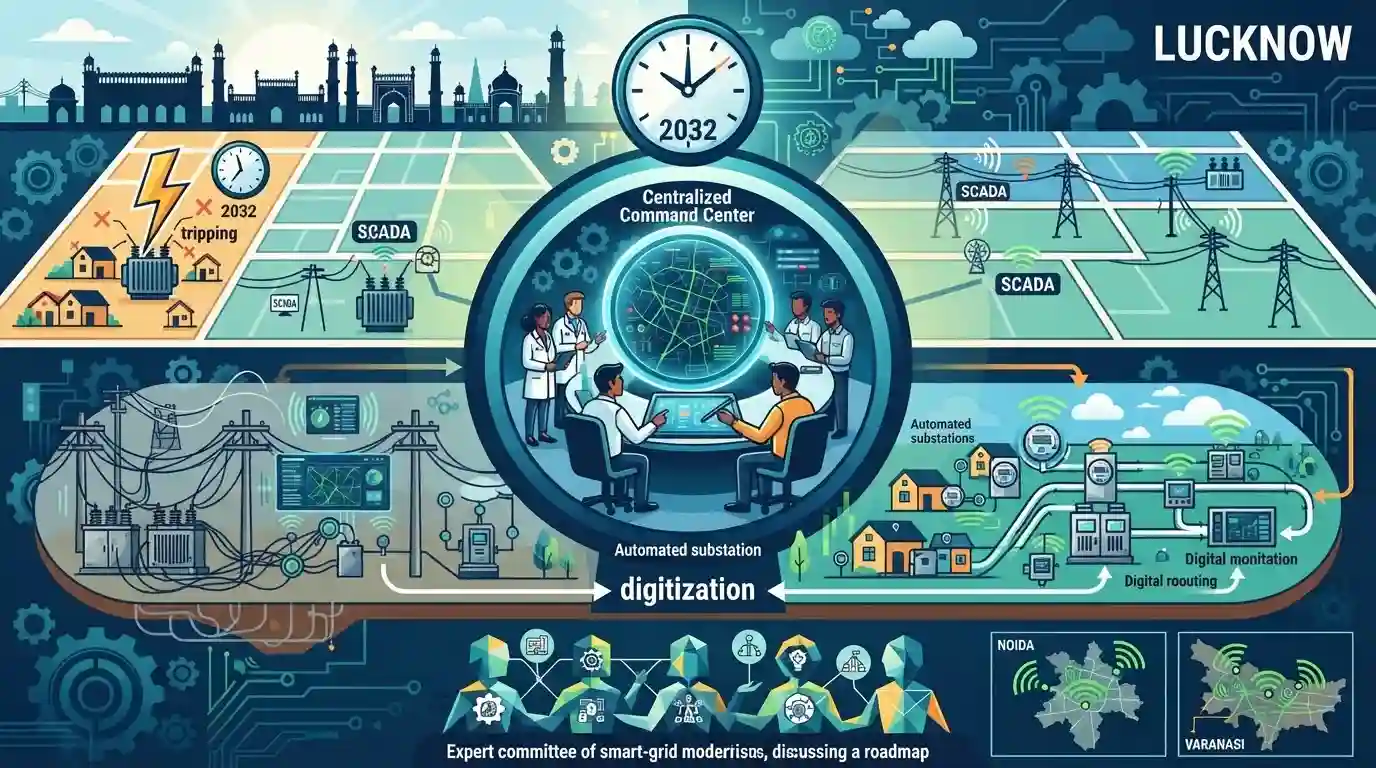
The Uttar Pradesh Power Corporation Limited (UPPCL) has initiated a massive modernization project to make Lucknow a "no-tripping zone" by 2032. The initiative involves digitizing the city's entire electricity distribution network using SCADA (Supervisory Control and Data Acquisition) technology at an estimated cost of ₹2,400 to ₹2,700 crore. A centralized command center will use sensors and communication networks to monitor grid health, automatically detect faults, and reroute power in real-time, eliminating the need for manual fault tracking. A seven-member expert committee has been set up to draft a comprehensive roadmap for this smart-grid transition, mirroring similar efforts underway in Noida and Varanasi.
Key Points
- Uttar Pradesh Power Corporation Limited (UPPCL) plans to transform Lucknow into a 'no-tripping zone' by 2032 by completely digitizing the electricity distribution network.
- The project, estimated to cost between ₹2,400 crore and ₹2,700 crore, will utilize SCADA (Supervisory Control and Data Acquisition) technology for centralized monitoring.
- The SCADA system will connect major substations, transformers, and feeders, allowing a central command centre to automatically detect faults and reroute power, replacing manual tracking.
- A seven-member expert committee of engineers has been formed to draft a detailed project report (DPR) and roadmap for the transition.
- Similar technological upgrades to modernize power distribution are already being implemented in Noida and Varanasi.
Important Terms
SCADA (Supervisory Control and Data Acquisition)

A computerized industrial control system that remotely monitors and manages infrastructure via sensors. It enables real-time data collection, automated fault detection, and precise control over decentralized physical processes.
UPSC context
Crucial for GS Paper 3 (Infrastructure & Cyber Security), especially concerning the automation of critical infrastructure and its cybersecurity vulnerabilities.
Smart Grid
An intelligent electricity network that uses automation, sensors, and two-way communication to monitor and optimize power generation, distribution, and consumption in real time.
UPSC context
Essential for GS Paper 3 (Energy). It highlights India's push for reducing transmission losses, grid modernization, and renewable energy integration.
No-Tripping Zone
An urban power distribution area upgraded with automated monitoring systems to instantly detect faults and reroute electricity, entirely eliminating manual tracking and frequent power outages.
UPSC context
Relevant to GS Paper 1 & 3 (Urbanization & Infrastructure) as a model for creating resilient, modern, and energy-efficient smart cities.
Uttar Pradesh Power Corporation Limited (UPPCL)
The state-owned enterprise overseeing electricity transmission and distribution in Uttar Pradesh, currently driving the region's transition toward digitized, smart-grid infrastructure.
UPSC context
Useful as a state-level case study for GS Paper 3 (Energy) regarding power sector reforms and DISCOM modernization efforts.
Prelims Trap
SCADA technology is exclusively used for electricity grids and its cybersecurity is overseen by the Ministry of Power.
SCADA is used across various sectors (water pipelines, oil, gas). Further, protecting power grid SCADA systems (Classified as CII) falls under NCIIPC (NTRO), not the Ministry of Power.
Static Concepts Connected
What constitutes Critical Information Infrastructure (CII) and who protects it in India?
- Legal Definition: Defined under Section 70 of the IT Act as infrastructure whose destruction would severely impact national security, the economy, or public health.
- Nodal Agency: The National Critical Information Infrastructure Protection Centre (NCIIPC) is the designated nodal agency for protecting CII against cyber threats.
- Parent Body: NCIIPC operates under the National Technical Research Organisation (NTRO), placing it under the PMO/NSA framework.
What are the core features of a Smart Grid under India's power sector?
- Self-Healing: Uses real-time sensors, communication networks, and SCADA to automatically detect electrical faults, isolate them, and reroute power.
- Loss Reduction: Aims to significantly lower Aggregate Technical and Commercial (AT&C) losses through smart metering, eliminating theft and improving billing.
- Renewable Integration: Balances the intermittent nature of solar and wind energy by matching real-time supply with consumer demand.
Cross-Topic Patterns
SCADA cyber-vulnerabilities & State Actors
Digitizing grids via SCADA merges IT with Operational Technology (OT), making previously 'air-gapped' physical infrastructure vulnerable to remote cyber-attacks by state actors, linking infrastructure directly to internal security.
Smart Grids & Renewable Intermittency
Grid modernization isn't just about reducing power cuts; smart grids are foundational to India's 500 GW non-fossil fuel target, acting as dynamic balancers for intermittent solar and wind power.

Expect a 2026 Prelims question mapping SCADA and 'IT/OT convergence' to Critical Information Infrastructure (CII) under the IT Act.
Linked PYQs · 4
Linked PYQs · 4
- 2022UPPSC_PRELIMSGS1
Solar energy is converted into electric energy through
- 2021UPPSC_PRELIMSGS1
The functions of the State Public Service Commission of Uttar Pradesh can be extended by
- 2013UPPSC_PRELIMSGS1
In Uttar Pradesh I.T. City is being established in
- 2018UPPSC_PRELIMSGS1
Which of the following cities in Uttar Pradesh has NOT been selected for development under the Smart City Development Programme of the Central Government?
