Life and scientific contributions of astrophysicist Jayant Narlikar
Source:The Hindu ↗
Why It Matters
UPSC GS-3 specifically outlines the 'achievements of Indians in science & technology'. Dr. Narlikar is a foundational figure in Indian astrophysics and cosmology. His work in establishing institutions like IUCAA and his awards (such as the UNESCO Kalinga Prize) are highly relevant for Prelims fact-based questions and Mains answers on India's scientific development and the importance of science popularisation.
Summary
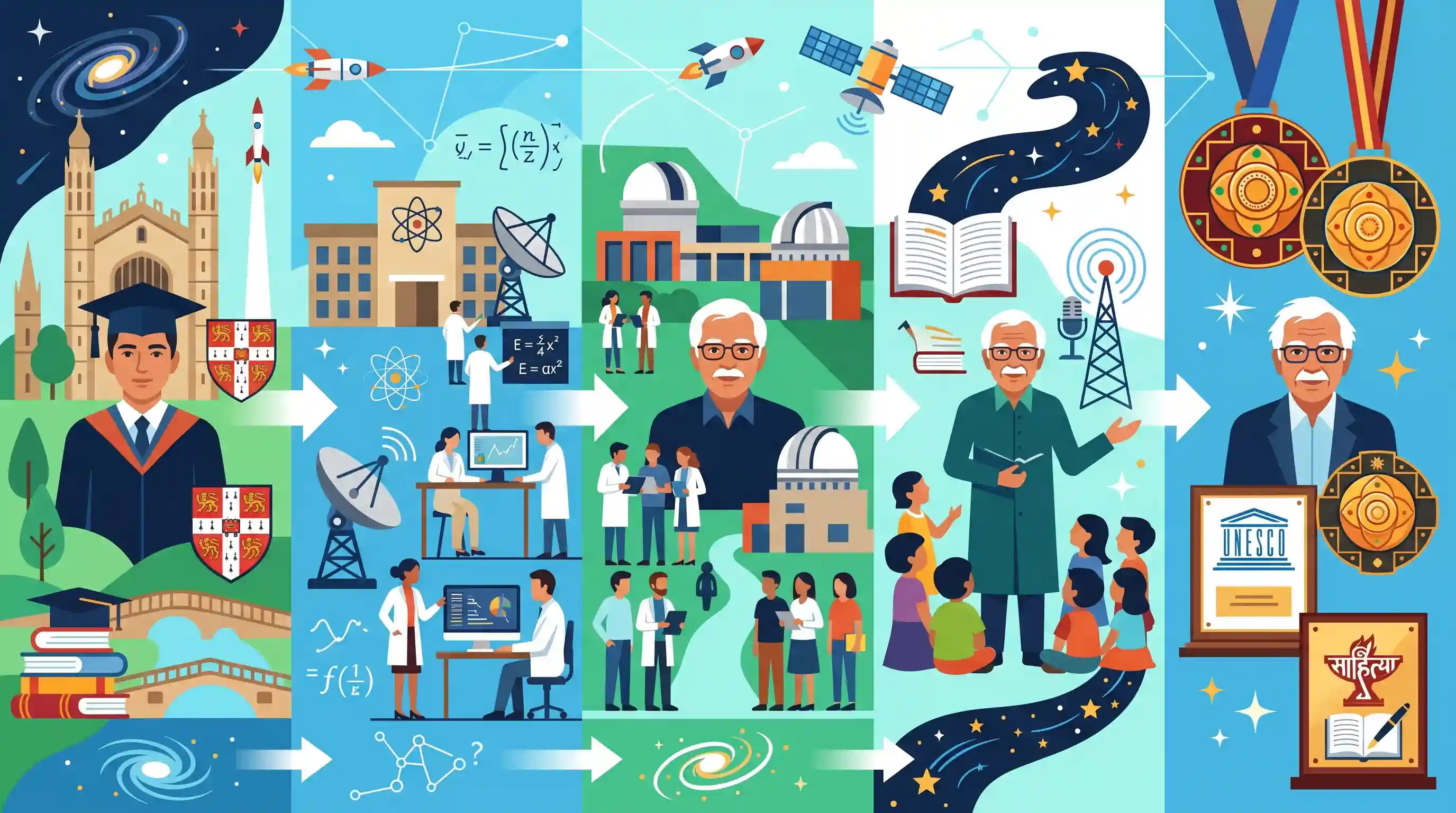
Eminent Indian astrophysicist and renowned science communicator Dr. Jayant Vishnu Narlikar passed away at 87 in Pune. Educated at Cambridge, Narlikar was instrumental in advancing astrophysics and cosmology research in India. He significantly expanded the Theoretical Astrophysics Group at the Tata Institute of Fundamental Research (TIFR) and served as the Founder Director of the Inter-University Centre for Astronomy and Astrophysics (IUCAA) in Pune. Beyond his scientific research, Narlikar was highly celebrated for his efforts to popularise science through fiction and literature, receiving the UNESCO Kalinga Award and the Sahitya Akademi Award for his Marathi autobiography. His immense contributions earned him prestigious honours, including the Padma Vibhushan and Padma Bhushan.
Key Points
- Dr Jayant Vishnu Narlikar, a celebrated Indian astrophysicist and science communicator, passed away at the age of 87 in Pune.
- He played a pivotal role in institutionalising astrophysics research in India by expanding the Theoretical Astrophysics Group at TIFR and founding the Inter-University Centre for Astronomy and Astrophysics (IUCAA).
- He was widely recognised for popularising science, winning the UNESCO Kalinga Award, and authoring science fiction and an acclaimed autobiography in Marathi.
- Narlikar's lifetime contributions were honoured with India's highest civilian awards, including the Padma Vibhushan and Padma Bhushan.
Important Terms
Padma Vibhushan

India's second-highest civilian award, presented for "exceptional and distinguished service" in any field, including science and literature.
UPSC context
GS Paper I (Awards) and Prelims; tests knowledge of India's civilian honors and their hierarchy.
UNESCO Kalinga Prize
An international award established by UNESCO in 1951 to recognize exceptional contributions to the popularization of science and bridging the gap between science and society.
UPSC context
GS Paper III (Science & Technology); focuses on global recognition of science communication and Indian contributions to international prizes.
Tata Institute of Fundamental Research (TIFR)
A premier public research institution in India founded by Homi J. Bhabha in 1945, dedicated to advanced research in mathematics and basic sciences.
UPSC context
GS Paper III (Science & Technology); tests awareness of India’s foundational scientific infrastructure and institutional history.
Inter-University Centre for Astronomy and Astrophysics (IUCAA)
An autonomous institution founded in 1988 by the University Grants Commission (UGC) to promote research and teaching in astronomy and astrophysics across Indian universities.
UPSC context
GS Paper III (Space Technology); relevant for questions on institutional frameworks supporting space research in India.
Sahitya Akademi Award
A prestigious literary honor in India conferred annually by the National Academy of Letters for outstanding works in 24 major Indian languages.
UPSC context
GS Paper I (Art & Culture) and Prelims; assesses knowledge of India's literary achievements and cultural institutions.
Padma Bhushan
India's third-highest civilian award, granted for distinguished service of a high order in fields like science, arts, and public affairs.
UPSC context
GS Paper I (Awards) and Prelims; involves distinguishing between various categories of national civilian honors.
Prelims Trap
Jayant Narlikar is widely celebrated for providing mathematical proofs that firmly established the Big Bang theory.
Narlikar was famously a prominent advocate of the Steady State Theory, which directly opposes the Big Bang theory.
Static Concepts Connected
What is the Steady State Theory of the Universe?
- Constant Density: The theory postulates that the universe is expanding but maintains a constant density through the continuous creation of new matter.
- No Origin: Unlike the Big Bang theory, it posits that the universe has no definitive beginning or end point in time.
- Key Proponents: It was heavily championed by scientists like Fred Hoyle, Thomas Gold, Hermann Bondi, and Jayant Narlikar.
What does the Panspermia hypothesis propose about the origins of life?
- Extraterrestrial Origins: It suggests that life exists throughout the universe and is distributed by space dust, asteroids, comets, or meteoroids.
- Extremophile Survival: It assumes that extremophile microorganisms can survive the harsh conditions of space travel and atmospheric entry to seed life on habitable planets.
- Stratospheric Testing: Indian stratospheric balloon experiments, conducted jointly by Narlikar and ISRO, sought to collect microbes at 41 km altitudes to find empirical evidence.
Cross-Topic Patterns
Science popularisation and Sahitya Akademi
Narlikar winning a Sahitya Akademi Award for his Marathi autobiography highlights the intersection of vernacular literature and hard science, a theme UPSC frequently tests in 'Contributions of Indians' mains questions.
IUCAA's critical role in Aditya-L1
Institutions founded by Narlikar are highly relevant today. IUCAA developed the SUIT payload for ISRO’s Aditya-L1 mission, directly connecting foundational 20th-century astrophysics institutions to contemporary space exploration.
UNESCO Kalinga Prize's Indian roots
The UNESCO Kalinga Prize for science communication was funded by Indian politician Biju Patnaik in 1952. UPSC often frames prelims questions around international awards with deep Indian historical connections.

A 'Pairs' question matching Indian scientists (Narlikar, SN Bose) to their theories (Steady State, Bosons) is highly likely in 2026.
Linked PYQs · 2
Linked PYQs · 2
- 2016MainsGS3
Discuss India's achievements in the field of Space Science and Technology. How the application of this technology has helped India in its socio-economic development?
- 2023PrelimsGS1
Consider the following pairs: Objects in space Description 1. Cepheids: Giant clouds of dust and gas in space 2. Nebulae: Stars which brighten and dim periodically 3. Pulsars: Neutron stars that are formed when massive stars run out of fuel and collapse How many of the above pairs are correctly matched?
