UNSC Counter Terrorism Statements and Multilateral Diplomacy Limits
Source:The Hindu ↗
Why It Matters
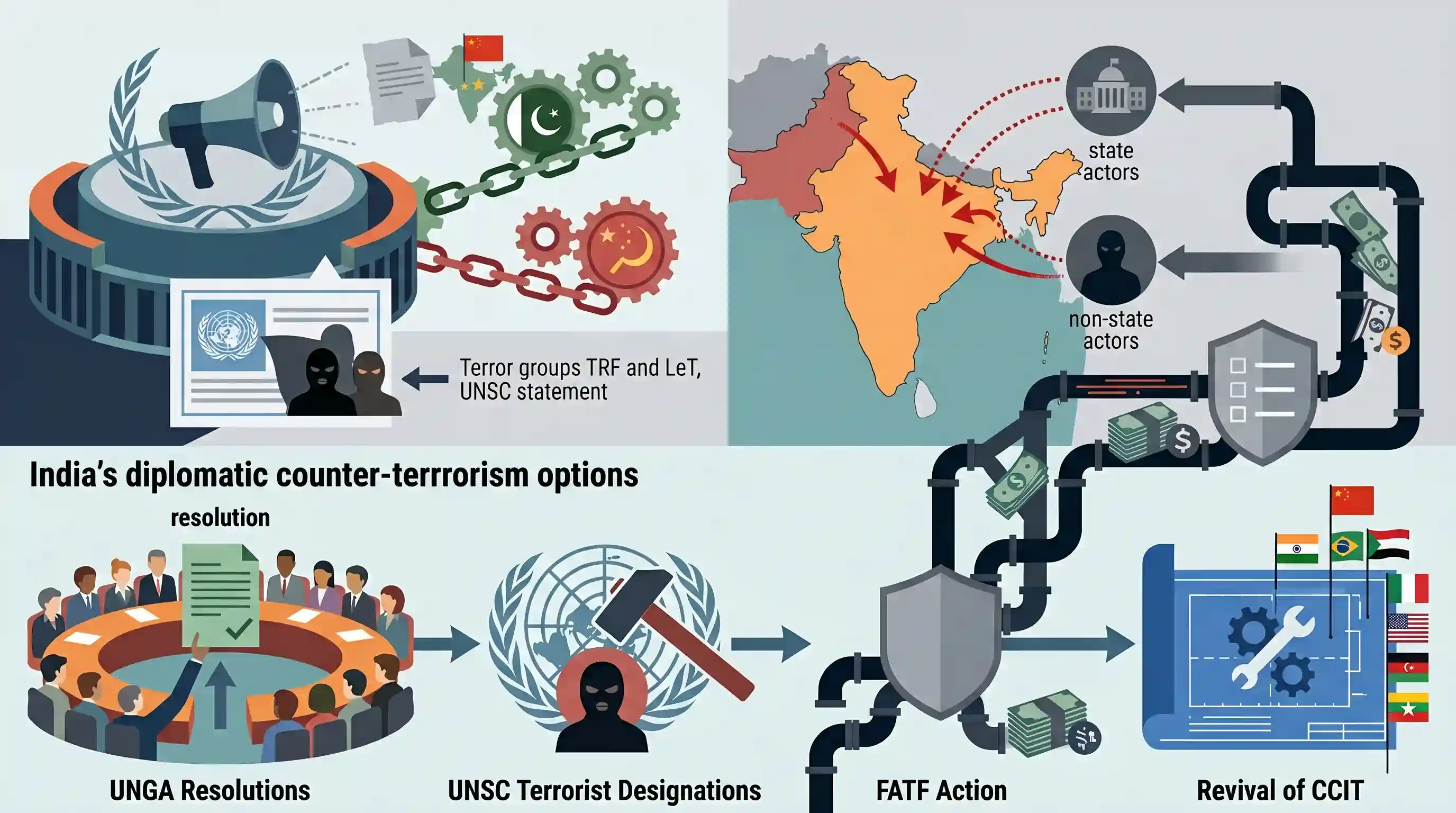
Highlights the structural constraints India faces in multilateral forums like the UNSC when addressing state-sponsored terrorism. It provides a comprehensive overview of India's diplomatic toolkit (UNGA, FATF, CCIT) to counter cross-border terror.
Summary
An editorial critiquing the UNSC's diluted statement on the Pahalgam terror attack, noting the omission of specific terror groups like TRF and LeT due to Pakistan's current UNSC membership and China's backing. It outlines India's diplomatic counter-terrorism options, including UNGA resolutions, UNSC terrorist designations, FATF action, and the revival of the Comprehensive Convention on International Terrorism (CCIT).
Key Points
- The UNSC statement condemning the Pahalgam terror attack was criticized as inadequate for failing to name The Resistance Front (TRF) or its links to Lashkar-e-Taiba (LeT).
- The diluted language of the statement is attributed to Pakistan's current tenure as a non-permanent UNSC member (2025-26) and diplomatic backing from China.
- India's diplomatic recourse includes pushing for a stronger UNGA resolution and seeking UNSC designation for the involved terrorists and the TRF.
- Other strategic options for India involve building a case at the Financial Action Task Force (FATF) and reviving the Comprehensive Convention on International Terrorism (CCIT) at the UN.
Important Terms
Comprehensive Convention on International Terrorism (CCIT)

A proposed treaty initiated by India (1996) to provide a universal legal definition of terrorism, criminalize all forms of international terror, and mandate the denial of safe havens and extradition of terrorists.
UPSC context
GS Paper 2: International Relations. Tests knowledge of India's leadership in global counter-terrorism and the diplomatic hurdles in international law.
United Nations Security Council (UNSC)
The primary UN organ for international peace and security. It can issue binding resolutions, impose sanctions, and designate terrorists through its 1267 Sanctions Committee.
UPSC context
GS Paper 2: Important International Institutions. Focuses on structural reforms, veto power, and the impact of geopolitics on security mandates.
Financial Action Task Force (FATF)
An intergovernmental organization that sets global standards to combat money laundering and terrorist financing. It maintains 'Grey' and 'Black' lists to pressure non-compliant countries into implementing financial reforms.
UPSC context
GS Paper 3: Internal Security. Evaluates mechanisms for preventing terror financing and the role of international watchdogs in national security.
The Resistance Front (TRF)
A militant group active in Jammu and Kashmir, designated by India and the US. It is considered a proxy for Lashkar-e-Taiba, used to give militancy an indigenous facade.
UPSC context
GS Paper 3: Internal Security. Tests understanding of non-state actors, proxy warfare, and evolving challenges to J&K's stability.
Lashkar-e-Taiba (LeT)
A Pakistan-based jihadist group responsible for major attacks in India, including 26/11 Mumbai. It is a UN-designated terrorist entity often operating through front organizations.
UPSC context
GS Paper 3: Internal Security. Focuses on the role of external non-state actors and cross-border terrorism in India.
UN General Assembly (UNGA)
The main deliberative and representative organ of the UN. It serves as a secondary diplomatic avenue for India to advance counter-terrorism resolutions when the UNSC is deadlocked.
UPSC context
GS Paper 2: International Relations. Relates to India's use of multilateral forums to shape global security discourse.
Prelims Trap
"Decisions under the UNSC 1267 Sanctions Committee require a two-thirds majority to designate individuals as global terrorists."
The 1267 Committee operates strictly by consensus, not majority. This structural rule allows any single member (like China) to place "technical holds" on terror designations.
Static Concepts Connected
What is the mandate and structure of the UN 1267 Sanctions Committee?
- Origin: Established by UNSC resolution 1267 in 1999, it was initially created to oversee sanctions against the Taliban and Al-Qaeda.
- Core Function: It imposes targeted sanctions—specifically asset freezes, travel bans, and arms embargoes—on designated terrorist individuals and entities.
- Decision-making: It operates by consensus. This allows member states to place "technical holds," delaying global designations for months without formally vetoing them.
What is India's proposed Comprehensive Convention on International Terrorism (CCIT)?
- Core Objective: Proposed by India at the UN General Assembly in 1996, it seeks to establish a universal, legally binding definition of terrorism.
- Key Mandates: It mandates member states to criminalize all forms of international terrorism, deny funds and safe havens, and make cross-border terrorism an extraditable offense.
- Deadlock Reason: Stalled for decades over definitions. The OIC wants exceptions for "national liberation movements," while the US opposes including peacetime state military acts.
Cross-Topic Patterns
Proxy terror groups & FATF evasion
Groups like TRF are floated as "indigenous fronts" by LeT specifically to evade FATF scrutiny of state-sponsorship, blending India's internal security challenges with global financial governance.
Procedural holds as strategic shields
China's repeated use of technical holds in the 1267 Committee perfectly illustrates India's broader argument for UNSC reform and the weaponization of consensus rules by P5 nations.

A 2026 Prelims question will likely test the exact consensus mechanisms of UN Sanctions Committees alongside FATF's mandate.
Linked PYQs · 5
Linked PYQs · 5
- 2023MainsGS3
Give out the major sources of terror funding in India and the efforts being made to curtail these sources. In the light of this, also discuss the aim and objective of the 'No Money for Terror (NMFT)' Conference recently held at New Delhi in November 2022.
- 2021MainsGS3
Discuss how emerging technologies and globalisation contribute to money laundering. Elaborate measures to tackle the problem of money laundering both at national and international levels.
- 2021MainsGS3
Analyse the complexity and intensity of terrorism, its causes, linkages and obnoxious nexus. Also suggest measures required to be taken to eradicate the menace of terrorism.
- 2024MainsGS2
‘Terrorism has become a significant threat to global peace and security.’ Evaluate the effectiveness of the United Nations Security Council's Counter Terrorism Committee (CTC) and its associated bodies in addressing and mitigating this threat at the international level.
- 2025MainsGS2
"The reform process in the United Nations remains unresolved, because of the delicate imbalance of East and West and entanglement of the USA vs. Russo-Chinese alliance.” Examine and critically evaluate the East-West policy confrontations in this regard.
