Universal Healthcare Systems versus Health Insurance Models
Source:Indian Express ↗
આ શા માટે મહત્વનું છે
It addresses a core GS2 governance and social justice issue concerning the efficacy of public health systems vs insurance models, matching recent Mains questions on public healthcare delivery and marketisation.
સારાંશ
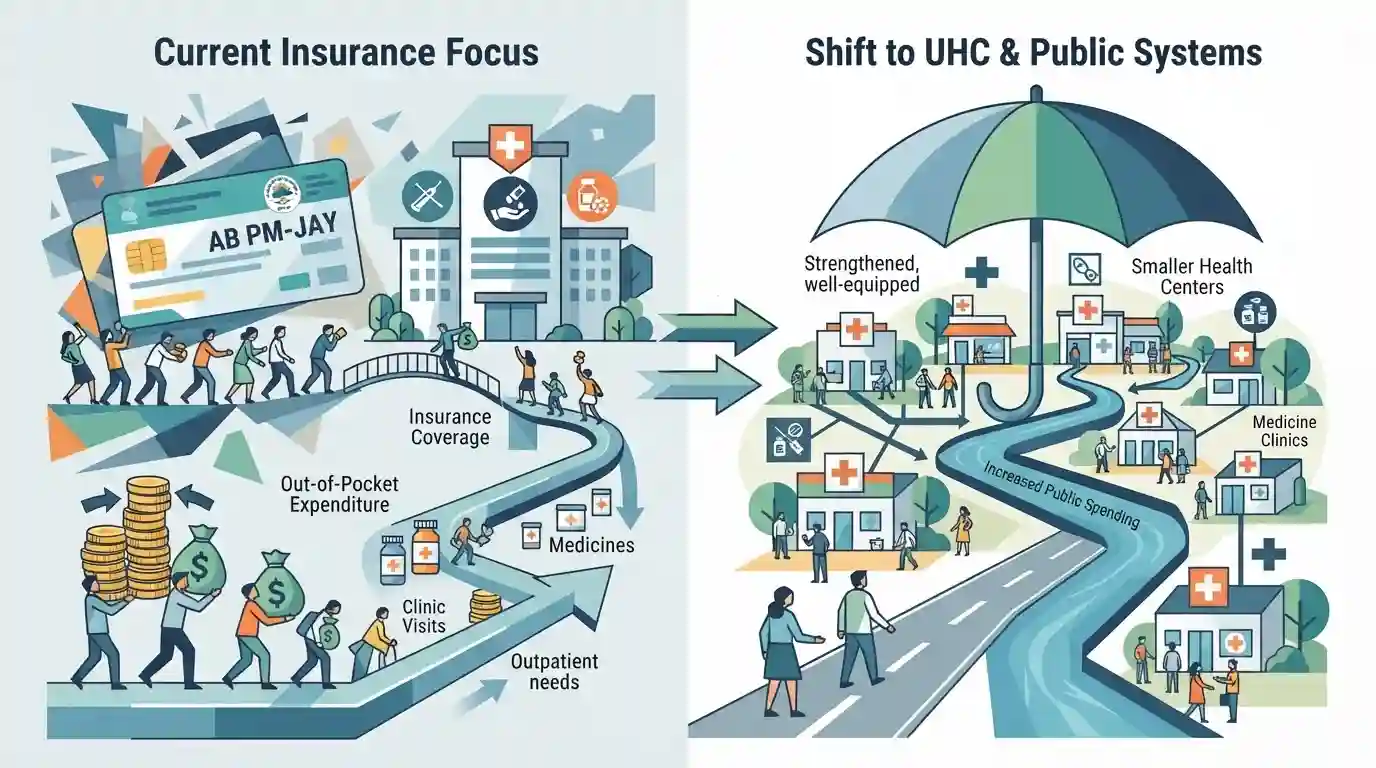
The article critiques the heavy reliance on health insurance schemes like Ayushman Bharat (PM-JAY) as a panacea for India's healthcare challenges, arguing that insurance only covers tertiary hospitalisation while ignoring outpatient care. It advocates for a transition towards Universal Health Coverage (UHC) through strengthened public healthcare systems and increased public spending.
મુખ્ય મુદ્દા
- Insurance-based models like PM-JAY primarily cover hospitalisation costs but fail to address outpatient care and preventive services, which make up the bulk of healthcare expenses for Indian households.
- Out-of-pocket expenditure (OOPE) remains high in India, pushing millions into poverty due to medical costs.
- Universal Health Coverage (UHC) requires a shift from fragmented insurance schemes to a robust, publicly funded primary healthcare delivery system.
- Strengthening grassroots public healthcare infrastructure is essential to counter the adverse impacts of marketisation in healthcare.
મહત્વપૂર્ણ શબ્દો
Ayushman Bharat - Pradhan Mantri Jan Arogya Yojana (AB PM-JAY)

India's flagship public health insurance scheme providing health coverage of up to ₹5 lakh per family per year for secondary and tertiary hospitalisation to vulnerable families.
UPSC context
UPSC GS Paper II (Social Sector Schemes, Health Policy). Essential for evaluating government interventions in healthcare and financial risk protection.
World Health Organization (WHO)
The specialized agency of the United Nations responsible for international public health, setting global standards, guidelines, and tracking progress towards Universal Health Coverage.
UPSC context
UPSC GS Paper II (International Organizations, Global Health Policy). Important for understanding multilateral health frameworks and SDG targets.
NITI Aayog
The apex public policy think tank of the Government of India providing strategic inputs, policy guidance, and monitoring health outcomes and index metrics across states.
UPSC context
UPSC GS Paper II (Governance, Institutional Frameworks). Relevant for governance policies, cooperative federalism, and social sector evaluations.
સંલગ્ન સ્થિર ખ્યાલો
What are the core pillars of Universal Health Coverage (UHC) according to the WHO?
- Financial Protection: Financial risk protection ensuring access without financial hardship.
- Service Coverage: Comprehensive service coverage spanning promotion, prevention, treatment, and rehabilitation.
- Essential Medicines: Availability of affordable and quality essential medicines and technologies.
આંતર-વિષય પેટર્ન
PM-JAY vs Sustainable Development Goals (SDG 1 & 3)
While PM-JAY provides financial protection for hospitalisation, out-of-pocket spending on drugs and diagnostics at the primary level directly undermines poverty alleviation targets under SDG 1.

UHC vs Insurance models will likely feature as a statement-based question contrasting tertiary financial risk protection with primary care.
સંલગ્ન PYQ · 1
સંલગ્ન PYQ · 1
- 2024MainsGS2
In a crucial domain like the public healthcare system the Indian State should play a vital role to contain the adverse impact of marketisation of the system. Suggest some measures through which the State can enhance the reach of public healthcare at the grassroots level.
