Not Found Suitable Clause in Central University Vacancies
Source:The Hindu ↗
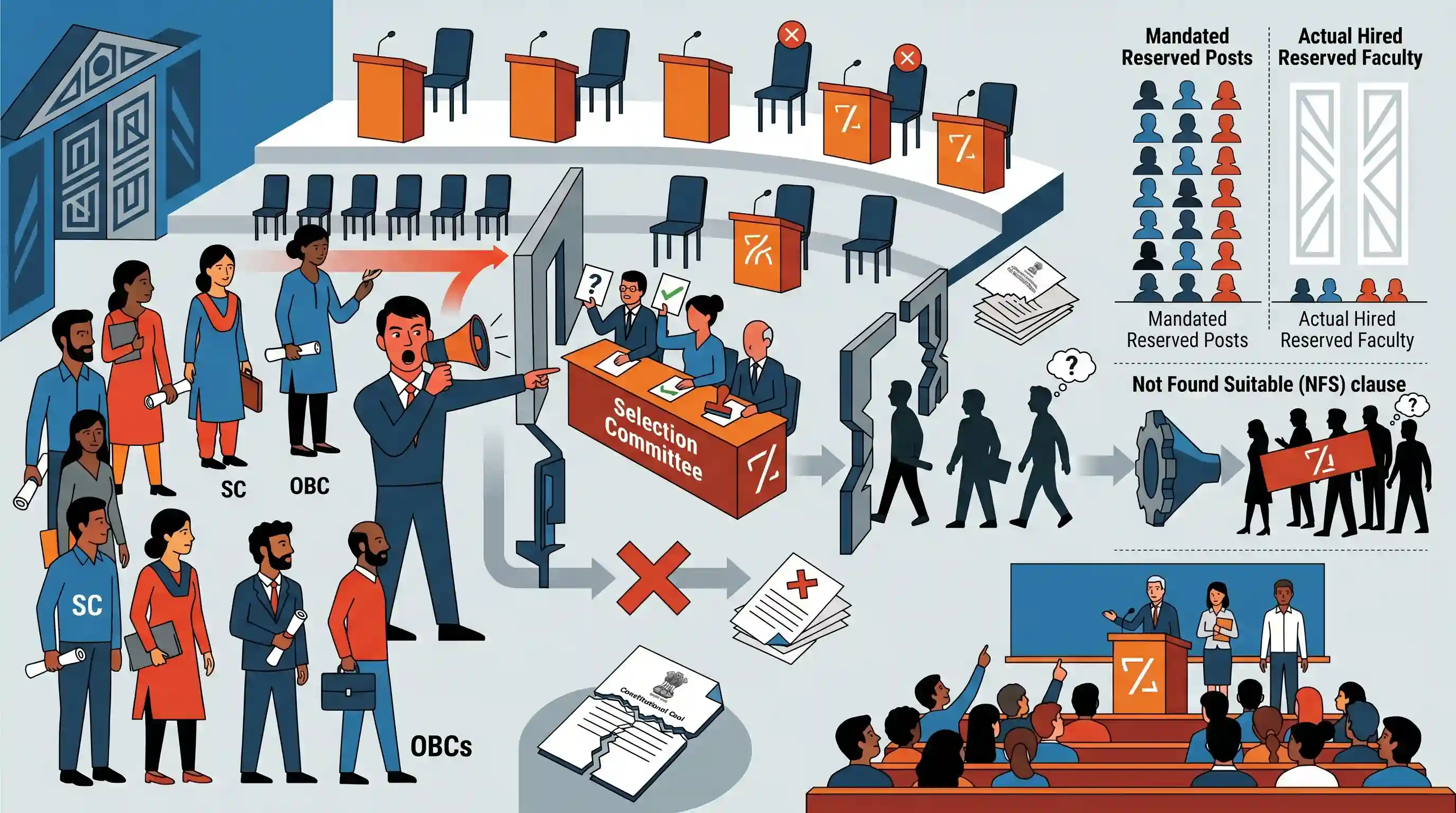
Why It Matters
The article exposes practical implementation challenges in India's affirmative action framework. It highlights how administrative mechanisms (like the NFS clause) can potentially be misused to undermine constitutional mandates (such as Article 16) for social justice, forming a crucial case study for GS2 questions on the welfare of vulnerable sections and representation in public institutions.
Summary
The Congress party has raised alarms over the systemic denial of employment opportunities to SC, ST, and OBC candidates in central university faculty recruitments. Citing data from the Minister of State for Education, Congress highlighted massive vacancy rates for reserved categories, notably at senior levels (Professors and Associate Professors). The party alleges that selection committees frequently weaponize the 'not found suitable' (NFS) clause to reject candidates from marginalized backgrounds, effectively subverting constitutional reservation policies and depriving these communities of fair representation in higher education and research.
Key Points
- Significant vacancy rates persist for SC, ST, and OBC candidates in central university faculty positions, particularly at the Professor and Associate Professor levels.
- The Congress party alleges that the 'not found suitable' (NFS) clause is being weaponized by selection panels to disproportionately reject reserved category candidates.
- Data presented in Parliament revealed that at the professor level, 80% of OBC, 83% of ST, and 64% of SC posts remain vacant.
- Critics argue this practice undermines the constitutional mandate of reservation in public employment and systematically denies marginalized groups representation in higher education.
Important Terms
Article 16

Article of the Indian Constitution guaranteeing equality of opportunity in public employment. Clause (4) specifically enables the State to provide reservations for backward classes not adequately represented.
UPSC context
GS Paper II: Constitution & Governance. Core fundamental right governing reservation policies and affirmative action in government jobs.
'Not Found Suitable' (NFS) Clause
A recruitment provision used by selection committees to reject candidates who meet minimum eligibility criteria but are deemed 'unfit' for the specific academic role.
UPSC context
GS Paper II: Social Justice. Represents a systemic barrier in implementing reservation policies in higher education and research institutions.
Central Universities
Higher education institutions established by an Act of Parliament under the purview of the Union Education Ministry, mandated to implement constitutional reservation for faculty.
UPSC context
GS Paper II: Education & Human Resources. Tests knowledge of institutional autonomy versus constitutional compliance in recruitment.
Central Educational Institutions (Reservation in Teachers’ Cadre) Act, 2019
A 2019 legislation ensuring that reservation in direct recruitment for teachers is calculated by treating the university as one unit rather than individual departments.
UPSC context
GS Paper II: Governance/Laws. Key statutory framework for implementing quotas in senior academic positions (Associate Professor/Professor).
13-Point Roster System
A mechanism used to determine the vacancy allocation for reserved categories. The shift from a 200-point (university-wide) to 13-point (department-wise) roster has been a major point of contention.
UPSC context
GS Paper II: Social Justice. Crucial for understanding technical hurdles in achieving representative diversity in small departments.
SC, ST, and OBCs
Historically marginalized communities in India entitled to 15%, 7.5%, and 27% reservation respectively in public employment and educational institutions.
UPSC context
GS Paper I & II: Social Empowerment/Vulnerable Sections. Foundational categories for all social justice and reservation-related questions.
Prelims Trap
Unfilled reserved faculty posts in Central Universities can be de-reserved and filled by general candidates.
The Ministry of Education strictly bans the de-reservation of reserved faculty vacancies in direct recruitment, unlike DoPT which permits it for Group A posts exceptionally.
Static Concepts Connected
How does Article 335 balance the reservation policy under Article 16(4)?
- Article 16(4): Empowers the State to make reservations in appointments or posts for any backward class of citizens inadequately represented in state services.
- Article 335: Mandates that claims of SCs and STs to public services must be considered consistently with the maintenance of administrative efficiency.
- Judicial Interpretation: In the Nagaraj (2006) judgment, the Supreme Court held that providing reservations must not compromise overall administrative efficiency.
How does the CEI Act, 2019 alter roster calculations in Central Universities?
- Single Unit Roster: Mandates considering the entire university or institution as a "single unit" for roster calculation, rather than treating individual departments as isolated units.
- Preventing Seat Loss: Ensures comprehensive reservation representation for SC, ST, OBC, and EWS categories, overcoming the severe shortfalls previously seen in the department-wise roster system.
Cross-Topic Patterns
Autonomy vs. Affirmative Action
Relates the 'Not Found Suitable' clause to broader debates on academic autonomy, mirroring issues of affirmative action exemptions in specialised scientific bodies.
Constitutional Commissions' Oversight Role
Connects to the specific constitutional mandate of the NCSC (Article 338) and NCBC (Article 338B) to investigate systemic biases and grievances in public employment.

Expect a multi-statement Prelims question testing the difference between general DoPT de-reservation rules and the MoE's strict academic ban.
Linked PYQs · 3
Linked PYQs · 3
- 2022MainsGS2
Discuss the role of the National Commission for Backward Classes in the wake of its transformation from a statutory body to a constitutional body.
- 2018MainsGS2
Whether National Commission for Scheduled Castes (NCSC) can enforce the implementation of constitutional reservation for the Scheduled Castes in the religious minority institutions? Examine.
- 2020PrelimsGS1
Which one of the following categories of Fundamental Rights incorporates protection against untouchability as a form of discrimination?
