Homebuyers Peaceful Protest Rights against Builders and Defamation
Source:The Hindu ↗
Why It Matters
This judgement is a crucial precedent regarding the boundaries of Freedom of Speech and the Right to Protest vis-a-vis Criminal Defamation. It also highlights the continuing governance challenges in the real estate sector and the efficacy of statutory bodies like RERA, which is highly relevant for GS Paper 2 (Polity & Governance).
Summary
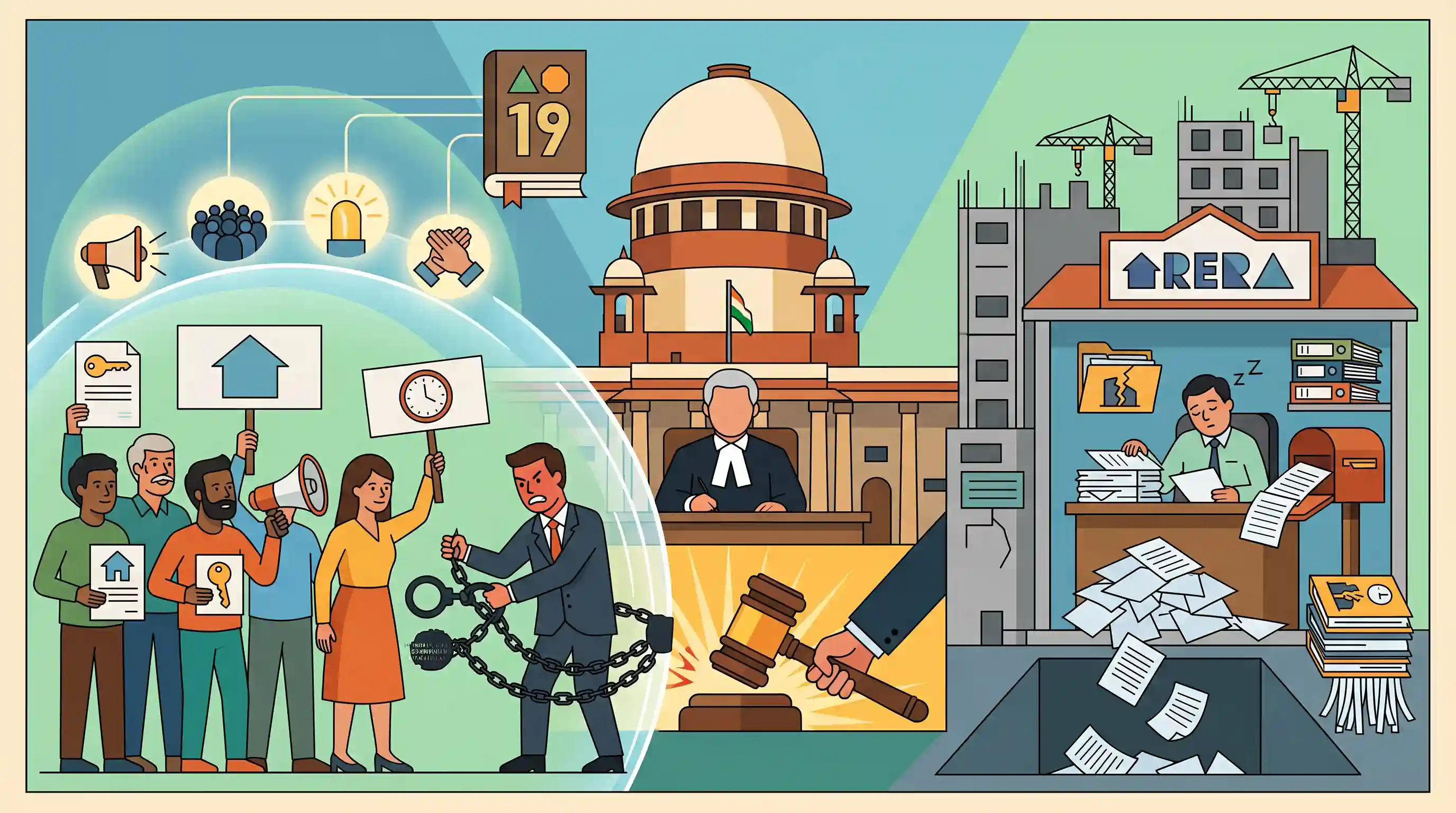
The Supreme Court has ruled that peaceful protests by homebuyers against builders over project delays or issues do not constitute criminal defamation under Section 499 of the IPC. The Court held that such protests fall under the Ninth Exception to Section 499, as they are expressions made in good faith to protect one's interests. The ruling upholds homebuyers' fundamental rights to freedom of speech, assembly, and association under Article 19(1) of the Constitution. Additionally, the Court expressed disappointment over the functioning of the Real Estate Regulatory Authority (RERA) in protecting consumer rights, stating it often functions merely like a "post office."
Key Points
- The Supreme Court ruled that homebuyers peacefully protesting against builders for failing to deliver flats or for other grievances does not amount to criminal defamation.
- Such protests are protected under the Ninth Exception to Section 499 of the IPC, which exempts imputations made in good faith for the protection of one's interests or for the public good.
- The Court affirmed that peaceful protests are a manifestation of the fundamental rights to freedom of speech, assembly, and association under Article 19(1)(a), (b), and (c) of the Constitution.
- The Bench also expressed disappointment over the functioning of RERA bodies across states, noting they often fail to effectively resolve homebuyer grievances.
Important Terms
Real Estate (Regulation and Development) Act (RERA Act)

The 2016 central legislation enacted to regulate India's real estate sector, ensure transparency, mandate project registration, and protect homebuyers from delays and unfair practices.
UPSC context
GS-II/GS-III: Important for Governance, Statutory Bodies, and Infrastructure. Tests knowledge of consumer protection and regulatory frameworks.
Real Estate Regulatory Authority (RERA)
State-level statutory bodies established under the RERA Act to oversee property transactions, adjudicate disputes, and ensure builders comply with project timelines and financial disclosures.
UPSC context
GS-II: Statutory, regulatory and various quasi-judicial bodies. Significant due to Supreme Court criticism of its effectiveness.
Section 499 (IPC) / Criminal Defamation
Defines criminal defamation as making/publishing false imputations to harm a person's reputation. It has been retained in the new Bharatiya Nyaya Sanhita (BNS) as Section 356.
UPSC context
GS-II: Judiciary and Governance. Tests understanding of legal restrictions on free speech and protection of individual reputation.
Ninth Exception to Section 499
A specific legal defense stating it is not defamation to make imputations in good faith to protect one's own or another's interests, or for the public good.
UPSC context
GS-II: Polity/Legal. Vital for understanding how consumer grievances are legally protected against harassment suits by corporations.
Article 19(1) of the Indian Constitution
The provision guaranteeing fundamental freedoms including speech (a), peaceful assembly (b), and forming associations (c), which the Supreme Court linked to the right to protest builders.
UPSC context
GS-II: Fundamental Rights. Core syllabus topic; tests the balance between individual liberty and reasonable restrictions.
Prelims Trap
"The 'Right to Protest' is explicitly listed as a Fundamental Right under Article 19 of the Constitution."
The Right to Protest is a derived right interpreted from Articles 19(1)(a), 19(1)(b), and 19(1)(c). It is not explicitly listed as a standalone right.
Static Concepts Connected
What are the grounds for restricting Freedom of Speech under Article 19(2)?
- Sovereignty & Security: Protecting the state from secessionist threats, public disorder, or overthrow of the government.
- Friendly Relations: Preventing actions that strain diplomatic ties with foreign states.
- Defamation & Morality: Protecting public morals, maintaining court authority (contempt), and safeguarding individual reputation (defamation).
What are the key consumer protection mandates under the RERA Act, 2016?
- Escrow Account: Developers must deposit at least 70% of project funds collected from buyers into a dedicated bank account to prevent fund diversion.
- Carpet Area Pricing: Properties must be sold based on clearly defined 'carpet area' rather than ambiguous 'super built-up area'.
- Appellate Tribunals: Establishes state-level Real Estate Regulatory Authorities and Appellate Tribunals for fast-tracking buyer-builder dispute resolution.
Cross-Topic Patterns
Defamation vs Right to Life (Art 21)
The SC balances Article 19(1)(a) with Article 21, as established in Subramanian Swamy (2016) where the "right to reputation" was deemed an inherent part of the right to life.
Insolvency Code (IBC) + Homebuyers
Homebuyers are classified as "financial creditors" under the IBC, granting them a seat at the Committee of Creditors. This SC ruling further protects their collective bargaining power against defaulting builders.

Expect a multi-statement Prelims question interlinking derived rights (Art 19), defamation as a restriction, and RERA's escrow mandates.
Linked PYQs · 1
Linked PYQs · 1
- 2014MainsGS2
What do you understand by the concept "freedom of speech and expression"? Does it cover hate speech also ? Why do the films in India stand on a slightly different plane from other forms of expression ? Discuss.
