India Deems Trade Deal Impractical Amid Punitive US Tariffs
Source:The Hindu ↗
Why It Matters
The article highlights the practical challenges of global protectionism on India's export economy and bilateral trade strategy. It is highly relevant for GS-2 (India-US relations) and GS-3 (Impact of protectionism, export promotion policies, and liquidity issues facing the manufacturing/export sector).
Summary
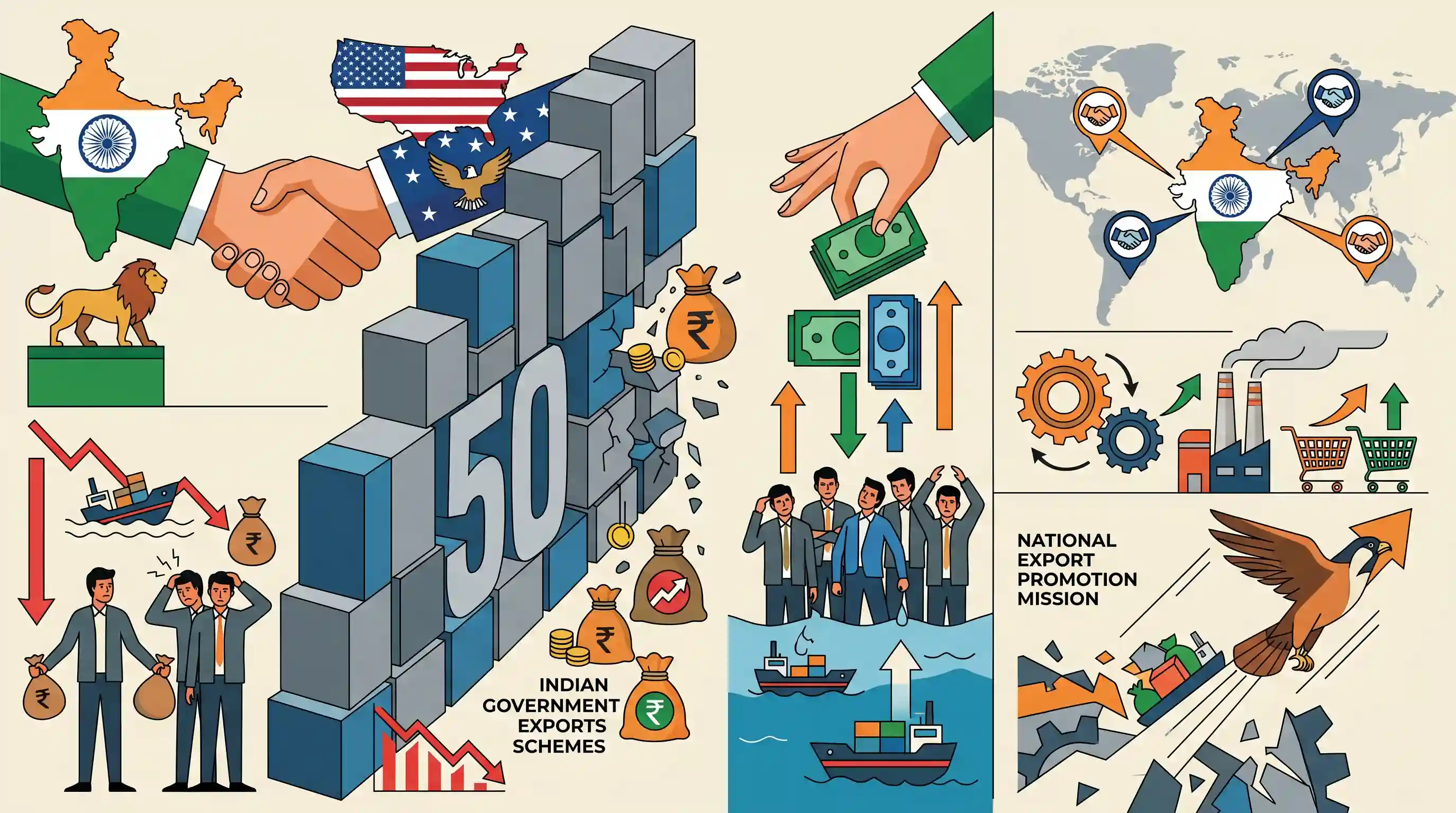
India remains open to a bilateral trade agreement (BTA) with the United States but emphasizes that practical negotiations are hindered by existing US tariffs, which, when combined with reciprocal Indian tariffs, amount to a restrictive 50% rate. Officials note this level of tariff acts as a virtual trade embargo, neutralizing the benefits of export promotion schemes and causing acute liquidity crises for exporters. To mitigate these impacts, the Indian government is working on immediate liquidity measures while relying on medium-term strategies such as seeking alternative Free Trade Agreements (FTAs), stimulating domestic demand, and launching the National Export Promotion Mission to bolster the export sector amidst growing global protectionism.
Key Points
- India has indicated willingness to engage in trade talks with the US, but considers a bilateral deal impractical while punitive US tariffs (amounting to 50% combined) are in effect.
- The government notes that a 50% tariff essentially acts as a trade embargo, rendering standard export promotion incentives ineffective.
- Indian exporters are facing acute liquidity issues as a result of the tariff environment, prompting the government to consider short-term liquidity support measures.
- Medium-term mitigation strategies include diversifying exports, expanding alternative Free Trade Agreements (FTAs), boosting domestic demand, and launching a National Export Promotion Mission.
Important Terms
National Export Promotion Mission (EPM)

A flagship central-sector scheme (Budget 2025-26) to boost export competitiveness, specifically targeting MSMEs through financial (Niryat Protsahan) and non-financial (Niryat Disha) support. Outlay: ₹25,060 crore.
UPSC context
GS Paper III: Indian Economy; tests knowledge of government initiatives to achieve the $2 trillion export target by 2030.
Free Trade Agreements (FTAs)
Comprehensive agreements between two or more countries to eliminate or significantly reduce tariffs and non-tariff barriers on 'substantially all trade,' ensuring preferential market access and economic integration.
UPSC context
GS Paper II/III: International Relations and Economy; tests understanding of trade diplomacy, WTO compliance (Article XXIV), and market diversification.
Bilateral Trade Agreement (BTA)
A trade pact between two nations aimed at reducing tariffs, quotas, and other barriers to encourage economic cooperation and bilateral investment.
UPSC context
GS Paper II: Bilateral relations involving India; specifically tests India-US trade dynamics and 'Mission 500' trade goals.
Reciprocal Tariffs
A trade policy where a country imposes import duties on another nation's goods equivalent to the tariffs that the nation levies on its own exports.
UPSC context
GS Paper III: Economy; tests understanding of trade wars, protectionism, and their impact on India's export competitiveness.
Trade Protectionism
Economic policy of shielding domestic industries from foreign competition by imposing tariffs, quotas, or subsidies, often leading to reduced global trade efficiency.
UPSC context
GS Paper III: Globalization; tests analytical ability regarding the resurgence of economic nationalism and its impact on developing economies.
Liquidity Crisis (Exporters)
A severe shortage of cash or easily convertible assets among exporters, often caused by high tariffs or delayed government refunds, hindering their ability to fund operations.
UPSC context
GS Paper III: Indian Economy; tests understanding of macroeconomic stability and the financial health of the MSME and export sectors.
Prelims Trap
India and the United States are currently trading under a Bilateral Trade Agreement (BTA).
India and the US do not have an FTA or BTA. Their bilateral trade relies on WTO MFN rates, leading to frequent friction over punitive and retaliatory tariffs.
Static Concepts Connected
What are India's primary Export Promotion Schemes?
- RoDTEP Scheme: Remission of Duties and Taxes on Exported Products (RoDTEP) refunds embedded indirect taxes (central, state, local) not covered by other mechanisms.
- Advance Authorization: Allows duty-free import of inputs that are physically incorporated into export products, subject to strict value addition norms and export obligations.
- EPCG Scheme: Export Promotion Capital Goods scheme allows zero-duty import of capital goods for pre-production, production, and post-production, tied to export performance.
What distinguishes retaliatory tariffs under WTO rules?
- Purpose & Trigger: Punitive customs duties enacted by a nation to offset the economic harm caused by another nation's unfair trade barriers or tariff hikes.
- DSB Authorization: Legally, WTO members must obtain Dispute Settlement Body (DSB) approval before retaliating, though unilateral exceptions (like 'national security') are increasingly exploited.
Cross-Topic Patterns
Protectionism & Dual Circulation Model
India's strategy to stimulate domestic demand alongside pursuing alternative FTAs closely mirrors China’s 'Dual Circulation' model, functioning as a structural hedge against Western trade volatility.
Export Liquidity & MSME Credit
Punitive tariffs acutely hit export-oriented MSMEs by freezing their working capital. This links international trade friction directly to domestic MSME credit lines and priority sector lending targets.

Expect a 2026 Mains question evaluating how India balances Western protectionism with alternative FTAs and domestic demand stimulation.
Linked PYQs · 4
Linked PYQs · 4
- 2025MainsGS3
What are the challenges before the Indian economy when the world is moving away from free trade and multilateralism to protectionism and bilateralism? How can these challenges be met?
- 2019MainsGS2
‘What introduces friction into the ties between India and the United States is that Washington is still unable to find for India a position in its global strategy, which would satisfy India's national self-esteem and ambitions.’ Explain with suitable examples.
- 2012MainsGS2
Discuss the likely negative impact of the protectionist measures proposed by the US on India's software industry.
- 2017MainsGS3
Account for the failure of manufacturing sector in achieving the goal of labour-intensive exports. Suggest measures for more labour-intensive rather than capital-intensive exports.
