Strategic Autonomy Dictates India Energy Ties Amid Sanctions
Source:Indian Express ↗
ఇది ఎందుకు ముఖ్యం
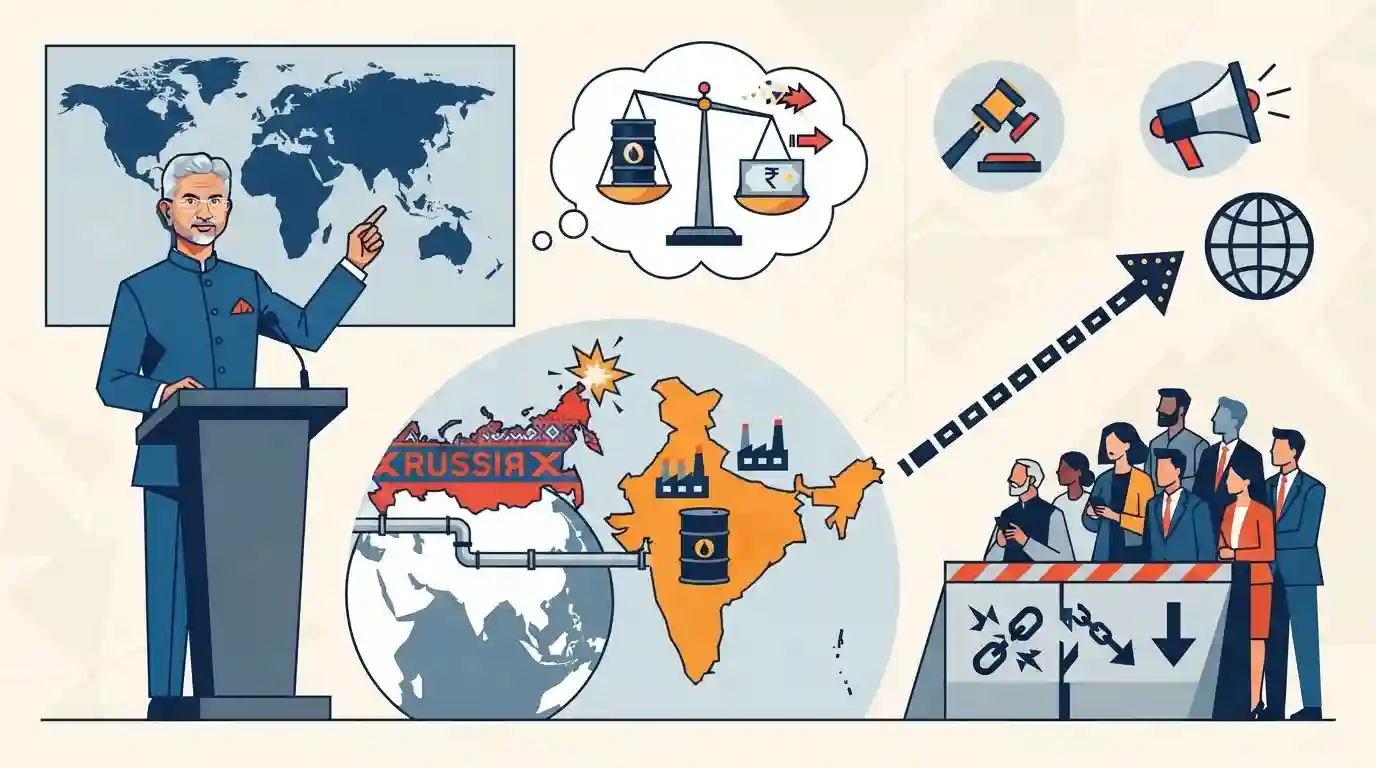
This statement underscores India's steadfast commitment to strategic autonomy, pragmatic foreign policy, and protecting national economic interests in the face of intense Western pressure regarding ties with Russia.
సారాంశం
External Affairs Minister S Jaishankar defended India's import of Russian oil, stating that stopping purchases would not halt the Russia-Ukraine war, while emphasizing India's priority on energy security and strategic autonomy amidst global sanctions.
ముఖ్య అంశాలు
- External Affairs Minister S Jaishankar defended India's decision to continue purchasing Russian oil, stating that halting these purchases would not stop the Ukraine war.
- He highlighted that global energy markets are interconnected, and western sanctions and market shifts have complex repercussions on inflation and energy security for developing nations.
- India emphasizes strategic autonomy and national interest in maintaining trade relations while navigating geopolitical pressures from Western nations.
ముఖ్యమైన పదాలు
External Affairs Ministry

The central government agency in India responsible for formulating, executing, and managing the country's foreign policy and diplomatic relations globally.
UPSC context
Important for UPSC CSE Prelims and Mains (GS Paper II - International Relations), covering institutional framework of India's foreign policy.
Strategic Autonomy
A core pillar of India's foreign policy ensuring independent decision-making in international affairs, free from external or bloc pressures, as highlighted in energy sourcing debates.
UPSC context
Critical for UPSC CSE Mains GS Paper II (International Relations - India's foreign policy principles and major global alignments).
Energy Security
The condition of ensuring uninterrupted, affordable, and diversified availability of energy resources to sustain national economic development and security.
UPSC context
Relevant for UPSC CSE GS Paper II (International Relations) and GS Paper III (Economy and Security - Energy Infrastructure).
ప్రిలిమ్స్ ఉచ్చు
India's purchase of Russian oil violates international sanctions regimes binding upon all UN member states.
Aspirants often confuse strategic autonomy with absolute neutrality or isolationism; India actively engages in plurilateral groupings while making independent procurement choices.
అనుసంధానమైన స్థిర భావనలు
What are the core pillars and evolution of India's Strategic Autonomy in foreign policy?
- Evolution: Historical roots stem from the Non-Aligned Movement (NAM), shifting post-Cold War toward multi-alignment and pragmatic national interest prioritization.
- Core Tenet: Prioritizes independent decision-making over bloc-based allegiance, engaging simultaneously with strategic rivals like the US, Russia, and regional groupings.
- Objective: Ensures domestic economic development and energy security remain insulated from external geopolitical coercion or secondary sanctions.
అంతర-అంశ నమూనాలు
Strategic Autonomy vs Multi-Alignment in IR
India's balancing act between Western security partnerships (QUAD) and traditional energy ties with Russia tests the limits of strategic autonomy in multi-aligned foreign policy.
Sanctions, Crude Flows, and Macroeconomic Stability
Western sanctions on Russian crude forced a structural shift in global oil trade routes, directly impacting developing nations' current account deficits and inflation metrics.

Expect a statement-based Q on strategic autonomy, distinguishing it from non-alignment, using India's Russian oil imports as context.
అనుసంధాన PYQలు · 1
అనుసంధాన PYQలు · 1
- 2020MainsGS2
What is the significance of Indo-US defence deals over Indo-Russian defence deals? Discuss with reference to stability in the Indo-Pacific region.
