Patna BPSC Protest: Child Detention and Public Safety Concerns
Source:the-print ↗
Why It Matters
The incident underlines the practical challenges of maintaining law and order during large-scale agitations while respecting fundamental rights (Article 19). It also throws light on the credibility issues plaguing recruitment commissions (like BPSC) and raises sensitive legal/ethical concerns about police conduct toward minors in conflict or protest situations.
Summary
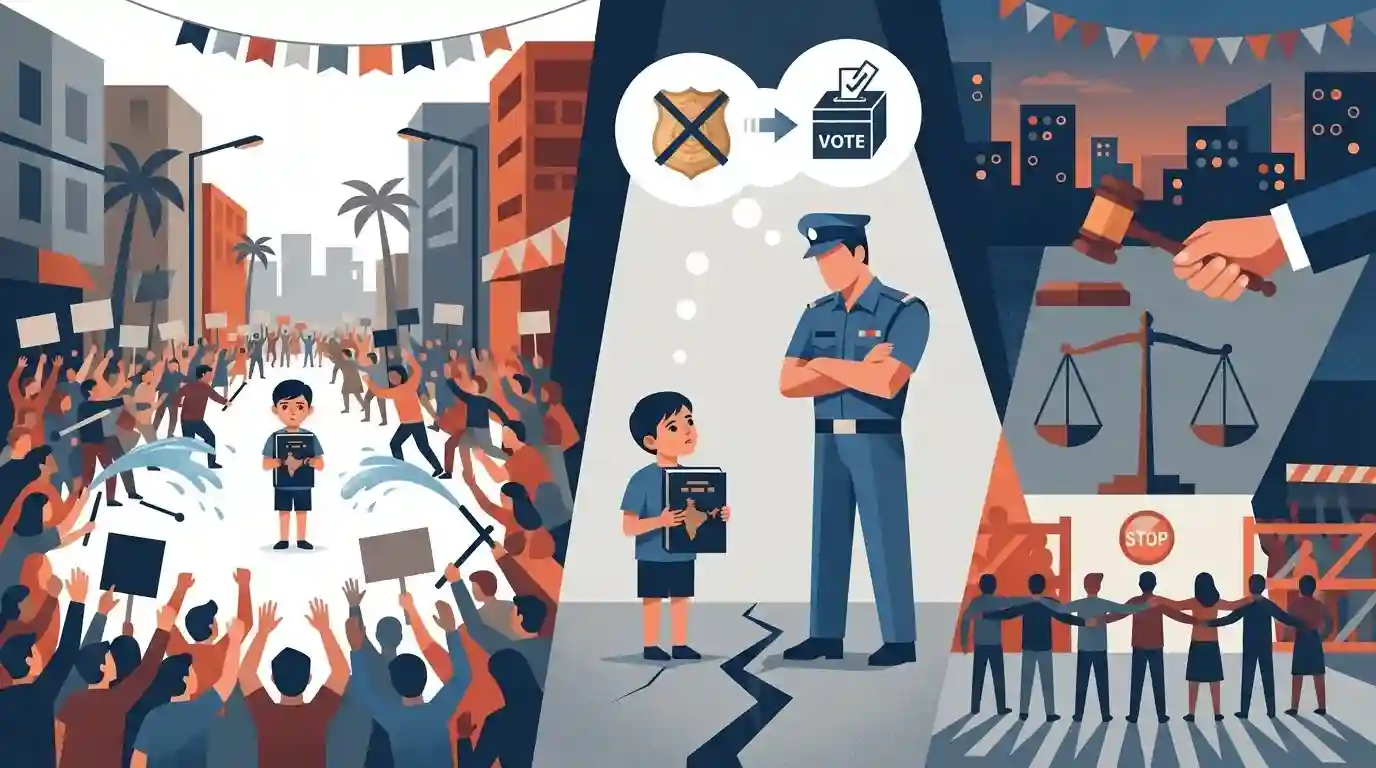
A six-year-old boy named Aditya Kumar went viral after being detained by the police during a massive student protest in Patna over alleged BPSC exam irregularities. Carrying a copy of the Indian Constitution, the boy criticized the police for their use of lathi-charges and water cannons against protesters. He expressed that he no longer wishes to become an IPS officer due to the police's behavior and instead wants to enter politics. The event highlights growing frustrations with State Public Service Commissions and raises legal questions concerning the detention of minors and the right to peaceful protest.
Key Points
- Six-year-old Aditya Kumar was detained by Bihar Police during a massive student protest in Patna.
- The students were protesting against alleged delays and paper leaks related to the Bihar Public Service Commission (BPSC) exams.
- Aditya gained viral attention for carrying a copy of the Constitution and criticizing police brutality during the lathi-charge and use of water cannons.
- He stated that witnessing the police actions made him abandon his dream of becoming an IPS officer, opting instead to become a politician to address these issues.
- The incident sparks debates regarding fundamental rights, the right to protest, and the ethics and legality of detaining minors during agitations.
Important Terms
Constitution of India

The supreme law of India establishing the framework for fundamental political principles, government institutions, and fundamental rights. In this context, it guarantees the right to peaceful assembly and freedom of expression.
UPSC context
BPSC GS Paper 2 (Polity). Tests understanding of Fundamental Rights (Article 19) and citizens' right to peaceful protest.
Bihar Public Service Commission (BPSC)
A state-level constitutional body authorized to conduct civil service and recruitment examinations in Bihar. It frequently faces scrutiny over alleged irregularities and transparency issues leading to student protests.
UPSC context
BPSC GS Paper 2 (Polity). Essential for questions on constitutional bodies, state administration, and civil service recruitment reforms.
Bihar Police
The primary law enforcement agency for Bihar, responsible for maintaining public order. Their crowd-control methods during protests—including lathi-charges and detaining minors—often raise serious human rights and ethical concerns.
UPSC context
BPSC GS Paper 2 (Governance). Relevant for topics covering law and order, police ethics, public administration, and human rights.
Juvenile Justice (Care and Protection of Children) Act, 2015
An Indian law ensuring the protection and rehabilitation of children under 18. It strictly regulates police interactions with minors, prohibiting the unlawful detention or intimidation of children during public demonstrations.
UPSC context
BPSC GS Paper 2 (Social Justice). Tests knowledge of vulnerable sections, child rights, and legal safeguards against unlawful detention.
Right to Protest
A democratic right derived from Article 19(1)(a) and 19(1)(b) of the Constitution, guaranteeing freedom of speech and peaceful assembly without arms, subject to reasonable restrictions for maintaining public order.
UPSC context
BPSC GS Paper 2 (Polity). Crucial for analyzing the balance between fundamental rights, state security, and public order.
Prelims Trap
The Chairman and members of a State Public Service Commission are appointed and removed by the Governor.
While SPSC members are appointed by the Governor of the state (Article 316), they can ONLY be removed by the President of India (Article 317).
Static Concepts Connected
What are the appointment and removal rules for SPSC members?
- Appointment: The Governor appoints the Chairman and members of a State Public Service Commission (Article 316).
- Removal: They can only be removed by the President on grounds of misbehaviour after a Supreme Court inquiry (Article 317).
- Independence: Their conditions of service cannot be varied to their disadvantage after appointment, ensuring autonomy.
What is Doli Incapax under Indian criminal law?
- Absolute Immunity: It means 'incapable of forming criminal intent', granting absolute immunity from criminal prosecution.
- Age Threshold: Under Section 20 of the BNS 2023, nothing done by a child under seven years of age is considered an offence.
- Juvenile Justice Act: Individuals below 18 are juveniles; only those aged 16-18 can be tried as adults for heinous offences.
Cross-Topic Patterns
SPSC Accountability + Right to Protest
The incident connects administrative accountability (SPSC exams) with constitutional rights [Art 19(1)(b) peaceful assembly] and reasonable restrictions under Article 19(3) for public order.
Police Ethics + BNS Doli Incapax
Detention of a 6-year-old directly triggers ethics of crowd control alongside Section 20 of BNS 2023 (absolute immunity for children under seven).

Expect a polity question mixing SPSC removal rules (Art 317) with BNS 2023 'Doli Incapax' (absolute immunity for children under 7).
Linked PYQs · 5
Linked PYQs · 5
- 2025BPSC_PRELIMSGS1
The constitution of India provides for reasonable restrictions on Fundamental Rights but reasonableness must keep in mind that: 1. The restrictions must be necessary for the protection of the rights of others. 2. The restrictions must be proportionate to the end sought. 3. The restrictions must be reasonable in the light of the circumstances. 4. The restrictions must be in the public interest.
- 2025BPSC_PRELIMSGS1
Which one of the following subjects fall within the jurisdiction of both High Court and Supreme Court?
- 2016BPSC_PRELIMSGS1
The Supreme Court has held that hoisting the National Flag atop the private buildings is a fundamental right of every citizen under:
- 2017BPSC_PRELIMSGS1
When was Patna Lawn renamed as Gandhi Maidan?
- 2015BPSC_PRELIMSGS1
Justice J. S. Verma Committee's Report, 2013 deals with:
