India-US Interim Trade Pact Sparks Strategic Autonomy Concerns
Source:The Hindu ↗
Why It Matters
The intersection of trade policies and geopolitics is a core UPSC theme. This development highlights the challenges India faces in balancing its strategic partnership with the U.S., protecting domestic agricultural livelihoods, and maintaining independent energy ties with Russia amid global sanctions.
Summary
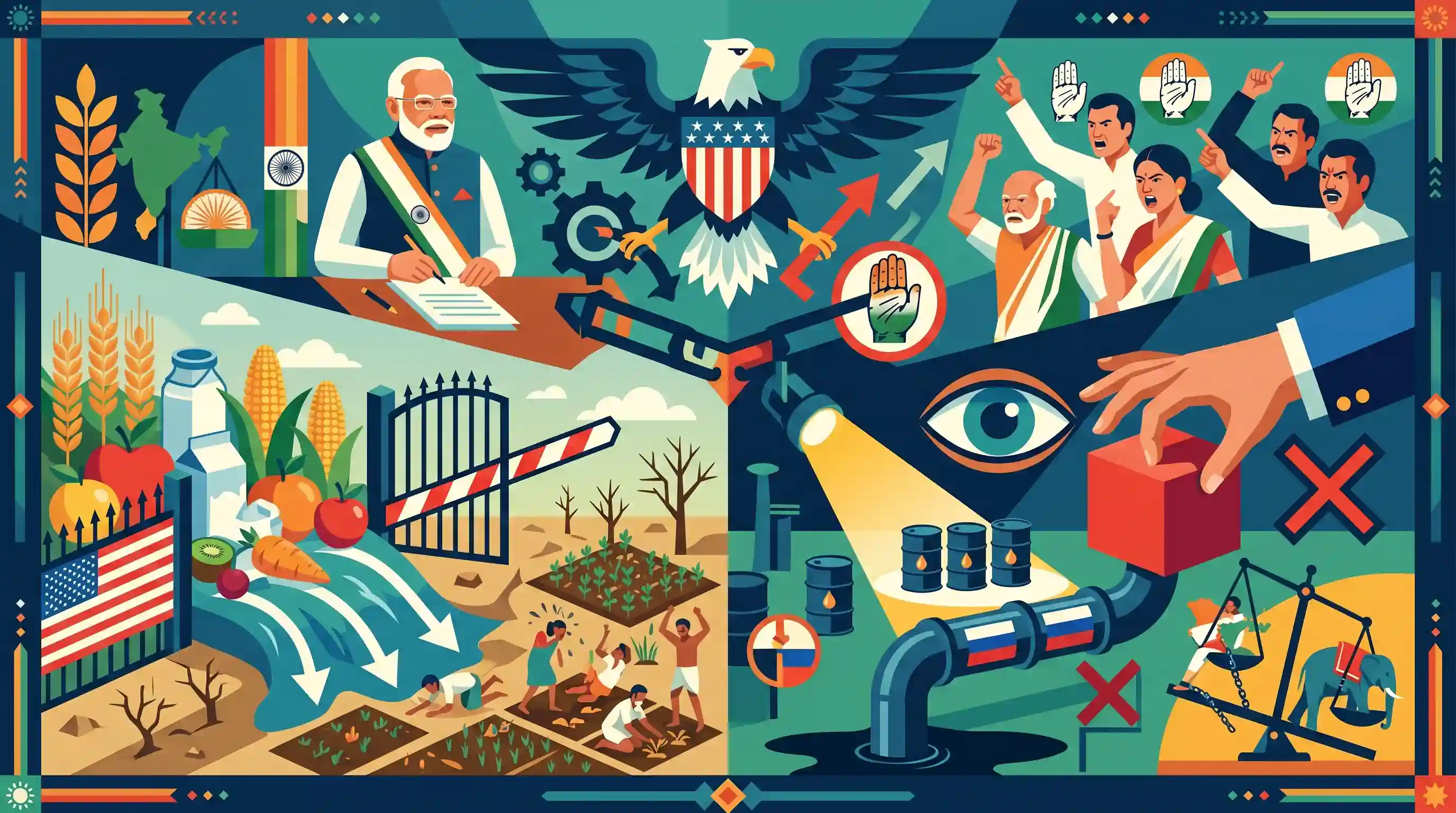
Opposition leaders from the Congress party have heavily criticized the Narendra Modi government over the recently signed Indo-U.S. interim trade agreement framework. The Congress alleges the deal compromises India's strategic autonomy and economic security by opening the domestic market to zero-tariff American agricultural products, potentially devastating millions of Indian farmers. Furthermore, the opposition raised alarms over a linked U.S. executive order that seeks to monitor India's crude oil imports from Russia, threatening a 25% tariff penalty if India continues these purchases. Critics argue the agreement resembles blackmail rather than an equal partnership.
Key Points
- The Congress party strongly criticized the newly signed Indo-U.S. interim trade framework, labeling it a "surrender" and a "betrayal" of India's interests.
- A major concern is the elimination of tariffs on U.S. agricultural products (like corn, soybean, nuts, and fruits), which opposition leaders claim will devastate domestic farmers and turn India into a dumping ground.
- The agreement is accompanied by a U.S. executive order mandating that America will "monitor" if India imports crude oil from Russia, either directly or indirectly.
- Under this monitoring clause, the U.S. reserves the right to reimpose a 25% tariff penalty on India if it continues purchasing Russian oil, which the opposition views as an attack on India's strategic autonomy.
Important Terms
Indo-U.S. interim trade agreement framework

A 2026 bilateral pact aimed at reducing tariffs, realigning supply chains, and deepening energy cooperation, involving India's commitment to purchase $500 billion in US goods and cease Russian oil imports.
UPSC context
GS Paper II: International Relations. Tests understanding of bilateral trade dynamics and the shift from multilateralism to transactional bilateralism.
Strategic Autonomy
The ability of a nation to pursue its national interests and adopt foreign policy stances without being constrained by other states, often balanced against economic dependencies.
UPSC context
GS Paper II: Indian Foreign Policy. Tests the concept of balancing relations with global powers like the US and Russia.
Samyukt Kisan Morcha (SKM)
An umbrella body of various Indian farmers' unions that advocates for remunerative prices and opposes trade policies perceived as harmful to domestic agricultural livelihoods and food security.
UPSC context
GS Paper II: Pressure Groups and GS Paper III: Agriculture. Relevant for issues related to farm protests and WTO/FTA impacts.
Energy Security
The uninterrupted availability of energy sources at an affordable price, encompassing long-term investments in energy supply and short-term ability to respond to market changes.
UPSC context
GS Paper III: Infrastructure and Energy. Focuses on diversification of oil sources and impact of global sanctions on domestic prices.
Reciprocal Tariffs
The practice of one country lowering or raising trade barriers in response to similar actions taken by another country, used as a negotiation tool in trade deals.
UPSC context
GS Paper III: Economy/Trade. Tests understanding of trade war mechanisms and bilateral negotiation strategies.
Non-Tariff Barriers (NTBs)
Policy measures other than ordinary customs duties that can potentially restrict international trade, such as sanitary regulations, labeling requirements, or import quotas.
UPSC context
GS Paper III: Economy. Relevant for trade negotiations and challenges faced by Indian exporters in global markets.
Prelims Trap
"The 25% U.S. tariff penalty on India is a WTO-compliant trade remedy."
The penalty is a unilateral geopolitical tool (coercion) to limit Russian oil imports, not a WTO-sanctioned measure like anti-dumping or countervailing duties.
Static Concepts Connected
How do zero-tariff agricultural imports impact India's domestic farm economy?
- Price Depression: Cheaper, heavily subsidized foreign imports undercut local crop prices and weaken the viability of the Minimum Support Price (MSP) safety net.
- Cropping Patterns: Exposure to volatile global commodity dumping discourages crop diversification, ultimately threatening farmer livelihoods and domestic food security.
What are the core tenets of India's 'Strategic Autonomy'?
- Independent Decision-Making: Formulating foreign policy based on national interest rather than aligning rigidly with formal military or political blocs.
- Multi-alignment: Simultaneously engaging with rival global powers (like the US and Russia) to maximize diplomatic and economic leverage.
- Energy Security: Prioritizing the uninterrupted supply of essential resources, like discounted crude oil, despite external secondary sanctions or coercive diplomacy.
Cross-Topic Patterns
FTAs vs. Domestic Agriculture
The conflict between granting market access in bilateral trade deals and protecting vulnerable domestic farmers frequently stalls India's FTAs, echoing the rationale behind India's 2019 withdrawal from the RCEP.
Weaponization of Trade & Tariffs
Using tariffs to dictate a sovereign nation's energy imports (like Russian oil) blurs the line between standard economic trade policy and geopolitical secondary sanctions.

Expect a 2026 question analyzing the clash between India's strategic autonomy in energy and the geopolitical weaponization of US trade.
Linked PYQs · 3
Linked PYQs · 3
- 2014MainsGS2
The aim of Information Technology Agreements (ITAs) is to lower all taxes and tariffs on information technology products by signatories to zero. What impact would such agreements have on India's interests?
- 2012MainsGS2
How have the US sanctions against Iran affected India's bilateral relations with Iran?
- 2023MainsGS3
What are the direct and indirect subsidies provided to farm sector in India? Discuss the issues raised by the World Trade Organization (WTO) in relation to agricultural subsidies.
