Northern Railway announces special train between Katra and Haridwar
Source:kashmirlife ↗
Why It Matters
This news highlights regional connectivity, infrastructure, and socio-cultural pilgrimage corridors linking J&K and Uttarakhand. Questions about rail lines, district demographics (like Haridwar's census features), and key local institutions (like IIT Roorkee or major shrines) are recurring themes in the UKPSC PCS Prelims exam.
Summary
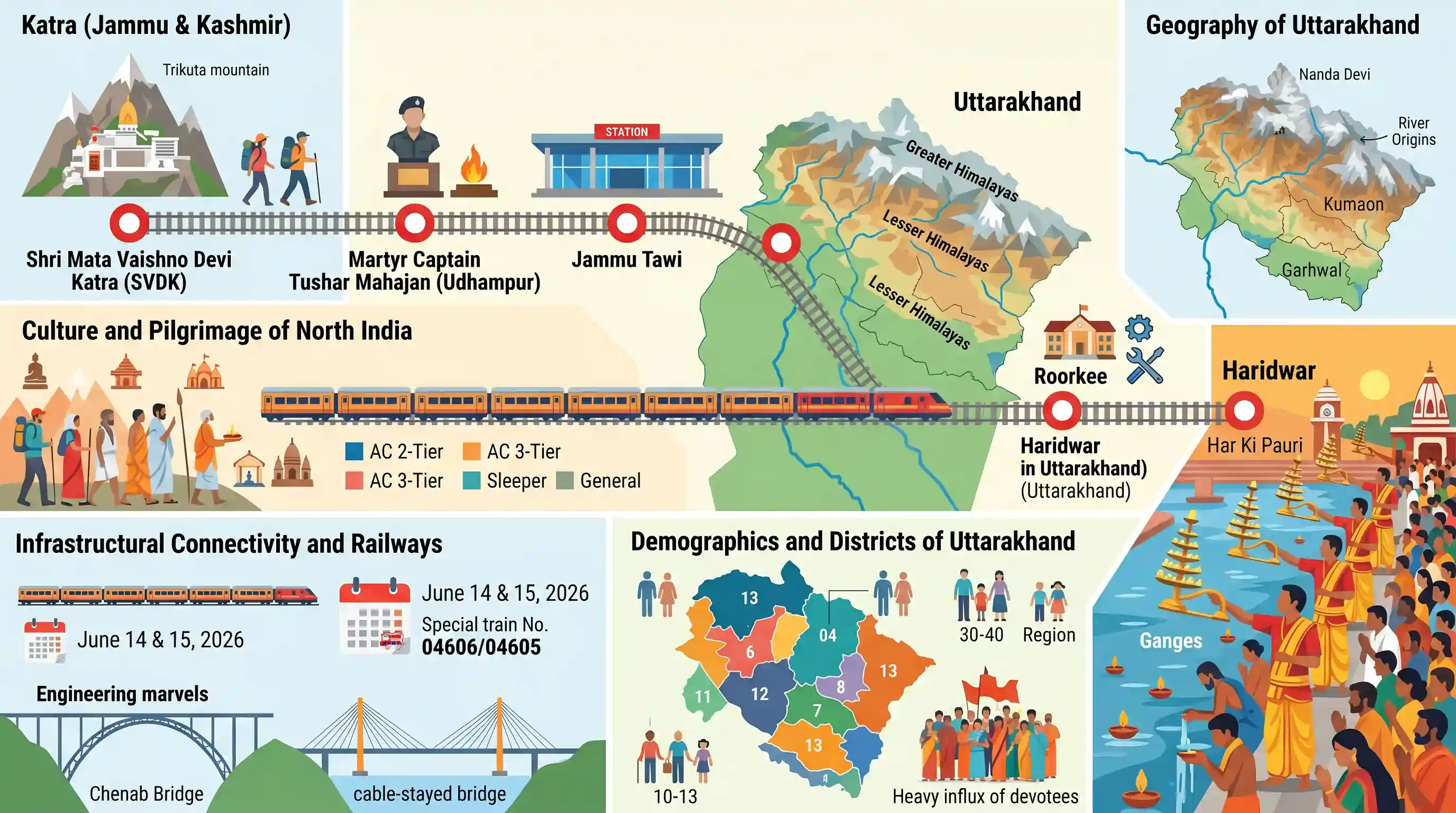
The Northern Railway (Jammu division) announced a special round-trip train service between Katra (Jammu & Kashmir) and Haridwar (Uttarakhand) to accommodate the heavy influx of devotees expected during Somvati Amavasya. Scheduled to run on June 14 and 15, 2026, the 16-coach reserved train will stop at several major transit points, including Roorkee in Uttarakhand and the newly renamed Martyr Captain Tushar Mahajan station in Udhampur.
Key Points
- Northern Railway is running a special round-trip reserved train (Train No. 04606/04605) between Katra in Jammu & Kashmir and Haridwar in Uttarakhand.
- The train is introduced specifically to handle the anticipated rush of pilgrims traveling for Somvati Amavasya, targeting devotees visiting the Mata Vaishno Devi shrine in Katra and those traveling to Haridwar.
- The service features 16 coaches, encompassing Sleeper, General, AC 3-Tier, and AC 2-Tier options.
- Key halts on the route include Roorkee (Uttarakhand) and Martyr Captain Tushar Mahajan station (previously Udhampur railway station, renamed in honor of a 9 Para SF captain martyred in 2016).
Important Terms
Udhampur-Srinagar-Baramulla Rail Link Project (USBRL)

A 272-km broad-gauge railway network linking the Kashmir Valley with the rest of India through challenging Himalayan terrain, declared a national project of strategic importance.
UPSC context
GS Paper III (Infrastructure-Railways). High strategic and economic significance for national integration and connectivity in remote areas.
Northern Railway
The largest of the 18 railway zones of Indian Railways, headquartered in New Delhi, managing rail networks across northern states and Union Territories.
UPSC context
GS Paper I (Geography) & GS Paper III (Infrastructure). Important for regional connectivity, passenger transit, and logistics.
9 Para (Special Forces)
An elite special forces unit of the Indian Army's Parachute Regiment, specialized in mountain warfare, counter-insurgency, and unconventional tactical operations.
UPSC context
GS Paper III (Internal Security). Focuses on roles, capabilities, and sacrifices of specialized national defense forces.
IIT Roorkee
India's oldest engineering institution, established in 1847 as the College of Civil Engineering and elevated to an IIT in 2001.
UPSC context
GS Paper I (Modern Indian History) & GS Paper II (Education). Marks colonial institutional development and modern scientific education.
Indian Railways
India's state-owned national railway system managed by the Ministry of Railways, operating one of the largest rail networks in the world by passenger volume.
UPSC context
GS Paper III (Infrastructure). Central to national logistics, passenger transport, and regional socio-economic integration.
Prelims Trap
The Trikuta Hills, housing the Vaishno Devi shrine, are geologically part of the Lesser Himalayan Pir Panjal range.
Trikuta Hills are actually part of the outermost Shivalik range, not the inner/lesser Pir Panjal range. UPSC often swaps adjacent Himalayan sub-ranges.
Static Concepts Connected
What are the key engineering highlights of the USBRL Project?
- Chenab Arch Bridge: The world's highest railway arch bridge, standing 359 meters above the riverbed, spanning the Chenab River.
- Anji Khad Bridge: India's first cable-stayed railway bridge, engineered to withstand extreme seismic activity and high wind velocities.
- National Project status: Designated as a project of national significance in 2002 to establish all-weather rail access to Kashmir.
What are the geological features of the Shivalik Range?
- Lithological composition: The youngest, southernmost Himalayan foothills composed mainly of unconsolidated sediments, sand, and conglomerate deposits.
- Structural topography: Characterized by rugged, landslide-prone terrain and distinctive flat-bottomed valleys known as 'Duns' (e.g., Dehradun).
- Trikuta Shivalik relation: The limestone-rich Trikuta Hills represent outer Shivalik formations, draining ultimately into the Chenab River system.
Cross-Topic Patterns
Infrastructure-led cultural tourism
Special pilgrim trains connect distant cultural hubs like Katra and Haridwar, illustrating how targeted railway connectivity boosts local tourism economies and strengthens national integration.
Academic-industry semiconductor synergy
IIT Roorkee's nanofabrication lab, built with Taiwanese collaboration, reflects India's strategy to decentralize semiconductor research and leverage global academic partnerships.

USBRL's engineering feats (Chenab & Anji Khad) integrated with Shivalik geomorphology and drainage systems likely for 2026 geography.
Linked PYQs · 3
Linked PYQs · 3
- 2025UKPSC_PRELIMSGS1
Which of the following groups of districts of Uttarakhand is correct in descending order of sex-ratio according to the Census of India 2011?
- 2025UKPSC_PRELIMSGS1
Which one of the following is incorrect about Uttarakhand's first nano-fabrication facility for semiconductor research setup by I.I.T. Roorkee?
- 2024UKPSC_PRELIMSGS1
Hindu religious pilgrimage place named 'Purnagiri' is situated in which of the following districts of Uttarakhand ?
