Supreme Court Proceedings on Conspiracy Charges in Delhi Riots
Source:Indian Express ↗
Why It Matters
This development is critical for UPSC aspirants as it touches upon the intersection of internal security (GS3) and constitutional rights (GS2). It reflects how the state interprets large-scale public disorder and applies stringent laws like UAPA, raising important questions about the 'Due Process of Law', the right to bail, and the role of the judiciary in balancing national security with individual liberty.
Summary
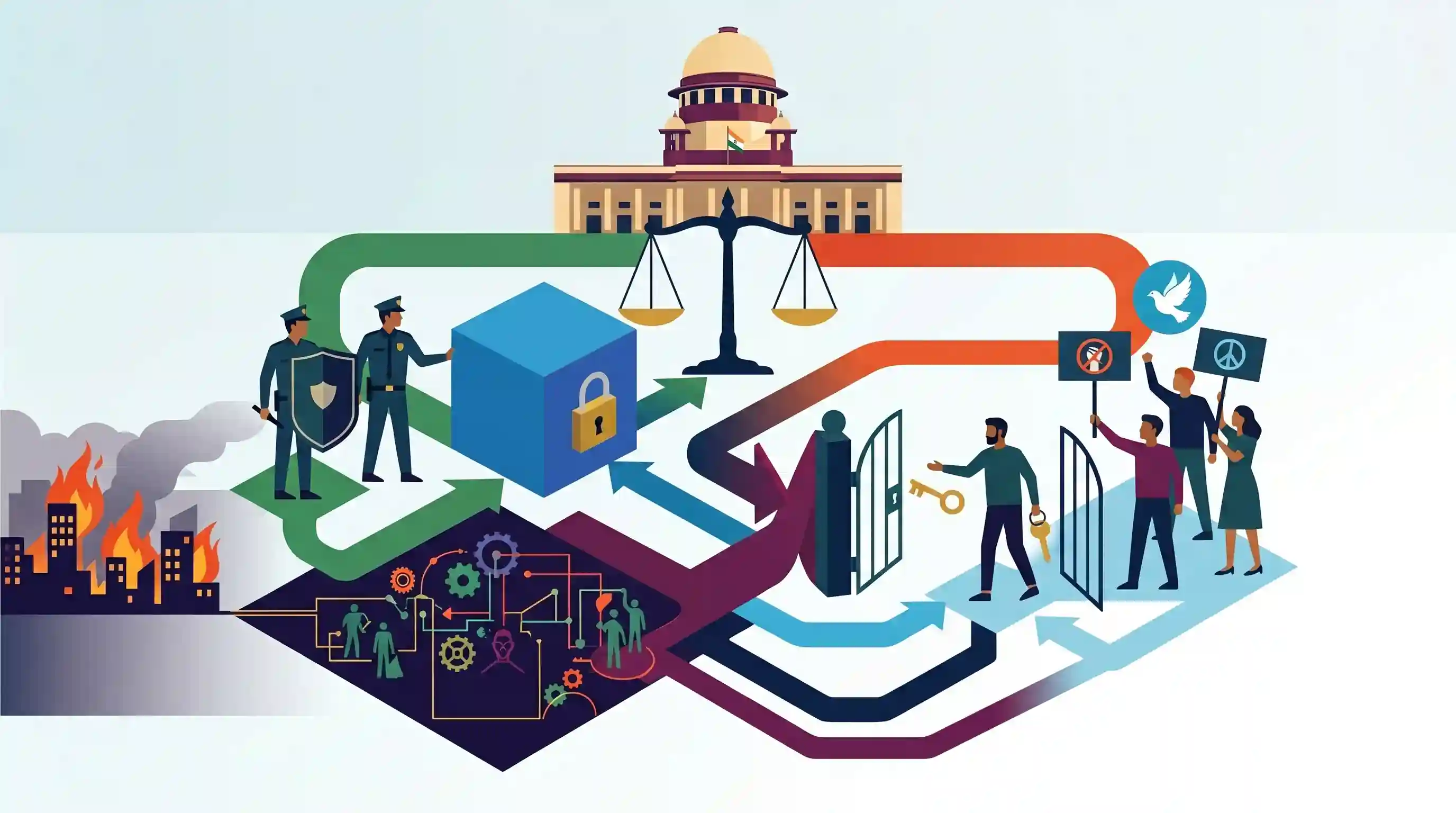
The Delhi Police opposed bail for the accused in the 2020 Northeast Delhi riots before the Supreme Court, arguing that the violence was a premeditated "regime change" conspiracy rather than a spontaneous communal flare-up. By framing the unrest as a coordinated attempt to destabilize the state, law enforcement continues to justify the use of stringent anti-terror laws such as the Unlawful Activities (Prevention) Act (UAPA). The proceedings highlight critical legal questions surrounding the distinction between political dissent, public disorder, and terrorism, as well as the broader implications for bail jurisprudence and civil liberties under rigorous statutory regimes.
Key Points
- The Delhi Police informed the Supreme Court that the 2020 Northeast Delhi riots were not spontaneous communal clashes, but rather a pre-planned "regime change" conspiracy.
- Authorities strongly opposed bail for the accused, arguing their actions were calculated to destabilize the state and disrupt public order.
- The application of stringent legal frameworks, such as the UAPA, in riot cases underscores the ongoing legal debates around the threshold for 'terrorism' versus public disorder.
- The case highlights the tension between state security imperatives and individual civil liberties, particularly concerning the prolonged incarceration of undertrials and bail jurisprudence.
Important Terms
Unlawful Activities (Prevention) Act (UAPA)

India’s primary anti-terror legislation designed to prevent activities threatening national sovereignty and integrity. It allows for extended detention and imposes stringent bail conditions on accused individuals and organizations.
UPSC context
GS III (Internal Security). Tests the balance between state-security laws and individual fundamental rights.
Section 43D(5) of UAPA
A specific clause in the UAPA that mandates courts to deny bail if the police accusations appear 'prima facie' true. It effectively makes 'jail the rule and bail the exception.'
UPSC context
GS II (Judiciary). Relevant for analyzing judicial discretion and procedural safeguards in anti-terror cases.
Bail Jurisprudence
The legal philosophy governing the release of an accused pending trial. In India, while 'bail is the rule,' special statutes often prioritize collective security over personal liberty.
UPSC context
GS II (Constitution/Judiciary). Tests understanding of prisoner rights and the principle of 'innocent until proven guilty.'
Article 19 (Fundamental Rights)
Guarantees freedom of speech and assembly, subject to 'reasonable restrictions' like public order and national security. It is frequently invoked to debate the limits of political dissent.
UPSC context
GS II (Fundamental Rights). Essential for evaluating the state's power to restrict protests in the interest of order.
Internal Security
The protection of a nation's borders and peace from domestic threats. The term 'regime change conspiracy' reflects the framing of internal unrest as a coordinated attempt to destabilize the state.
UPSC context
GS III (Internal Security). Relevant for analyzing domestic challenges like communalism, radicalization, and the role of law enforcement.
Prima Facie
A legal standard meaning 'at first sight.' Under UAPA, the court assumes the prosecution's facts are true for bail purposes without a detailed evaluation of the evidence.
UPSC context
GS II (Judiciary). Key for understanding the evidentiary thresholds required for pre-trial detention in India.
Prelims Trap
Constitutional courts cannot grant bail under UAPA if the allegations are deemed prima facie true.
False. The Supreme Court ruled (KA Najeeb case) that constitutional courts can bypass UAPA's strict bail embargo if an undertrial's Article 21 right to a speedy trial is violated.
Static Concepts Connected
How does the Supreme Court differentiate Law & Order, Public Order, and State Security?
- Concentric Circles: Defined in the Ram Manohar Lohia case: Law and Order is the largest circle, containing Public Order, which contains Security of the State (the smallest).
- Severity Threshold: Routine crimes affect law and order; widespread riots affect public order; only acts threatening national existence or sovereignty affect the security of the state.
- UAPA Applicability: Anti-terror laws like UAPA are legally justified only when actions breach the 'security of the state', not for mere public order disruptions.
What are the specific bail constraints under the Unlawful Activities (Prevention) Act (UAPA)?
- Section 43D(5): Mandates courts to deny bail if the case diary or report makes the accusations appear 'prima facie true'.
- Reversal of Norm: Subverts the general criminal jurisprudence principle of 'bail is the rule, jail is the exception'.
- Article 21 Override: Prolonged incarceration without trial violates Article 21, allowing higher courts to grant bail despite the statutory embargo.
Cross-Topic Patterns
UAPA Bail vs. Article 21 Speedy Trial
Prolonged undertrial incarceration under anti-terror laws links GS3 Internal Security directly to GS2 Fundamental Rights, a frequent Mains intersection requiring judicial precedents like KA Najeeb.
Federalism and Article 355 Interventions
While 'Public Order' is exclusively a State List subject, severe riots allow the Union to utilize central agencies, invoking its Article 355 duty to protect states from 'internal disturbance'.

Expect a 2026 Prelims multi-statement question distinguishing 'Public Order' from 'Security of State' regarding the invocation of UAPA.
Linked PYQs · 3
Linked PYQs · 3
- 2017MainsGS3
Mob violence is emerging as a serious law and order problem in India. By giving suitable examples, analyze the causes and consequences of such violence.
- 2023PrelimsGS1
Consider the following statements: 1. According to the Constitution of India, the Central Government has a duty to protect States from internal disturbances. 2. The Constitution of India exempts the States from providing legal counsel to a person being held for preventive detention. 3. According to the Prevention of Terrorism Act, 2002, confession of the accused before the police cannot be used as evidence. How many of the above statements are correct?
- 2023PrelimsGS1
In essence, what does 'Due Process of Law' mean?
