Northeast Monsoon Brings Agricultural Benefits and Urban Flood Risks
Source:The Hindu ↗
Why It Matters
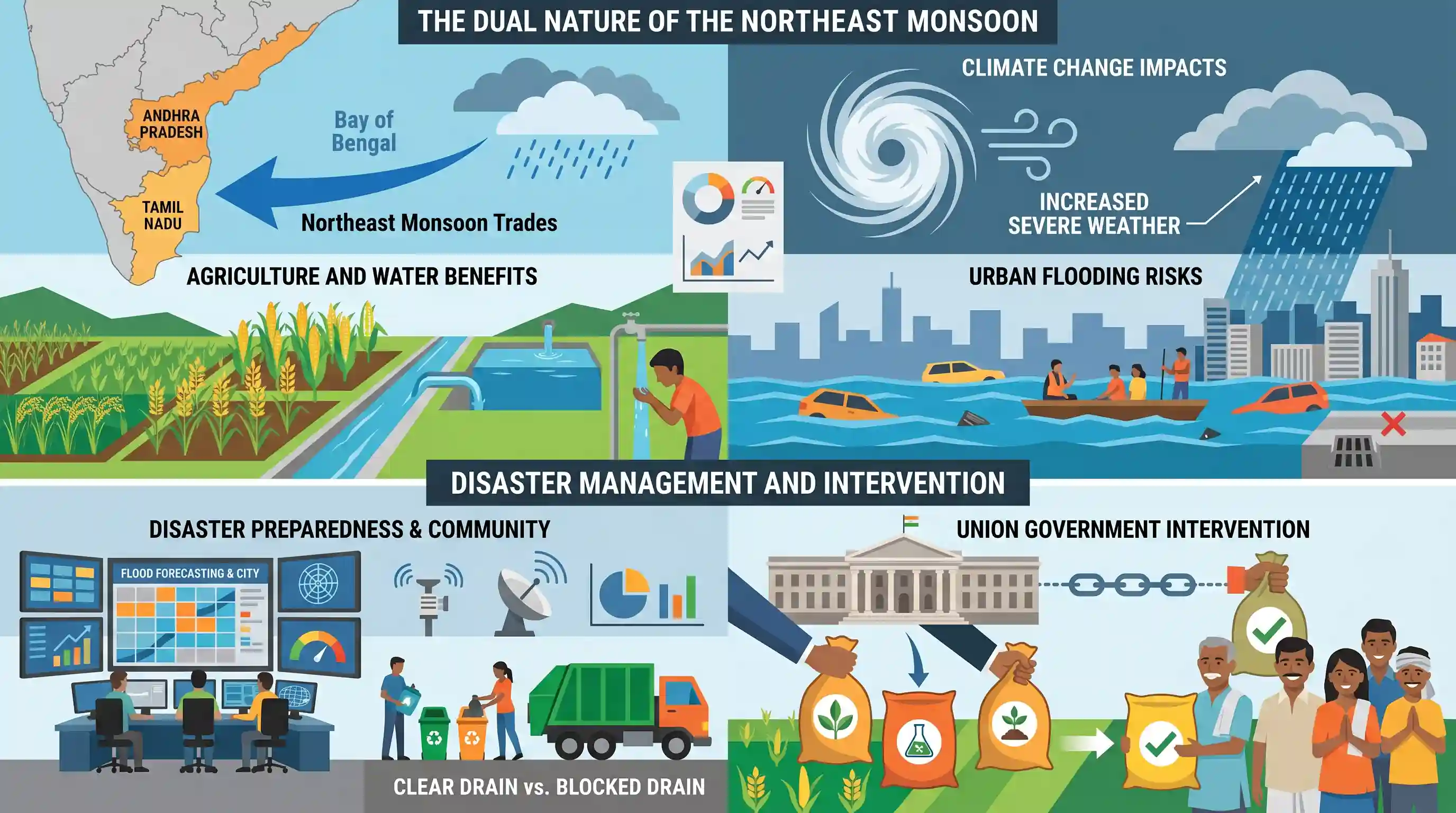
Highlights the dual nature of the northeast monsoon as both a lifeline for agriculture and a trigger for urban disasters, emphasizing the intersection of climate change, urban planning, disaster preparedness, and agricultural supply chain management.
Summary
The onset of the northeast monsoon brings much-needed rainfall to Tamil Nadu and Andhra Pradesh, vital for agriculture and drinking water, but also poses severe urban flooding risks due to increased cyclonic disturbances and cloudbursts. The editorial emphasizes the need for robust disaster preparedness, such as Chennai's real-time flood forecasting system, community cooperation in waste management, and timely intervention by the Union government to address critical fertilizer shortages for farmers.
Key Points
- The IMD's forecast of 'above normal' rainfall during the northeast monsoon is vital for the agricultural and drinking water needs of Tamil Nadu and Andhra Pradesh.
- Increased frequency of cyclonic disturbances and cloudbursts over the Bay of Bengal, driven by climate change, exacerbates urban flooding risks in coastal cities.
- Tamil Nadu has deployed a real-time flood forecasting system for Chennai to scientifically calibrate excess water discharge and mitigate flood impacts.
- Successful disaster management requires behavioral changes from citizens to prevent the choking of stormwater drains and waterbodies with solid waste.
- Timely supply of essential agricultural inputs like urea and DAP by the Union government is critical to maximize agricultural productivity during this monsoon season.
Important Terms
Northeast Monsoon (Retreating Monsoon)

A seasonal wind reversal (October–December) bringing moisture from the Bay of Bengal to southeastern India. It accounts for up to 60% of annual rainfall in Tamil Nadu and coastal Andhra Pradesh.
UPSC context
GS Paper 1 (Geography) & GS Paper 3 (Agriculture). Tests understanding of seasonal wind patterns and regional agricultural dependency.
India Meteorological Department (IMD)
The premier government agency under the Ministry of Earth Sciences responsible for weather forecasting, cyclone tracking, and seismology. Established in 1875, it celebrates its 150th year in 2025.
UPSC context
GS Paper 3 (Disaster Management). Crucial for questions on early warning systems and the National Monsoon Mission.
Urban Flooding
Inundation of built-up areas caused by heavy rainfall overwhelming drainage capacity. It is exacerbated by unplanned urbanization, loss of wetlands (concretization), and inadequate solid waste management.
UPSC context
GS Paper 3 (Disaster Management). NDMA defines it as a distinct 'man-made disaster' requiring city-specific flood cells.
Cloudburst
A localized meteorological event characterized by intense rainfall exceeding 100 mm per hour over a small area (20–30 sq km), typically involving convective cumulonimbus clouds.
UPSC context
GS Paper 1 (Physical Geography). Relevant for studying extreme weather events and their increasing frequency due to climate change.
Agricultural Inputs (Fertilizers)
Substances like Urea and DAP used to enhance soil fertility. India faces structural vulnerabilities due to heavy import reliance (potash and phosphate) and skewed nutrient usage (N:P:K ratio).
UPSC context
GS Paper 3 (Economy/Agriculture). Tests knowledge of the subsidy regime (NBS), food security, and agricultural productivity constraints.
Real-time Flood Forecasting System
A technological framework using sensor networks and hydrological models to predict water levels in real-time, enabling proactive evacuation and disaster mitigation in vulnerable cities like Chennai.
UPSC context
GS Paper 3 (S&T/Disaster Management). Highlights the role of technology and the 'Smart Cities' mission in hazard mitigation.
Prelims Trap
India is entirely self-sufficient in the production of Di-ammonium Phosphate (DAP).
India is heavily dependent on imports for DAP and its raw materials (rock phosphate, phosphoric acid), making it highly vulnerable to global supply shocks.
Static Concepts Connected
What drives the Northeast Monsoon in India?
- Wind reversal: The southward retreat of the Inter Tropical Convergence Zone (ITCZ) causes a seasonal reversal of winds from southwest to northeast.
- Moisture pickup: These initially dry continental winds pick up significant moisture as they travel over the Bay of Bengal.
- Impact areas: It brings the bulk of annual rainfall (Oct-Dec) to Tamil Nadu, Coastal Andhra Pradesh, Rayalaseema, and parts of Kerala.
What is the nutrient profile and economic status of DAP in India?
- Composition: Contains 18% Nitrogen and 46% Phosphorus; it is applied just before or during sowing as a basal dose.
- Import dependence: It is India's second most consumed fertilizer after Urea, but production relies heavily on imported raw materials.
- Subsidy mechanism: Unlike Urea, DAP is covered under the Nutrient Based Subsidy (NBS) scheme, which offers a fixed subsidy based on nutrient content.
Cross-Topic Patterns
Urban Flooding & Waste Rules
Choked storm drains exacerbate climate-induced floods, linking urban disaster management directly to the enforcement of Solid Waste Management Rules, 2016 in coastal megacities.
Climate Shocks & Fertilizer Subsidies
Unpredictable monsoons force narrow sowing windows, suddenly stressing supply chains and subsidy bills for critical imported inputs like DAP during the Rabi season.

Expect a 2026 prelims question merging NE monsoon geographical spread with the NBS regime and import dependence of DAP fertilizers.
Linked PYQs · 5
Linked PYQs · 5
- 2024MainsGS3
Flooding in urban areas is an emerging climate-induced disaster. Discuss the causes of this disaster. Mention the features of two such major floods in the last two decades in India. Describe the policies and frameworks in India that aim at tackling such floods.
- 2020MainsGS1
Account for the huge flooding of million cities in India including the smart ones like Hyderabad and Pune. Suggest lasting remedial measures.
- 2020PrelimsGS1
With reference to chemical fertilizers in India, consider the following statements : 1. At present, the retail price of chemical fertilizers is market-driven and not administered by the Government. 2. Ammonia, which is an input of urea, is produced from natural gas. 3. Sulphur, which is a raw material for phosphoric acid fertilizer, is a by-product of oil refineries. Which of the statements given above is/are correct?
- 2016PrelimsGS1
Why does the Government of India promote the use of 'Neem-coated Urea' in agriculture?
- 2022MainsGS1
Discuss the meaning of colour-coded weather warnings for cyclone prone areas given by India Meteorological Department.
